

Turkish comedian Deniz Göktaş was arrested by an İstanbul court on Friday and jailed pending trial after prosecutors accused him of insulting President Recep Tayyip Erdoğan and religious values in his viral stand-up show “Ölü Deniz,” Turkish media reported.
Göktaş, 32, was detained at İstanbul Airport on Thursday during passport control after returning from a previously planned vacation abroad.
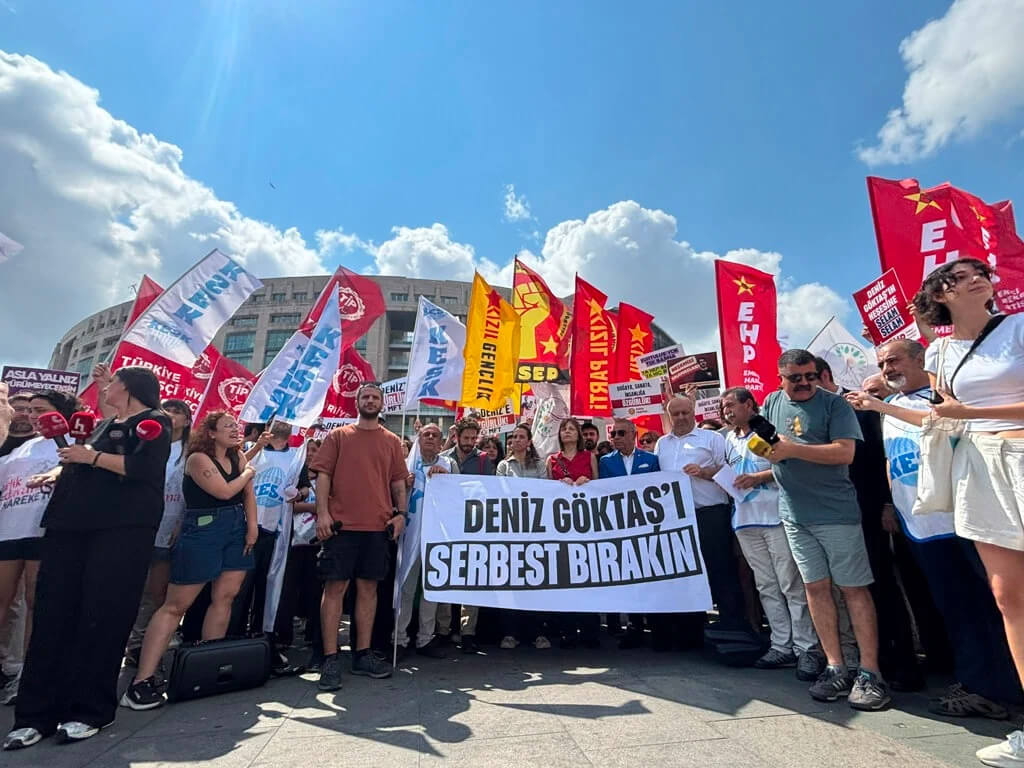
His arrest prompted protests inside the İstanbul Courthouse, where supporters chanted “Deniz Göktaş is not alone” and “Shoulder-to-shoulder against fascism.”
Göktaş had been referred to court for arrest after spending the night at the İstanbul Police Department before being taken to the İstanbul Courthouse on Friday to give a statement to prosecutors.
The İstanbul Chief Public Prosecutor’s Office is investigating him on charges of “insulting the president” and “publicly insulting religious values adopted by a segment of the public” over remarks in the 90-minute performance, which was uploaded to his YouTube channel on June 24.
The show had been viewed more than 9.5 million times in about 10 days.
The performance includes satirical comments on Turkish politics, Erdoğan, jailed İstanbul Mayor Ekrem İmamoğlu, universities, public protests, nationalism and the secular children of conservative families.
In his police statement, published by Turkish media, Göktaş said he had no intention of insulting religious people and that the show had been performed for about three years in different cities across Turkey.
“I absolutely had no intention of publicly insulting the religious values adopted by a certain segment of society,” he said, adding that more than 100,000 people had seen the show and that he had not previously received complaints from audience members over the disputed section.
Before the investigation, pro-government media outlets and conservative social media users accused Göktaş of mocking the Quran, the Muslim holy book, in his show.
The part cited by critics involved a joke about holy books and the Quran being regarded in Islam as the final holy book.
Göktaş said the disputed joke about the Quran being a “weak translation” was a reference to long-running public debates over interpretations of religious texts.
“I absolutely had no intention of hurting a believer,” he said.
He also denied insulting Erdoğan, saying he had no intention of degrading the president.
“The word ‘dictator’ is a political description and is frequently discussed in public,” Göktaş said. “It is just a word like democrat or autocrat.”
Göktaş said the remarks were part of a comic performance that also addressed authoritarian rule, limits on free speech and social issues in Turkey.
In his show the comedian also jokes about the possibility of being investigated or imprisoned because of his remarks, making legal pressure on comedians one of the themes of the performance.
The stage features a large sculpture of Göktaş’s head, a visual element that reinforces the show’s sense of personal risk.
In another part of the show, Göktaş talks about good and bad fathers and says his own father would not protect him if he were involved in a deadly traffic accident, an apparent reference to a 1998 crash involving Erdoğan’s son Ahmet Burak Erdoğan.
Turkish classical music singer Sevim Tanürek died days after being hit by a car driven by Burak Erdoğan, who was later cleared of fault in the case.
Göktaş later said on social media that this was his favorite part of the show.
In his statement to prosecutors Göktaş again denied the accusations against him. Prosecutors then asked the court to order his arrest on both charges.
His referral to court and subsequent arrest drew supporters to the İstanbul Courthouse, where political parties, professional organizations and fellow performers called for his release.
Police increased security around the courthouse and deployed a water cannon vehicle nearby.
Actor Cem Yiğit Üzümoğlu, speaking on behalf of the Actors’ Union, said Göktaş should be released immediately and that the process should be conducted in line with the law.
“Deniz Göktaş is not alone,” he said.
Kemal Kılıçdaroğlu, the court-reinstated leader of the main opposition Republican People’s Party (CHP), also went to the courthouse to follow the case.
KILIÇDAROĞLU ADLİYEDE
CHP Genel Başkanı Kemal Kılıçdaroğlu, sanatçı Deniz Göktaş’ın duruşmasını izlemek üzere Çağlayan Adliyesi’ne geldi.@tv100 için edindiğim bilgiye göre; Kılıçdaroğlu’na CHP İstanbul İl Başkanı Gürsel Tekin de eşlik ediyor. Avukat Yiğit Acar da… pic.twitter.com/FxWCjVwDN9
— Barış Yarkadaş (@barisyarkadas) July 3, 2026
Kılıçdaroğlu returned to party leadership under a disputed court ruling in May that removed elected CHP leader Özgür Özel, a decision that deepened divisions inside the party.
Kılıçdaroğlu’s presence drew criticism from some people gathered outside the courthouse, who chanted slogans against him.
The case also drew international criticism.
The European Democrats said on social media that treating a stand-up comedian as a security threat showed the state of free expression in Turkey ahead of next week’s NATO summit in Ankara.
When a stand-up comedian is arrested in handcuffs as if he were a national security threat, the problem is not comedy. The problem is @RTErdogan ’s fear of free citizens. Days before the NATO summit in Ankara, Turkey is exposing the reality behind the façade: critics, activists… pic.twitter.com/CNFPum5qvT
— European Democrats (@democrats_eu) July 3, 2026
The summit, scheduled for July 7-8, will bring leaders of NATO’s 32 member states to the Turkish capital under heavy security measures and restrictions on public gatherings.
“When a stand-up comedian is arrested in handcuffs as if he were a national security threat, the problem is not comedy,” the group said. “The problem is Erdoğan’s fear of free citizens.”
Footage published in Turkish media showed Göktaş with his hands cuffed behind his back during his detention.
Turkish comedian Deniz Göktaş is escorted by police officers with his hands cuffed behind his back. Göktaş, 32, was detained on Thursday as part of an investigation into his viral stand-up performance for allegedly insulting religious values.pic.twitter.com/jWneFCD21z https://t.co/zaOiwHdJNT
— Turkish Minute (@TurkishMinuteTM) July 2, 2026
Before his detention, Turkey blocked access to X posts carrying clips from the same show, citing threats to national security and public order after Şamil Tayyar, a former member of the ruling Justice and Development Party’s (AKP) top decision-making body, accused Göktaş of insulting Erdoğan.
The case comes amid growing concern over criminal investigations and online restrictions targeting satire, stage performances and political expression in Turkey.
In May prosecutors filed an indictment seeking up to three years in prison for comedian Tuba Ulu over a joke she made about Ottoman Sultan Suleiman the Magnificent during a performance.
Ulu was accused of “inciting hatred and enmity among the public” after a clip from her show circulated on social media. She had earlier been detained on accusations of “insulting historical, national and moral values” and was later released under judicial supervision.
Free speech advocates and fellow performers criticized the case, saying comedians should not face criminal prosecution over stage performances.
Turkey has long faced criticism over restrictions on freedom of expression, with artists, journalists, academics and social media users frequently targeted in criminal investigations over their remarks.
International monitors continue to rank Turkey poorly on freedom of expression and media freedom. Freedom House classifies the country as “Not Free,” while Reporters Without Borders ranked it 163rd out of 180 countries in its “2026 World Press Freedom Index.”