
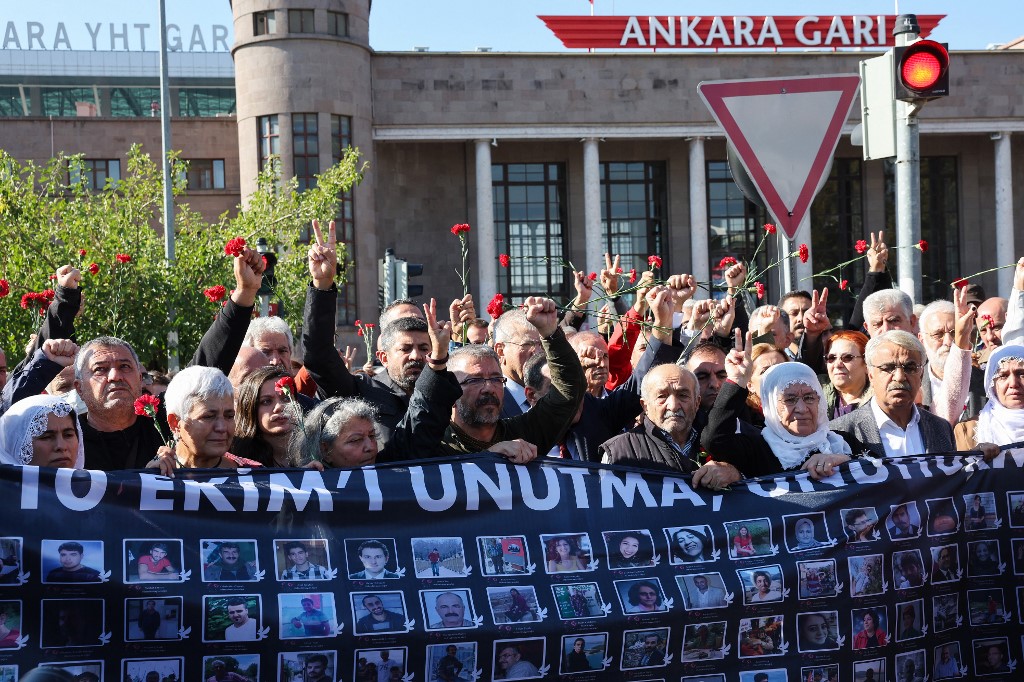
 suspects before Turkey’s deadliest terrorist attack in Ankara in 2015, saying the statute of limitations had expired, the Evrensel daily reported.)
Turkish prosecutors have declined to investigate police officials accused of failing to act on information about Islamic State in Iraq and the Levant (ISIL) suspects before Turkey’s deadliest terrorist attack in Ankara in 2015, saying the statute of limitations had expired, the Evrensel daily reported.
The Gaziantep Chief Public Prosecutor’s Office ruled on June 17 that there were no grounds to investigate public officials over allegations of negligence before the October 10, 2015, Ankara train station bombing, citing the statute of limitations.
The Ankara bombing targeted a peace rally outside the city’s main train station, killing 104 people and injuring hundreds of others in the deadliest attack in modern Turkey’s history.
The rally had been organized by labor unions, professional associations and pro-peace groups at a time of renewed conflict between the Turkish state and the outlawed Kurdistan Workers’ Party (PKK).
The decision concerns claims that police failed to act after two ISIL suspects were identified while trying to obtain ammonium nitrate, a fertilizer ingredient that can be used to make explosives, in the Nizip district of Gaziantep 10 days before the attack.
According to case documents cited by the lawyers, a fertilizer dealer reported to police on September 30, 2015, that two people had tried to buy a large amount of nitrate fertilizer without providing identification.
Counterterrorism officers in Nizip examined security camera footage and identified one of the suspects as Yakub Şahin, a key suspect in the Ankara bombing case.
The lawyers representing the victims’ families said the documents also showed that Hüseyin Tunç, who was allegedly moving with the suicide bombers before the attack, was among the people linked to the attempt to obtain bomb-making material.
The Nizip Police Department sent an official letter on October 2, 2015, to the counterterrorism and intelligence branches of the Gaziantep Police Department, naming the suspects and asking that the necessary inquiries be carried out, according to the lawyers.
The lawyers said documents later found in the case file showed that the Gaziantep police did not take effective action after receiving the warning.
The indictment identified one of the Ankara suicide bombers as Yunus Emre Alagöz, a Turkish national from Adıyaman whose brother carried out another ISIL suicide bombing in the Suruç district of Şanlıurfa province in July 2015, killing 33 people, most of them young activists.
The second Ankara bomber was identified only as a Syrian national.
According to summaries in the case file, the two bombers left a safe house in Gaziantep the night before the Ankara attack with help from ISIL operatives.
The question of whether public officials ignored warnings or failed to prevent the attack has been one of the central demands of victims’ families and lawyers, who say accountability has remained incomplete because state officials have not been prosecuted.
The issue attracted new attention in 2019, four years after the attack, when nine folders of investigation documents were reportedly left by unidentified people on a prosecutors’ floor at the Ankara courthouse.
The lawyers say those documents revealed that authorities had information about suspects before the attack.
The group of lawyers representing victims’ families said the documents showed that the Nizip Chief Public Prosecutor’s Office had opened an investigation into Şahin and Tunç before the bombing because they had allegedly tried to obtain material that could be used to make explosives.
Unions, professional organizations and relatives of those killed later sought an investigation into public officials who served at the Gaziantep Police Department at the time.
They asked prosecutors to investigate allegations including negligent homicide, destruction or concealment of evidence and abuse of office.
The victims’ lawyers first asked the trial court in Ankara to file a criminal complaint against police officials, but the request was rejected. They later filed their own complaint.
For years the case was delayed by disputes over whether prosecutors needed permission from the Gaziantep Governor’s Office to investigate the officials.
The governor’s office refused permission, while an administrative court twice ruled that the allegations were serious enough to require an investigation.
Despite those rulings, prosecutors closed the file again on June 17. They said any possible offense by public officials would fall under “abuse of office through negligence” and that the eight-year statute of limitations had expired in 2023.
The lawyers rejected that reasoning, saying prosecutors had reduced the allegations to a lesser offense and ignored the wider nature of the attack.
“Since the beginning of the investigation, we have said that the perpetrators are not limited to those standing trial in court,” the commission said. “They were able to carry out massacres thanks to public officials who paved the way and ignored them.”
The commission said it would continue to seek the prosecution of all public officials who had responsibility for the attack.
A case was later filed against 35 ISIL suspects, including İlhami Balı, who was described in the indictment as the group’s Turkey commander. Sixteen defendants remain fugitives and are believed to be in Syria.
In 2018 an Ankara court handed down multiple aggravated life sentences and prison terms to several defendants over the attack. However, no public official has stood trial despite claims that authorities had received intelligence warnings before the bombing and failed to take adequate security measures.
A separate inspectors’ report found negligence by several Ankara police officials at the time, according to lawyers and rights groups, but the Ankara Governor’s Office did not authorize an investigation. No official resigned or was criminally punished after the attack.