
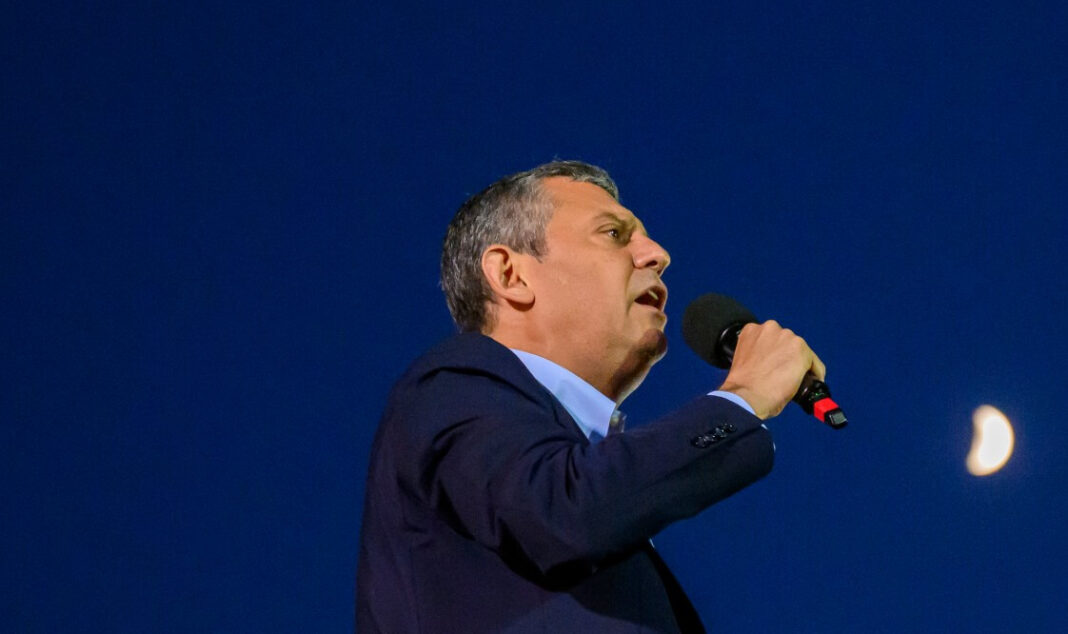
 leader Özgür Özel has urged NATO allies meeting in Ankara not to treat President Recep Tayyip Erdoğan’s government as Turkey’s only political voice, saying the government’s reliance on courts and state institutions to weaken opponents has created a legitimacy crisis that matters for the alliance.)
Ousted main opposition Republican People’s Party (CHP) leader Özgür Özel has urged NATO allies meeting in Ankara not to treat President Recep Tayyip Erdoğan’s government as Turkey’s only political voice, saying the government’s reliance on courts and state institutions to weaken opponents has created a legitimacy crisis that matters for the alliance.
In an article published by Project Syndicate ahead of the July 7-8 NATO summit in Ankara, Özel said Erdoğan would try to present Turkey as “stable, confident, and essential to Western security,” adding that only the last claim was true.
“The key question confronting Turkey today is one of legitimacy,” Özel wrote, saying governments may survive economic crises but struggle when citizens stop believing the political system is fair.
Özel said Erdoğan had increasingly relied on state institutions, especially the judiciary, to weaken political rivals and preserve his hold on power rather than competing with them on equal terms.
His remarks come after months of pressure on the CHP, which defeated Erdoğan’s ruling Justice and Development Party (AKP) in the March 2024 local elections and became Turkey’s leading political force for the first time in decades.
Since then İstanbul Mayor Ekrem İmamoğlu, the CHP’s presidential candidate and Erdoğan’s strongest political rival, has been jailed pending trial, while investigations have targeted CHP-run municipalities across the country.
Özel also remains at the center of a court-driven leadership crisis in the CHP.
In May a court annulled the party’s 38th Ordinary Congress, held in November 2023, when Özel defeated former chairman Kemal Kılıçdaroğlu and became party leader. The ruling removed Özel and the party administration from office and reinstated Kılıçdaroğlu as chairman.
Özel referred to the case in his article, accusing the government of trying to invalidate the party convention years after it was held “in an effort to reshape the leadership of the main opposition.”
“The distinction between legal process and political intervention has become increasingly difficult to discern,” he wrote.
He said Turkey’s importance to NATO was not in dispute because of its geography, military strength and role in regional crises, including “Russia’s war against Ukraine” and instability from Syria to Iran.
But he claimed that allies should also pay attention to whether Turkey remains a country governed by elections, courts and public consent.
‘Merely holding power does not confer legitimacy,” he said.
For NATO, Özel said, the issue was not only Turkey’s military value but whether the country could remain stable without the rule of law.
“A country of nearly 90 million people, a major military power, and a pivotal NATO member cannot indefinitely separate political legitimacy from national stability,” he wrote.
“Repression may create the appearance of order, but it cannot produce durable security.”
Özel urged Turkey’s allies to engage not only with Erdoğan’s government but also with the country’s opposition and civil society.
“Turkey’s allies must learn to look beyond the current government and the disorder it has caused, and engage not only with those who hold power today but also with the democratic future they no longer credibly represent,” he wrote.
“Governments and leaders come and go. Turkey and its people endure. And Turkey’s people are determined to build a country that is free and democratic at home, reliable abroad, and fully committed to the rule of law.”
“That is the Turkey we are preparing to build: prosperous, confident in its institutions, and a strong, constructive actor in international peace and security,” he added.
İmamoğlu and opposition mayors
Özel said voters had already shown they wanted political change.
In the March 2024 local elections, the CHP became Turkey’s leading political force and delivered Erdoğan’s AKP its worst electoral defeat since coming to power.
Rather than accepting the result, Özel said, the government increased pressure on the opposition.
He pointed to the jailing of İmamoğlu, who has repeatedly defeated Erdoğan-backed candidates in Turkey’s largest city and has been in pretrial detention since March 2025.
Özel also said more than 30 opposition mayors were in pretrial detention and that prosecutors were seeking sentences “measured not in years but in millennia,” a reference to the thousands of years in prison requested in cases targeting opposition figures.
The CHP claims the investigations targeting its mayors and municipal officials are politically motivated and aimed at reversing the party’s local election gains. Government officials deny targeting the opposition and say the judiciary acts independently.
Detentions before the NATO summit
Özel also pointed to detentions in Ankara ahead of the NATO summit, saying authorities had detained “hundreds of innocent people” in operations officially described as counterterrorism measures.
The detentions came after the Ankara Governor’s Office imposed a province-wide ban on public gatherings from June 28 to July 10, citing national security and security measures for the NATO summit.
The crackdown has attracted criticism of NATO’s silence on Turkey’s rights record. Human Rights Watch said ahead of the summit that NATO leaders should recognize that “the state of human rights, rule of law, and democracy in Turkey should matter to the alliance,” while Amnesty International urged Turkish authorities to lift the blanket protest ban in Ankara and release those it said had been arbitrarily detained.
Critics say NATO governments have largely avoided public criticism of Turkey’s democratic backsliding because of Ankara’s strategic role in the alliance, including its position on Ukraine, the Black Sea, Syria, Iran and migration.
Cost-of-living crisis
Özel also said screens and barriers were reportedly erected along parts of the route from the airport to central Ankara to hide visible signs of economic hardship from summit visitors.
He said such measures showed a government more focused on controlling appearances than addressing the problems facing the country.
Turkey has been struggling with a long-running cost-of-living crisis. Official annual inflation stood at 32.11 percent in June, according to the Turkish Statistical Institute, while the 2026 net minimum wage was set at 28,075 Turkish lira ($600).
The high cost of food, rent and basic services has eroded household incomes, particularly for minimum-wage workers, pensioners and young people. Labor groups have repeatedly said the minimum wage is no longer enough to cover basic living costs, even as the government says inflation is slowing.