
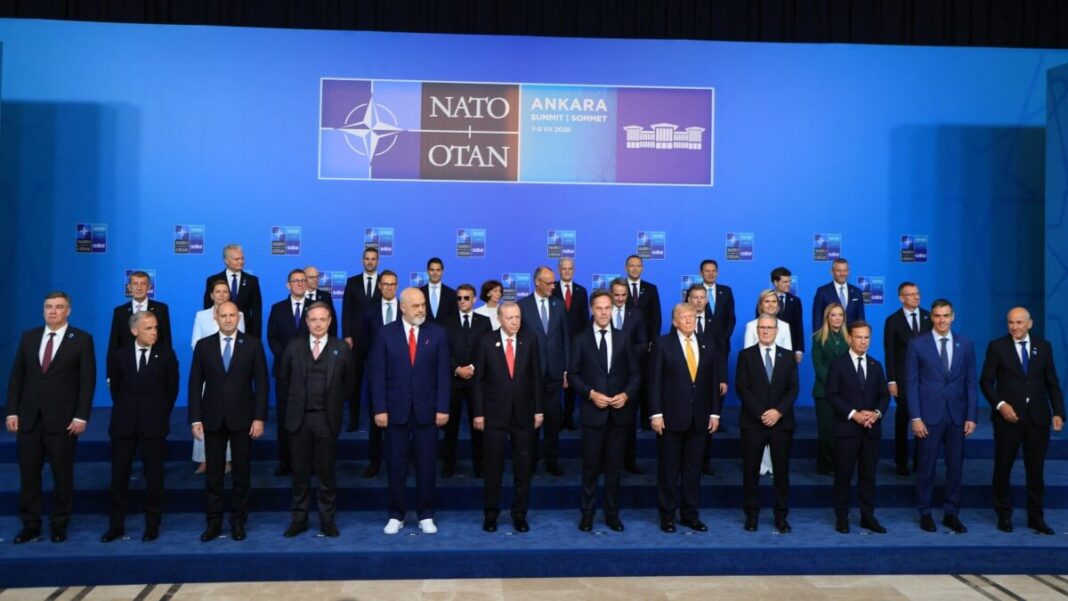

NATO leaders reaffirmed their “ironclad commitment” to collective defense in the final declaration of their Ankara summit on Wednesday, despite US President Donald Trump’s repeated warnings that he might not defend European allies in the event of an attack, his renewed threat to take over Greenland and his criticism of allies over Iran.
“We, the Heads of State and Government of the North Atlantic Alliance, have gathered in Ankara to reaffirm our ironclad commitment to our collective defence under Article 5 of the Washington Treaty and to the transatlantic bond,” the declaration said. “An attack on one is an attack on all.”
Article 5 is NATO’s core mutual defense clause, under which an attack on one ally is treated as an attack on all. The wording was closely watched because Trump has repeatedly questioned the US commitment to defending allies he says do not spend enough on defense.
At the opening of the leaders’ summit on Wednesday morning, Trump lashed out at NATO allies as tensions with Iran threatened to overshadow the gathering.
He declared that a ceasefire with Iran was “over” and criticized NATO allies he said had failed to back his campaign against Tehran.
Trump also repeated his demand for Greenland, a self-governing territory of NATO member Denmark, calling European resistance to the idea a “big problem.”
“I’m very upset with NATO … because of what they did with Greenland, and … because of the fact that they didn’t want to help us with the number one state sponsor of terror, that’s Iran,” he said.
Trump also singled out Spain, calling it a “terrible partner in NATO.”
“Spain is a wasted cause. We don’t want to do any trade business with Spain anymore,” he said, referring to a dispute that also involves Madrid’s defense spending. Trump urged Treasury Secretary Scott Bessent to “cut it off.”
Trump later struck a warmer tone after the closed-door meeting of NATO leaders in Ankara, saying there had been “a lot of love in that room” and “a lot of unity.”
“It was a great meeting, there was a lot of love in that room, a lot of unity,” Trump told reporters after the session.
A source inside the meeting told Agence France-Presse that Trump had reassured allies that Washington wanted to remain in NATO.
“We want to remain with you,” Trump was quoted as saying behind closed doors.
“There is a strong contrast between what Trump says in public and what he actually says inside,” the source, who attended the talks, told AFP.
Estonian Prime Minister Kristen Michal also told AFP that Trump had delivered a “kind of constructive message” that Europe needed to “step up, invest more in defense.”
Lithuanian Foreign Minister Kęstutis Budrys said Trump’s remarks should not be read as evidence that NATO was weakening.
“I wouldn’t see in it an indicator that we are somehow weakening NATO, and that the transatlantic bond is not there,” he told AFP. “I think we should dramatize things less.”
Russia, defense spending and new procurements
The declaration described Russia as a long-term threat to Euro-Atlantic security and said allies were moving ahead with their defense spending commitments.
“To counter the long-term threat Russia poses to Euro-Atlantic security and stability, and the persistent threat of terrorism, Allies are delivering on The Hague defence commitment,” the declaration said.
It said European allies and Canada increased investments in core defense requirements by more than $139 billion in 2025.
NATO leaders also announced “more than $50 billion in new procurements” and pledged to expand collective manufacturing capacity and work with industry to speed up innovation.
The declaration said allies would continue efforts to remove defense trade barriers among NATO members and use partnerships to deepen defense industry cooperation.
“We will continue our work to eliminate defence trade barriers among Allies and leverage NATO’s partnerships to maximise defence industrial depth and cooperation,” it said.
The language reflects one of the main themes of the Ankara summit: how to increase weapons production on both sides of the Atlantic as Europe tries to take more responsibility for its own defense and support Ukraine against Russia.
Stronger Europe in NATO
NATO leaders said they were building “a stronger Europe in a stronger NATO,” with European allies and Canada taking on greater responsibility for the alliance’s defense while working with the United States.
The declaration said NATO’s deterrence and defense depend on “an appropriate mix of nuclear, conventional, and missile defence capabilities,” supported by space and cyber assets.
Allies also pledged to invest in military capabilities including “deep precision strike, integrated air and missile defence, uncrewed systems, cutting edge technologies, and intelligence capabilities.”
The declaration also said NATO was developing “an interoperable transatlantic warfighting cloud” and adopting powerful artificial intelligence models.
Ukraine support
Ukraine was another central focus of the declaration, which said Kyiv contributes to transatlantic security and that allies remain united in supporting its freedom, sovereignty and territorial integrity.
“Ukraine contributes to transatlantic security, and Allies stand united in our unwavering support for Ukraine in defending its freedom, sovereignty, and territorial integrity,” the declaration said.
NATO said European allies and Canada now finance most security assistance to Ukraine through bilateral and multilateral channels.
For 2026, allies pledged €70 billion in military equipment, assistance and training for Ukraine and said they would sustain at least equivalent levels in 2027.
The declaration also welcomed the European Union’s decision to provide multi-year funding to Ukraine through the Ukraine Support Loan.
Trump also met with Ukrainian President Volodymyr Zelensky on the sidelines of the summit. He said the United States would allow Ukraine to make Patriot air defense missiles under license at a time when Kyiv is trying to defend itself against Russian missile attacks.
“We’re going to give a license to you to make Patriots. That’s pretty cool, right,” Trump told Zelensky.
Iran and Strait of Hormuz
The declaration also referred to Iran, saying allies continue to respond to strategic competition, instability, hybrid threats and other shocks affecting NATO’s wider security environment.
“Allies reiterate that Iran must never have a nuclear weapon and call on Iran to fully respect freedom of navigation in the Strait of Hormuz,” it said.
The Strait of Hormuz is a key route for oil and gas shipments from the Gulf, and any disruption there could affect global energy markets.
Trump had earlier used harsh language about Iran, calling it the “number one state sponsor of terror,” but the source inside the meeting told AFP his comments on Iran behind closed doors were “not as harsh.”
‘A big win for Trump’
The summit came at a fraught time for the 77-year-old transatlantic alliance, with Trump demanding members make good on a pledge to ramp up defense spending as Washington takes a step back from Europe.
Keen to avoid a new confrontation with Trump, NATO allies unveiled tens of billions in new arms contracts on Tuesday in a bid to prove they were making good on a pledge to hike defense spending.
NATO chief Mark Rutte insisted the alliance was emerging stronger from the summit in Turkey — despite the disagreements.
“I always felt that families where sometimes you have a heart to heart and sometimes you fight each other a bit are much stronger,” he said.
Rutte said the next summit of the alliance will be held in Albania, although the date has not yet been determined.
Turkish Minute with reporting from Agence France-Presse