
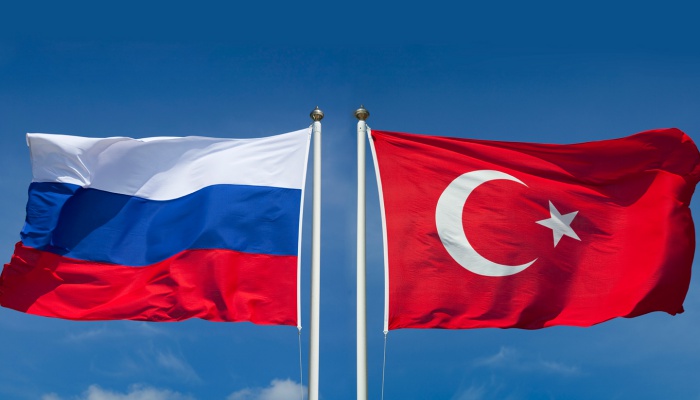

A Russian activist who fled to Turkey after being charged over a protest of Moscow’s war in Ukraine was arrested in St. Petersburg after Turkish authorities deported her to Russia, Russian media outlets and rights groups reported.
A court in St. Petersburg ordered Ariadna Litvinova, 24, jailed after she was sent from Turkey to Russia on July 4, The Insider reported, citing the city’s court press service.
This is Ariadna Litvinova. She was a student at a police college in St. Petersburg.
On the night of February 24, 2025, Ariadna spray-painted the words "Murderers," "Peace to Ukraine," and "Freedom for Prisoners" on street installations near the General Staff Arch. The… pic.twitter.com/0quG307215
— Olena Rohoza (@OlenaRohoza) July 7, 2026
Litvinova had moved to Turkey in September 2025 to stay with her father, Valery Kryzhanovsky, after Russian authorities opened a criminal case against her, he told BBC Russian, according to The Insider.
Her father said she was detained in Turkey in May after he and his wife called police during a family dispute. He said he did not file a complaint, but police took her over migration violations.
Litvinova spent about a month in a Turkish removal center before being sent to Russia, with her father learning of her deportation from media reports.
Russian authorities accuse Litvinova of repeatedly “discrediting” the army, a charge used to prosecute criticism of Russia’s invasion of Ukraine.
The case stems from a protest on February 24, 2025, the anniversary of Russia’s full-scale invasion, when Litvinova wrote “Killers,” “Peace to Ukraine” and “Freedom for prisoners” on banners supporting the war near the General Staff Arch in St. Petersburg, according to the Russian rights group Memorial.
Investigators put the damage at 135,536 rubles ($1,700). A court fined her 50,000 rubles under an administrative discrediting charge the next day and then ordered her arrest in a criminal vandalism case.
In March 2025 a court eased her pretrial restrictions, but Russian authorities later sought her detention again after she left for Turkey.
The Insider and Prison Lawyer said Litvinova had been wanted by Russia since February 4, 2026. The Moscow Times, citing her lawyers, reported that her removal was a deportation initiated by Turkey, not an extradition request.
She faces up to seven years in prison if convicted.
Russia has used war censorship laws to silence dissent since its 2022 invasion of Ukraine. Human Rights Watch, citing OVD Info, says 692 people had faced criminal prosecution on charges of spreading “false information” or “discrediting” the army by the end of September 2025, while at least 1,299 had faced criminal prosecution for opposing the war.
The case comes as Turkey, a NATO member, has maintained ties with both Kyiv and Moscow, giving military support to Ukraine while refusing to join Western sanctions on Russia.
Rights defenders described Litvinova’s case as the first publicly known deportation from Turkey to Russia of a person facing politically motivated criminal charges tied to nonviolent opposition to the war.
The Ark, a group helping Russian exiles, documented an attempted deportation from Turkey in September 2025 of a Russian man accused at home over an online comment. Activists secured his transfer to a safe third country instead of Russia.
Litvinova’s deportation also drew attention to Turkey’s record on returning migrants, refugees and dissidents to countries where they may face imprisonment, torture or persecution.
Turkey’s Law on Foreigners and International Protection bars returning anyone covered by the law to a place where they may face torture, inhuman or degrading treatment or a threat to life or freedom based on race, religion, nationality, membership in a social group or political opinion.
Rights groups say Turkish practice has often fallen short of that standard.
Human Rights Watch reported in 2025 that Turkish authorities were restricting the legal status of Uyghurs fleeing China by marking some as public security threats, sending them to removal centers and pressuring some to sign return forms. HRW said direct returns to China have been reported and that Uyghurs also face the risk of indirect return through third countries that have extradition ties with Beijing.
Amnesty International has accused Turkey of unlawfully returning Afghans after the Taliban takeover, including through pushbacks at the Iranian and Turkish borders and deportations from Turkey. Amnesty said in 2025 that thousands of Afghans had been deported from Turkey and Tajikistan despite the risk of rights violations under Taliban rule.
Iranian refugees in Turkey have also faced deportation fears.
In December 2023 Turkish authorities handed over Iranian singer and rapper Amir Hossein Maghsoudloo, known as Tataloo, to Iran after he had lived in Turkey for years. Iranian authorities arrested him on arrival. In January 2025 an Iranian court sentenced him to death on a blasphemy charge, and Iran Human Rights said in May 2025 that the sentence had been upheld and sent for enforcement.
Turkey had also deported two Iranian protesters, Mohammad Rajabi and Saeed Tamjidi, after they fled to Turkey following Iran’s 2019 nationwide protests. They were handed over to Iranian authorities and transferred to Evin Prison. Their case attracted attention in 2020 after Iranian courts upheld death sentences for them and another protester, Amir Hossein Moradi. The sentences were later overturned on appeal, but the case became one of the best-known examples of Turkey returning dissidents to Iran despite the risk of execution.
Another case, while not a formal deportation, underscored the danger faced by Iranian dissidents in Turkey. Habib Chaab, an Iranian Arab dissident with Swedish citizenship, was abducted in İstanbul in 2020 and smuggled into Iran in an operation Turkish authorities attributed to Iranian intelligence. Iran executed him in 2023.