
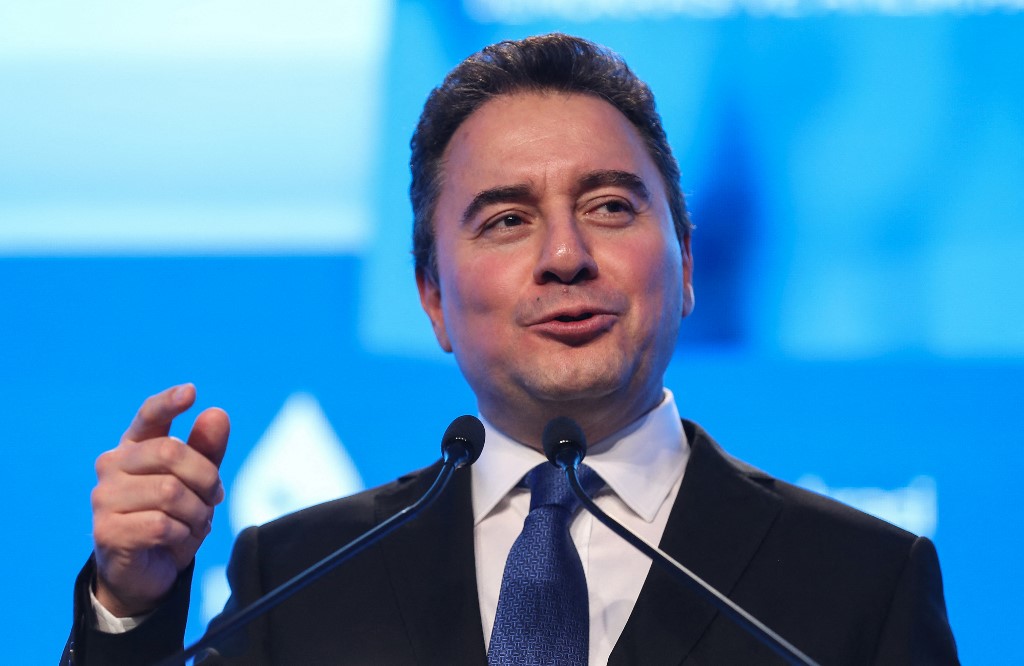
 is holding talks with several parties to build a broader alliance that could offer voters a new alternative to Erdoğan’s ruling Justice and Development Party (AKP).)
Ali Babacan, a former economy chief under President Recep Tayyip Erdoğan who later broke with him, has said his Democracy and Progress Party (DEVA) is holding talks with several parties to build a broader alliance that could offer voters a new alternative to Erdoğan’s ruling Justice and Development Party (AKP).
Speaking to a group of journalists in Ankara, Babacan said the talks included the Islamist New Welfare Party (YRP) and were aimed at expanding the New Path group, a parliamentary bloc formed in early 2025 by DEVA, the Future Party (GP) and the Felicity Party (SP).
The New Path group allows each party to preserve its separate identity while acting together in parliament. Babacan described it as the first step toward broader political cooperation ahead of future elections.
DEVA and the GP are led by former senior figures in Erdoğan’s party who broke away after years in government, citing concerns over authoritarianism and the weakening of institutional checks and balances.
Babacan said DEVA had already been in dialogue with the YRP, adding that the party had also expressed support for an alliance. He declined to name the other parties involved in the discussions, saying early announcements could damage the process before a mutual understanding is reached.
“We had the experience of the Table of Six in 2023. We took both positive and negative lessons from it. Beyond those experiences we now think building a truly new alternative is critical,” he said.
DEVA and the GP were both members of the “Table of Six,” an opposition platform that also included the SP, the Democrat Party, the nationalist İYİ (Good) Party and the main opposition Republican People’s Party (CHP) before the 2023 presidential and parliamentary elections.
Babacan said an electoral alliance was only one possible framework for cooperation and that other options, including joint lists or a joint presidential candidate, could also be discussed later. He added, however, that the priority was first to determine which parties would act together.
The DEVA leader said the political alternative they are seeking to build would appeal to three main voter groups: religious and conservative people dissatisfied with Erdoğan and the AKP; voters who previously supported center-right leaders such as former prime minister Adnan Menderes and former president Turgut Özal; and young people who have lost hope in politics.
Asked about a possible presidential candidacy, Babacan said he was DEVA’s “natural candidate” but stressed that the immediate goal was to expand the alliance and present that political unity to voters, with election cooperation and candidacies to be discussed later.
Babacan also commented on the main opposition CHP, saying he had no current contact with either removed CHP leader Özgür Özel or former chairman Kemal Kılıçdaroğlu, who was ordered restored to party leadership by a court. He said the CHP first needed to resolve its internal disputes before any broader opposition cooperation could be discussed.
“At the moment, the CHP’s first priority is to build an alliance within itself,” Babacan said, referring to legal and political tensions surrounding the party.
The CHP has been facing a series of investigations, arrests and lawsuits targeting its municipalities and internal leadership processes since its victory over the AKP in the March 2024 local elections.
The party’s leadership crisis deepened after the 36th Civil Chamber of the Ankara Regional Court of Justice annulled the CHP’s 38th Ordinary Congress, where Özel defeated Kılıçdaroğlu in November 2023 and became party chairman. The court ruled that the congress was legally invalid and ordered Kılıçdaroğlu and the party bodies elected under his leadership to return to office as an interim measure, temporarily removing Özel and the current party administration from office.
More than 30 CHP mayors have also been arrested, removed from office or replaced by government appointed trustees since the March 2024 local elections, according to a BBC Turkish tally.
Speculation about an early election, according to Babacan, would depend on two main questions: whether Erdoğan could secure the 360 parliamentary votes needed to call an election that would allow him to run again, and whether he believed he could win more than 50 percent of the vote.
Babacan said November 2027 was the date most often discussed in Ankara political circles, adding that Erdoğan would consider how much of his current term he was willing to give up in exchange for a new five-year mandate.
Babacan, who served as economy minister and deputy prime minister during earlier AKP governments, said any improvement in the economy before an election would remain temporary without the rule of law and a stronger investment climate, framing the economy as another reason Turkey needs what he called a credible alternative to the current government.