
 leader Devlet Bahçeli on Tuesday criticized a recent European Parliament report on Turkey that called on the European Union to consider sanctions on Turkish officials accused of serious rights violations and to examine organizations linked to the ultranationalist Grey Wolves movement, the Anka news agency reported.)
Turkey’s far-right Nationalist Movement Party (MHP) leader Devlet Bahçeli on Tuesday criticized a recent European Parliament report on Turkey that called on the European Union to consider sanctions on Turkish officials accused of serious rights violations and to examine organizations linked to the ultranationalist Grey Wolves movement, the Anka news agency reported.
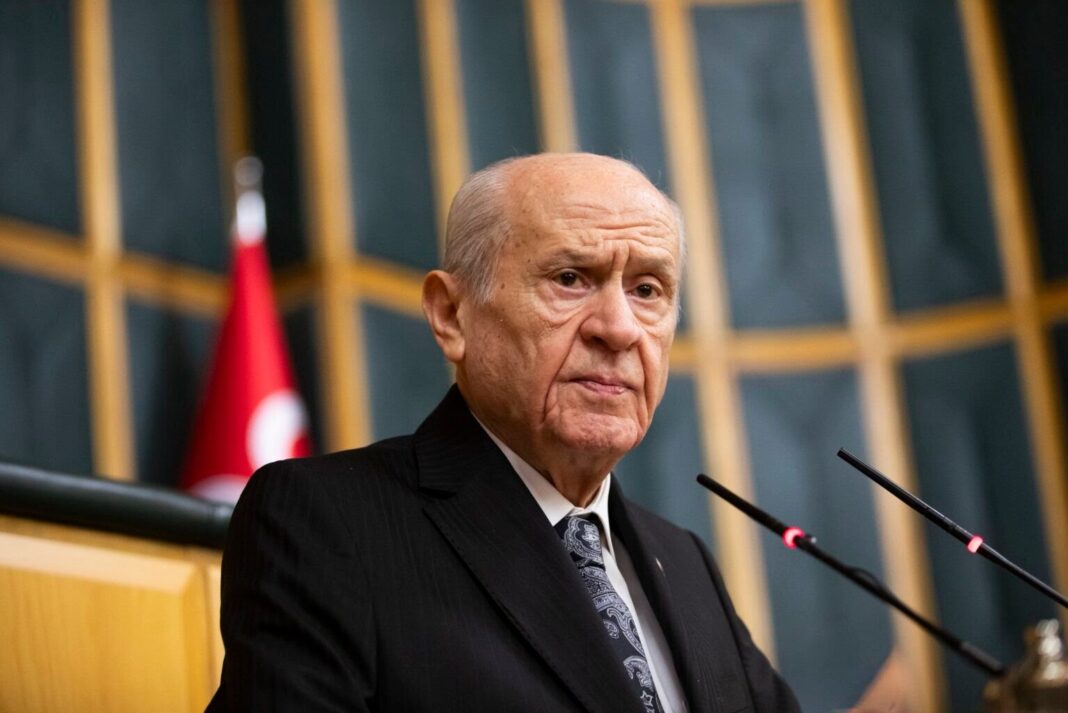
Speaking at his party’s parliamentary group meeting, Bahçeli accused European lawmakers of trying to pressure Turkey through what he described as politically motivated claims presented as a report.
“Europe has for years tried to lecture Turkey on democracy, law, security and foreign policy,” Bahçeli said, accusing European institutions of veiling threats as warnings of sanctions.
The European Parliament adopted the report on June 17 in response to the European Commission’s 2025 report on Turkey.
Prepared by Nacho Sánchez Amor, a Spanish lawmaker and the parliament’s standing rapporteur on Turkey, the resolution was approved by 381 votes to 107, with 171 abstentions.
The report cited what lawmakers described as a continued decline in democracy, the rule of law and fundamental rights in Turkey and called on Kaja Kallas, the EU’s foreign policy chief and a European Commission vice president, to consider measures under the EU Global Human Rights Sanctions Regime against Turkish officials accused of serious and deliberate human rights violations.
It specifically named Akın Gürlek, a former İstanbul chief public prosecutor who was appointed justice minister by President Recep Tayyip Erdoğan in February 2026, describing him as a key figure in what it called the state’s “repressive apparatus.”
Bahçeli said the report was not legally binding but should still be closely examined because of its “political intent.”
He rejected the criticism of Turkey’s judiciary, accusing European lawmakers of trying to interfere in ongoing legal proceedings and influence Turkish courts.
“One of the most serious parts of the report is its attempt to put our judiciary under siege,” Bahçeli said.
During Gürlek’s tenure as İstanbul’s chief prosecutor, his office led investigations targeting İstanbul Mayor Ekrem İmamoğlu and other members of the main opposition Republican People’s Party (CHP).
İmamoğlu, widely seen as Erdoğan’s strongest political rival, has been jailed pending trial since March 2025. He and the CHP deny the charges against them and say the investigations are politically motivated and aimed at sidelining Erdoğan’s opponents.
The Turkish government denies exerting control over the judiciary and claims the courts are independent.
Bahçeli said Turkish courts would not make decisions under the influence of reports written in Brussels and warned European officials not to pressure Ankara.
“The Republic of Turkey cannot be brought into line through threats, advice or lectures from external actors,” he said. “Everyone should watch their step, know their limits and remember their place.”
The European Parliament resolution is nonbinding and does not impose sanctions.
Any listing under the EU human rights sanctions regime would require a separate decision by the Council of the European Union, which represents the bloc’s 27 member states.
Measures under the sanctions system can include a travel ban, an asset freeze and a ban on EU citizens and companies providing funds or economic resources to the listed person.
Bahçeli also criticized the report’s references to the Ülkü Ocakları, a nationalist youth organization closely associated with the MHP and generally known in Europe as the Grey Wolves.
He said the report reflected what he described as longstanding hostility toward the movement and called the Ülkü Ocakları a source of pride for his party.
The European Parliament described the movement as racist and extremist and expressed concern about its presence in Turkey and EU member states.
Lawmakers called on the EU and national governments to examine the possibility of banning organizations affiliated with the movement.
The Grey Wolves emerged from Turkey’s nationalist movement and have long been associated with ultranationalist activism. Security officials and researchers in several European countries have warned that the movement promotes ethnic hostility and extremist ideology.
France banned the Grey Wolves in 2020 after a memorial to Armenians killed during World War I was defaced with graffiti, including the group’s name.
Austria has banned the public display of the Grey Wolves hand gesture, while German security services have monitored organizations linked to the movement for years and described it as one of the country’s largest far-right extremist networks. Germany has not imposed a nationwide ban.
In 2021 the European Parliament called on the EU and its member states to examine the possibility of adding the Grey Wolves to the EU terrorist list.