
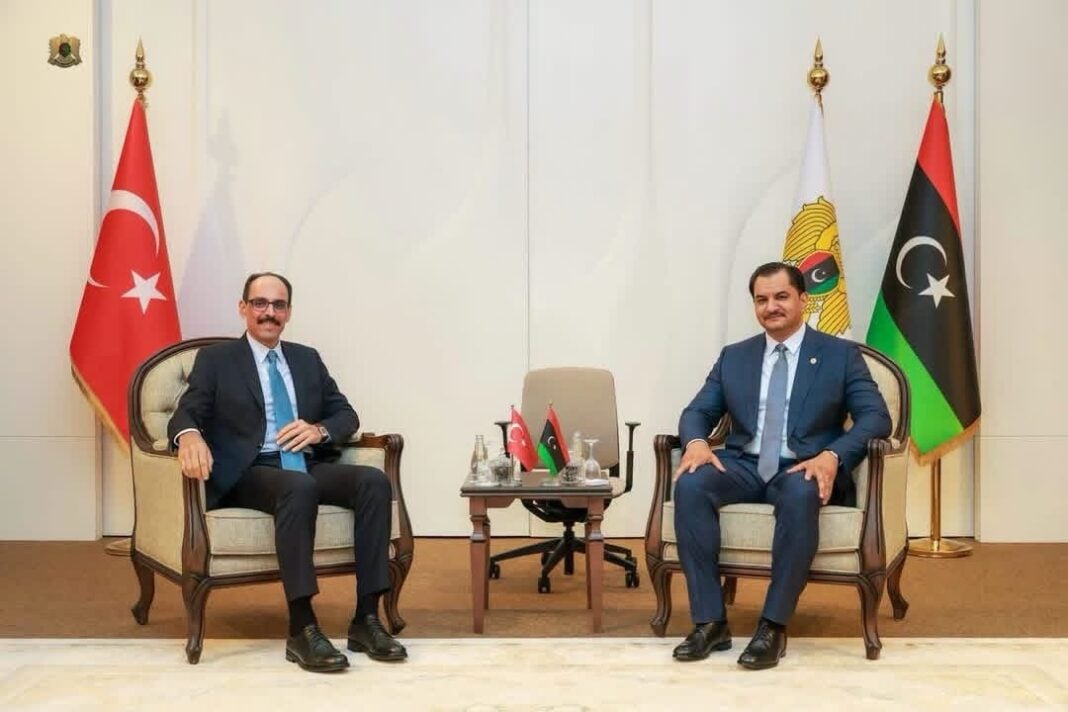

Turkey’s intelligence chief met with Saddam Haftar, the son and deputy of eastern Libyan commander Khalifa Haftar, in Benghazi on Tuesday, in the latest sign of Ankara’s effort to build ties with a faction it once helped stop from taking Tripoli.
İbrahim Kalın, the head of Turkey’s National Intelligence Organization (MIT), discussed the continuation of peace in Libya and efforts to unite the country’s rival eastern and western administrations and military forces under a single authority, the state-run Anadolu news agency reported, citing Turkish security sources.
The talks also covered Turkey-Libya relations, expanding cooperation in several fields and strengthening the partnership between the two sides, Anadolu said.
Saddam Haftar is deputy commander of the forces known as the Libyan National Army, which are based in eastern Libya and led by his father, Khalifa Haftar. The elder Haftar controls much of eastern and southern Libya and has become one of the country’s main power brokers despite lacking international recognition as Libya’s national leader.
Libya has been divided for years between the United Nations-recognized Government of National Unity in the capital of Tripoli, led by Prime Minister Abdul Hamid Dbeibah, and rival authorities in the east backed by Haftar. The split followed years of turmoil after the 2011 NATO-backed uprising that toppled and killed longtime ruler Muammar Gaddafi.
The meeting marks another step in Turkey’s recalibration of its Libya policy. Ankara was for years one of the main foreign backers of the Tripoli-based government and supported it militarily after signing maritime boundary and security cooperation deals with Libya’s then -internationally recognized Government of National Accord in 2019.
Turkish military support helped Tripoli repel Haftar’s 2019-2020 offensive on the capital, a campaign backed by Egypt, the United Arab Emirates and Russia. The fighting ended with a UN-brokered ceasefire in 2020, but Libya has remained divided, and national elections planned for December 2021 never took place.
Turkey has since moved away from dealing only with Tripoli and has opened channels with the Haftar camp. Saddam Haftar visited Ankara in April 2025 for talks with senior Turkish military officials, while Kalın met with Khalifa Haftar in Benghazi in August 2025 in a visit seen as one of the clearest signs of Ankara’s outreach to the east.
The change gives Turkey access to both centers of power in Libya, where foreign governments compete over energy routes, reconstruction contracts, migration control and military influence. It also supports Ankara’s effort to protect the 2019 maritime deal with Libya, which strengthened Turkey’s claims in the eastern Mediterranean but angered Greece, Cyprus and Egypt.
The latest meeting also comes as Saddam Haftar has gained visibility in talks over Libya’s future. The Financial Times reported this month that Massad Boulos, a senior adviser to US President Donald Trump, has pushed a power-sharing plan that could put Saddam Haftar at the head of an executive council while keeping Dbeibah as prime minister.
Such a plan would aim to unify Libya’s rival administrations and secure the country’s oil sector, but critics warn it could entrench rule by armed families rather than restore elected civilian government.
Haftar’s forces also remain under scrutiny over weapons flows. Reuters reported in April that eastern Libya’s military leader had acquired combat drones that appeared to include Chinese and Turkish models despite a longstanding UN arms embargo on the divided North African country.
The report highlighted the gap between diplomatic efforts to unify Libya and continued rearmament by rival forces. Turkey has not commented on the reported presence of Turkish-made drones in Haftar-controlled territory.
Ankara’s engagement with Saddam Haftar reflects a pragmatic turn in a country where its former battlefield adversaries now control territory, oil infrastructure and security routes that matter to Turkey, Europe and the wider region.