
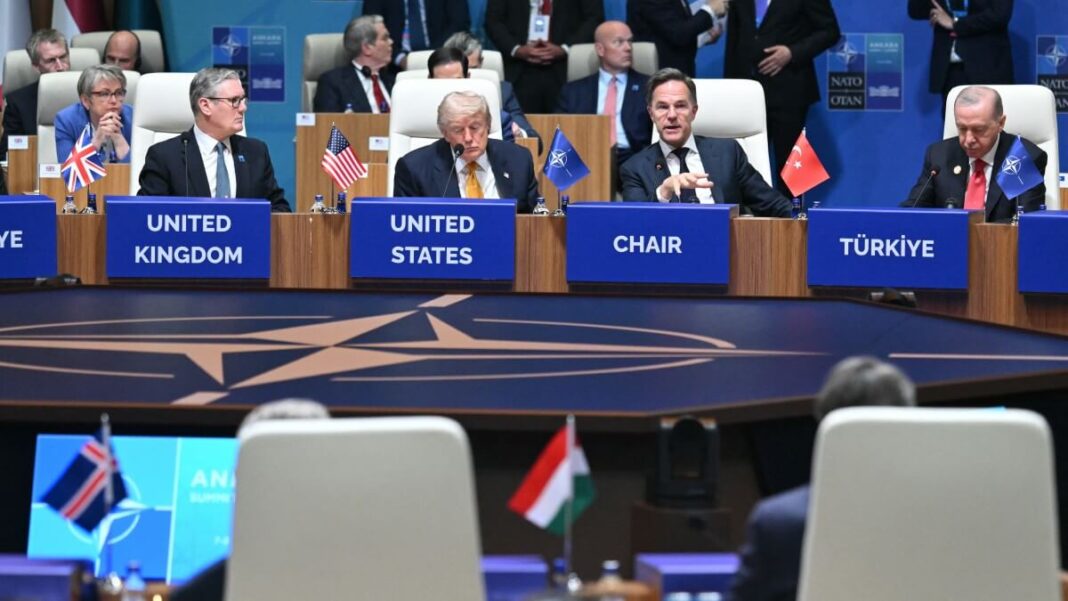

Turkish President Recep Tayyip Erdoğan on Wednesday urged NATO allies to remove restrictions on arms sales and defense cooperation, using the alliance’s Ankara summit to press a longstanding Turkish complaint, the state-run Anadolu news agency reported.
The 36th NATO summit brings together leaders of the alliance’s member states as well as representatives from several Gulf countries. It kicked off on Tuesday.
Speaking at the opening session of the NATO leaders’ summit at the presidential complex in Ankara, Erdoğan said allies should not block one another from buying weapons, developing defense projects or joining military industry programs.
“Restrictions among allies in defense cooperation, especially in the defense industry, must be removed,” Erdoğan said.
His remarks came as defense spending and weapons production dominated the summit agenda.
US President Donald Trump has been pressing NATO members to spend more on their own security, while European governments are trying to expand weapons production because of Russia’s war in Ukraine.
Turkey has repeatedly complained that NATO allies have limited its access to defense equipment.
The United States removed Turkey from the F-35 Joint Strike fighter program in 2019 after Ankara bought Russia’s S-400 air defense system. Washington said the Russian system could put the advanced fighter jet’s technology at risk.
The US also imposed sanctions on Turkey’s defense procurement agency under the Countering America’s Adversaries Through Sanctions Act (CAATSA). Some European allies imposed arms export restrictions on Turkey after Turkish military operations in northern Syria.
Trump said during a meeting with Erdoğan on Tuesday that Washington would consider selling F-35 fighter jets to Turkey and lifting the CAATSA sanctions, signaling a possible easing of one of the most serious disputes between the two NATO allies.
Turkey says it will reach NATO spending target early
Erdoğan said Turkey had taken steps to raise its defense spending to 3.5 percent of gross domestic product before 2030, part of a broader 5 percent defense and security spending target agreed at last year’s NATO summit in The Hague.
That means Ankara aims to reach NATO’s combined 5 percent target by 2030, five years before the 2035 deadline set at the alliance’s Hague summit, Erdoğan said.
“We aim to reach the 5 percent target five years before 2035, the date set in The Hague,” he said.
NATO allies have come under pressure from Trump to spend more on defense.
European governments are trying to show Washington that they can take more responsibility for protecting the continent as the US signals that it wants Europe to carry more of the burden.
Erdoğan also warns EU allies not to exclude Turkey
Erdoğan also warned European Union members not to leave non-EU NATO allies out of Europe’s defense plans, a message aimed mainly at Turkey’s concerns over EU defense programs.
One of those programs is Security Action for Europe (SAFE), an EU financial instrument designed to support joint investment in defense production and help member states close military capability gaps.
The program matters for Turkey because it could shape which countries and companies benefit from EU-backed defense contracts.
Turkey is not an EU member but has one of NATO’s largest militaries and a growing defense industry. It has also been a candidate for EU membership since 1999, although accession talks have long been stalled.
Turkey has sought access to SAFE, but its participation has faced objections from Greece and Cyprus, both EU members with long-running disputes with Ankara.
Greece has linked its objections to tensions in the Aegean, including Turkey’s threat of war if Athens extends its territorial waters and Ankara’s claims over some islands and islets. Cyprus has opposed Turkish participation because Turkey maintains troops in the island’s north and does not recognize the Republic of Cyprus.
EU rules give member states a say over whether non-EU countries can take part in such defense programs.
Erdoğan said European allies should take more responsibility for defending the continent but should not create separate defense structures that weaken NATO or leave Turkey outside major projects.
“I especially want to address our European Union member allies,” Erdoğan said. “Maximum benefit from the union’s security efforts can only be achieved by avoiding unnecessary duplication with NATO.”
Turkey has been a NATO member since 1952 and has the alliance’s second largest military.
Ankara says excluding it from European defense initiatives weakens NATO cooperation at a time when Europe is trying to produce more weapons and reduce gaps in air defense, ammunition and drone technology.
Additional $24 billion for Steel Dome
Erdoğan said Turkey would meet almost all of the 361 military capability targets assigned to it by NATO within three years, earlier than planned.
He also highlighted Turkey’s Steel Dome air defense project, saying Ankara had allocated an additional $24 billion to air and missile defense.
Steel Dome is Turkey’s planned multi-layered air defense network, designed to protect its airspace against threats including drones, aircraft, cruise missiles and ballistic missiles.
Turkey unveiled the project in August 2024 as part of an effort to build a domestically produced system that can link sensors, command systems and interceptors.
“As the country with the largest land army in Europe, we are working to make our capabilities available to the alliance whenever needed,” Erdoğan said.
Ukraine, Iran and Gaza
Erdoğan also addressed the war in Ukraine, saying he supported Trump’s push for peace and backed an initiative focused on Ukraine’s most urgent military needs.
He said Turkey would continue contributing under the Prioritised Ukraine Requirements List (PURL), in addition to military support from its own stocks.
PURL is a NATO-backed system that allows allies to pay for US weapons and equipment for Ukraine.
“While supporting Ukraine, we also use our communication channels in a way that encourages Russia toward peace,” Erdoğan said.
Turkey has supplied drones and other support to Ukraine while keeping diplomatic and economic ties with Russia. Ankara has also hosted talks between the two sides and helped broker earlier agreements on grain exports from Ukrainian ports.
On Iran, Erdoğan praised Trump’s “determined stance” in helping move the crisis toward a diplomatic solution despite what he called attempts at sabotage.
He said Turkey was ready to help clear mines from the Strait of Hormuz, a key route for oil and gas shipments from the Gulf.
Erdoğan also thanked NATO allies after missiles fired from Iran during the recent conflict were intercepted by NATO air defense systems deployed in Turkey.
He thanked the United States and Spain for support provided through NATO elements already in the country, and Germany and Italy for deploying additional air defense batteries in response to the threat.
Turning to the Middle East, Erdoğan said a two-state solution remained the key to lasting peace between the Israelis and the Palestinians and called for calm in Gaza and Lebanon.
“We all have the duty to ensure calm, especially in Gaza and Lebanon,” he said.