
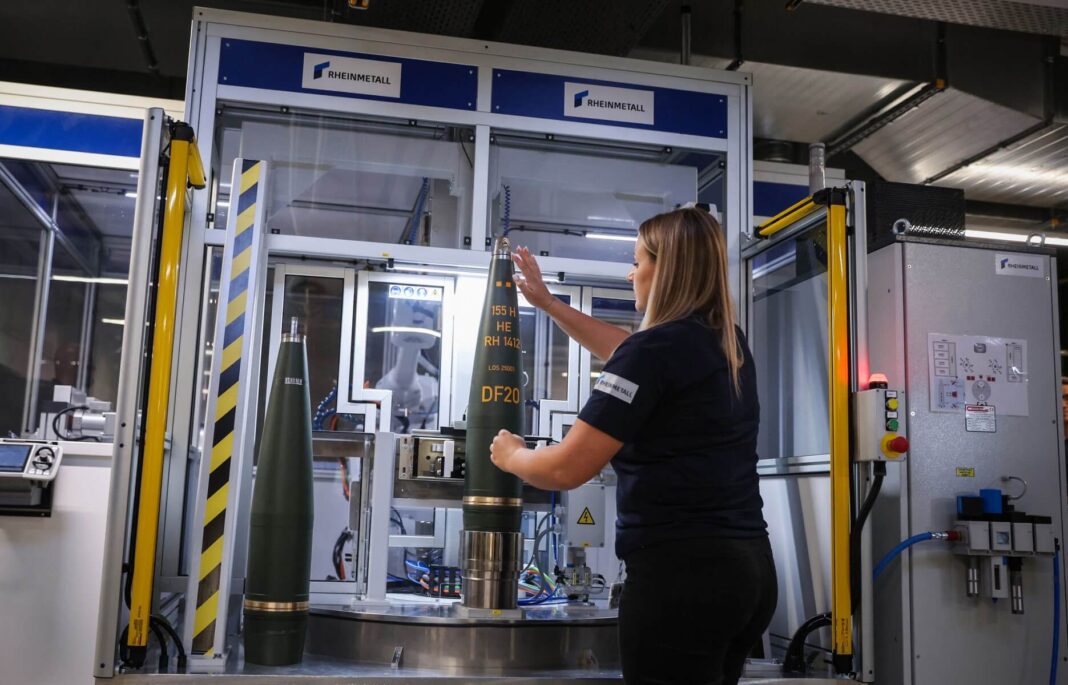

German arms giant Rheinmetall will produce US-designed ATACMS missiles in Germany under a joint venture with Lockheed Martin, the companies said Tuesday, in a deal announced as NATO leaders and defense industry executives gathered in Ankara for a summit focused on Europe’s military build-up.
The agreement marks the first time the Army Tactical Missile Systems, (ATACMS), will be produced in Europe. The missiles, which have a range of up to 300 kilometers, have been used in the Ukraine and Iran wars as well as in the Gulf and Iraq.
The deal was unveiled as the NATO summit got underway in Turkey, where European defense expansion is a central issue as US President Donald Trump presses allies to spend more on their own security.
“With our friends at Lockheed Martin, we are now establishing the industrial base in Germany for modern defense systems that are in high demand by Europe’s armed forces,” Rheinmetall CEO Armin Papperger said.
“We are grateful that Rheinmetall has been selected to establish and operate the world’s first and only production facility for ATACMS guided missiles outside the United States,” he added.
The joint venture is expected to strengthen Europe’s defense industrial base at a time when governments across the continent are trying to increase weapons production in response to Russia’s war in Ukraine and uncertainty over the future US role in European security.
The move is Rheinmetall’s latest effort to expand beyond its traditional business of tank guns and munitions as it seeks to benefit from soaring defense budgets across Europe.
Rheinmetall in March completed the acquisition of naval shipyard NVL, partly in expectation of a German order for six naval frigates, although the order later fell through.
In April the company said it would start making cruise missiles for the first time as part of a joint venture with Dutch defense contractor Destinus.
Rheinmetall shares have risen almost 12-fold since Russia’s full-scale invasion of Ukraine in February 2022 but have fallen almost 40 percent since last October, partly due to investor concerns that the 137-year-old company may be less well placed than rivals to produce cutting-edge systems such as drones and missiles.
© Agence France-Presse