

 has publicly rejected the idea of father-to-son succession, questioning whether President Recep Tayyip Erdoğan’s son could gain broad public support as his political visibility increases ahead of the next presidential election.)
A founding member of Turkey’s ruling Justice and Development Party (AKP) has publicly rejected the idea of father-to-son succession, questioning whether President Recep Tayyip Erdoğan’s son could gain broad public support as his political visibility increases ahead of the next presidential election.
Bülent Arınç, a former parliament speaker, deputy prime minister and one of the AKP’s founders, said the idea of leadership passing from father to son would not be widely accepted in Turkey, responding to questions about whether Erdoğan’s younger son, Necmettin Bilal Erdoğan, could one day seek high office.
“[Father-to-son transfers of power] may exist elsewhere, but I do not believe such a model would gain general acceptance in our country,” Arınç said during an interview on Sözcü TV, adding that while anything is possible if conditions line up, public support should not be assumed.
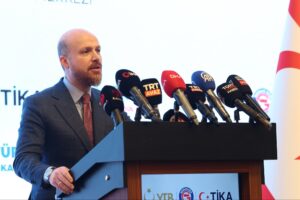
Arınç compared Turkey to European political systems rather than regional examples such as Azerbaijan or Middle Eastern states, saying father-to-son succession has no established tradition in Turkish republican politics.
Arınç’s remarks come as Bilal Erdoğan, who holds no elected office and is not a cabinet member, has attracted increased public and media attention amid speculation about the post-Erdoğan era.
Observers note a visible shift in how his public appearances and statements are covered, with more frequent headlines, video clips and commentary treating him as a political actor rather than solely as the president’s son.
Supporters describe this as a natural outcome of his civil society work, while critics argue it reflects an effort to normalize the idea of passing power to Erdoğan’s son following the end of Erdoğan’s tenure in 2028.
A December survey by Refleks Data and Research showed Bilal Erdoğan ranking third in hypothetical succession scenarios within the AKP, well behind Foreign Minister Hakan Fidan and former interior minister Süleyman Soylu.
Arınç also suggested that President Erdoğan could still introduce a surprise candidate as elections approach, recalling the 2007 presidential race in which Erdoğan ultimately backed Abdullah Gül, another AKP co-founder, who was later elected president.
“I won’t name names,” Arınç said, adding that unexpected choices remain possible given Erdoğan’s political style.
İmamoğlu’s arrest linked to his early candidacy
Arınç also addressed the imprisonment of İstanbul Mayor Ekrem İmamoğlu, the main opposition’s declared presidential candidate, linking his arrest to the timing of his candidacy announcement.
“İmamoğlu declared his candidacy too early,” Arınç said. “Had he not done so, perhaps he would not have been arrested. In politics, the early crowing rooster gets its head cut off.”
İmamoğlu, widely seen as President Erdoğan’s strongest political rival, was detained early on March 19, sparking mass protests that spread across Turkey. He was arrested on March 23, the day the CHP was set to hold a primary to select its presidential candidate. The vote was held as planned, and a record 15.5 million people cast ballots for the jailed mayor after the CHP opened the polls to the general public beyond its 1.5 million registered members.
The vote was taking place as an İstanbul court ordered his arrest in a corruption probe. Several hours later, the interior ministry suspended him as mayor as he was being sent to a prison on the megacity’s western outskirts.
Arınç also reiterated a position he had voiced in May, again criticizing the widespread use of pretrial detention in political cases. He said that İmamoğlu should be tried without being held in custody.
The AKP veteran’s remarks have drawn attention as rare public criticism from a senior AKP founding figure, reflecting unease within parts of the ruling camp over succession planning and the political costs of high-profile detentions.
Turkey’s next presidential election is scheduled for 2028 unless parliament calls an early vote.