
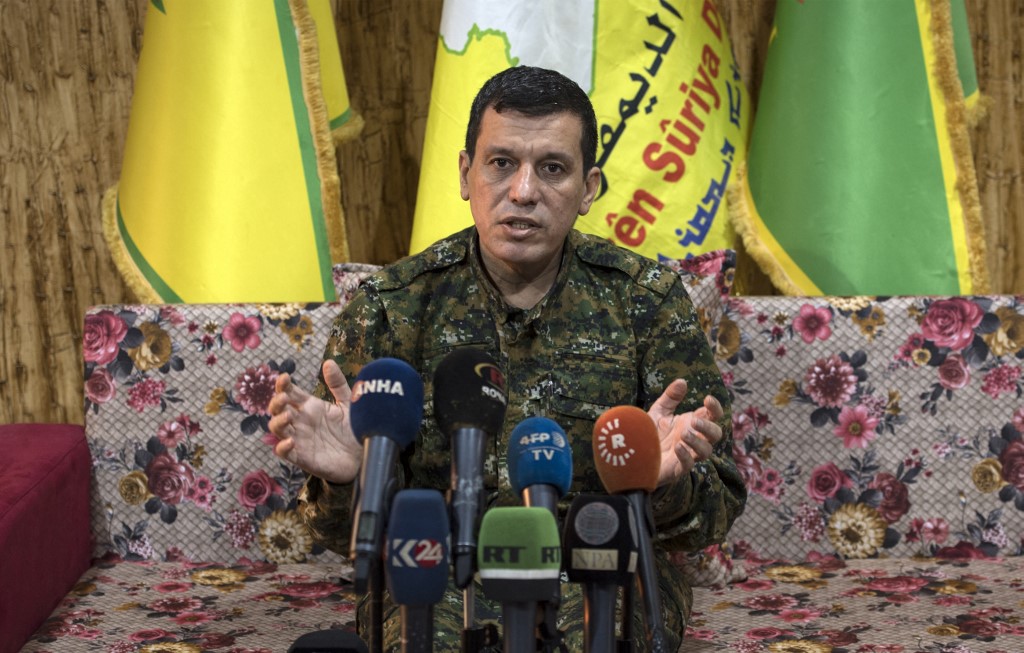
 may consider dialogue with #Turkey if negotiations with the Damascus government fail.)
Ömer Murat*
A recent report by the Syrian Observatory for Human Rights (SOHR) has sparked debate over a possible shift in regional dynamics, suggesting that the US-backed Syrian Democratic Forces (SDF) may be open to dialogue with Turkey if negotiations with the Damascus government break down.
The report, published last week, claims SDF leaders are weighing a political recalibration that could involve engagement with Ankara. The group, which includes the Kurdish-led People’s Protection Units (YPG), has long been viewed by Turkey as an offshoot of the outlawed Kurdistan Workers’ Party (PKK), designated as a terrorist organization by Ankara and its Western allies.
According to the UK-based SOHR, Turkish officials are allegedly attempting to disrupt SDF-Damascus talks while offering a strategic alternative rooted in Turkey’s nationalist vision of the Misak-ı Milli or National Pact. The 1920-era concept, historically associated with Turkish territorial claims in neighboring regions, is generally viewed as symbolic rhetoric rather than actionable policy.
The SOHR report says SDF leaders are considering establishing channels of communication with Ankara to gain political leverage amid allegations that Turkey is obstructing SDF-Damascus negotiations, “seeking to pull SDF in as a potential ally within arrangements that could intersect with the vision of the National Pact.” The report also establishes a correlation between this potential shift and Turkey’s ongoing peace process with Abdullah Öcalan, the jailed leader of the PKK.
Since 2006 the SOHR has been a key source of information on the Syrian conflict. It is frequently cited by major news outlets, such as Reuters, the BBC and The Guardian. Given its documented history of reporting news that is subsequently corroborated by other sources, it would be imprudent to dismiss the SOHR’s reports outright as baseless.
The SOHR report undoubtedly conflicts with the public stance of Turkish President Recep Tayyip Erdoğan’s government, which has long branded the SDF’s primary component, the YPG, as a terrorist offshoot of the PKK. Turkish officials have repeatedly emphasized Turkey’s demand that the SDF be disarmed and integrated into Syria’s new army under Damascus’s control. During his visit to Damascus in December 2024, Turkish Foreign Minister Hakan Fidan urgently appealed to Syria’s interim leader, Ahmed al-Sharaa, to dissolve the SDF. Fidan cautioned that Turkey would not acquiesce to the SDF’s persistent status as an autonomous military entity. In a March 2025 interview Fidan reiterated this position, stating that Turkey is “closely monitoring” SDF-Damascus agreements and views any autonomy for the SDF as a threat to Syria’s territorial integrity.
However, an article published on August 3 in the pro-Erdoğan Turkish newspaper Sabah lends some credence to the SOHR’s claims. Sabah is widely regarded as a pro-government outlet closely aligned with Erdoğan’s Justice and Development Party (AKP). The newspaper rarely publishes content critical of the government and often amplifies its nationalist agenda.
Titled “The YPG’s Misak-ı Milli Option,” columnist Bercan Tutar’s piece suggests that, wary of antagonizing a rising regional power, the SDF may seek to align with Turkey’s vision of a unified Kurdish-Turkish front under the Misak-ı Milli. Tutar’s analysis suggests that this shift is a logical consequence of Turkey’s growing influence and Erdoğan’s commitment to safeguarding regional Kurds from foreign manipulation.
Although Sabah generally aligns with government narratives and might be expected to dismiss the SOHR report as baseless, Tutar’s article portrays the SDF’s potential shift as a triumph of Turkey’s strategic dominance. The SOHR report’s unexpected alignment with the Sabah narrative suggests the potential validity of its assertions, albeit with the caveat that further scrutiny is necessary to substantiate these claims.
It is also important to emphasize that it would be incorrect to present the SOHR report as the primary indication of an unpublicized rapprochement between the Erdoğan government and the SDF, or that the recently initiated second peace process is associated with this development. Devlet Bahçeli, leader of the Nationalist Movement Party (MHP) and a staunch ally of Erdoğan, made a noteworthy statement following the announced dissolution of the PKK. Bahçeli emphasized the necessity of overseeing “the control and supervision of any possible transitions or transfers from the dissolved PKK to the PYD/YPG” in a manner consistent with public sentiment. With this statement, Bahçeli implied that the Turkish government does not expect the YPG to disband along with the PKK and that Turkey may be open to pragmatic engagement with the SDF.
The SDF is currently experiencing mounting pressure from the Syrian government, which has recently seen a marked strengthening under the leadership of al-Sharaa. The SDF also expresses uncertainty regarding the level of support it will receive from the United States under the Trump administration. In light of these challenges, the SDF may be exploring pragmatic options, including the initiation of intensive dialogue with Turkey. As the Syrian conflict continues to evolve, the possibility of an SDF-Turkey rapprochement remains speculative yet not implausible.
* Ömer Murat is a political analyst and a former Turkish diplomat who currently lives in Germany.