

Orhan Sait Berber – WASHINGTON DC
Turkey is closer than ever to resolving its long-running dispute with the United States over the Russian S-400 air defense system, which led to its removal from the F-35 fighter jet program and the imposition of sanctions under the Countering America’s Adversaries Through Sanctions Act (CAATSA), Deputy Foreign Minister Levent Gümrükçü has said.
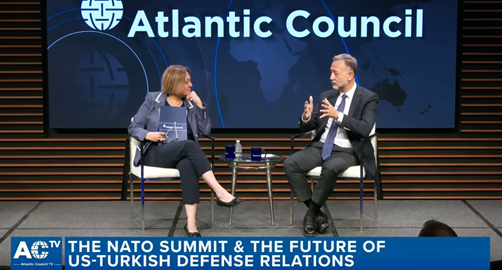
Speaking Friday at an event hosted by the Turkey Program of the Atlantic Council, a Washington-based foreign policy think tank, Gümrükçü said recent progress in bilateral ties under US President Donald Trump had brought the two NATO allies closer to a breakthrough.
“This time we really feel closer. We feel that we might be able to resolve this issue,” Gümrükçü said, pointing to improved relations between the two countries under US President Donald Trump and the personal rapport between Trump and Turkish President Recep Tayyip Erdoğan.
He said political and technical negotiations were continuing and that the two NATO allies were considering ways to overcome the remaining obstacles to restoring defense cooperation.
Responding to a Turkish Minute question about reports that Turkey may transfer the S-400 air defense system to a Gulf country and whether the purchase had proved to be a strategic mistake, Gümrükçü declined to discuss specific options.
“We are working on it. There are several options and we are of course talking to all the stakeholders from the United States to Russia and everyone involved but at this point in time we are not in a position to tell you what would be the best option that will take us… ahead and will allow us to leave this problem behind.”
His remarks came amid reports that Turkey was exploring the possible transfer of the S-400 system to the United Arab Emirates as it seeks to remove the main legal and political obstacle to acquiring the F-35s.
Any such transfer would still face substantial hurdles, including the need for Russia’s approval as the system’s original supplier.
If resolved, the dispute could pave the way for Turkey’s return to the F-35 program and remove one of the biggest sources of friction in US-Turkey relations in recent years.
The issue gained fresh momentum during the NATO summit in Ankara on July 7–8, when Trump said his administration would lift sanctions imposed on Turkey over the S-400 purchase and would make a decision on the possible sale of F-35 fighter jets to Ankara.
Trump later said he had not yet made a final decision on the aircraft, but his remarks marked the clearest public indication yet that his administration was prepared to seek a political solution to the dispute.
The administration had already taken steps toward easing tensions before the summit, including approving the sale of hundreds of millions of dollars’ worth of US-made fighter jet engines to Turkey.
Turkish Foreign Minister Hakan Fidan said after the summit that Ankara hoped to secure the lifting of US sanctions and make progress on its request to purchase the fighter jets, arguing that there should be no defense industry restrictions between NATO allies.
The S-400 is a Russian-made long-range surface-to-air missile system capable of detecting and engaging aircraft, drones and ballistic missiles. Turkey took delivery of the system despite repeated US warnings that it was incompatible with NATO defense infrastructure and posed a security risk to the F-35.
Before its removal, Turkey was both a customer and an industrial partner in the multinational F-35 program. Turkish defense companies manufactured more than 1,000 airframe and engine components for the fifth-generation fighter, while Ankara had planned to purchase up to 100 aircraft for its air force.
US officials argued that operating the S-400 alongside the F-35 could enable the Russian system to collect sensitive data about the fighter’s stealth characteristics and other classified technologies.
Washington removed Turkey from the F-35 program in 2019 and imposed sanctions on Turkey’s Presidency of Defense Industries under the Countering America’s Adversaries Through Sanctions Act (CAATSA) in December 2020.
US law also prevents the transfer of F-35 aircraft and related equipment to Turkey unless the administration certifies to Congress that Ankara no longer possesses the S-400 system, its associated equipment or personnel and has provided credible assurances that it will not acquire another Russian system capable of compromising the aircraft.
The requirement has made the removal, sale or transfer of the S-400s central to any formula for Turkey’s possible return to the program.