
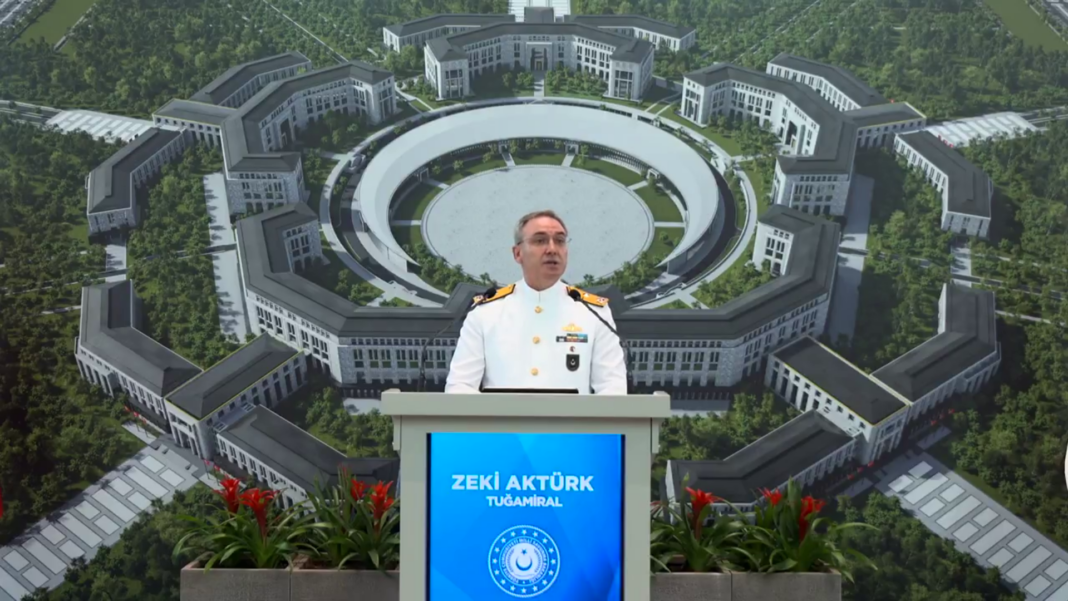

The Turkish Defense Ministry on Thursday welcomed US President Donald Trump’s pledge to lift sanctions imposed over Ankara’s purchase of a Russian air defense system, saying Washington should remove all restrictions on Turkey’s defense industry as debate grew over a possible return to the F-35 fighter jet program.
The comments came after Trump met with President Recep Tayyip Erdoğan on Tuesday on the sidelines of the 36th NATO summit in Ankara. Asked about sanctions imposed under the Countering America’s Adversaries Through Sanctions Act (CAATSA), Trump told reporters, “We’re going to be taking the sanctions off.” He also said he would decide on a possible F-35 sale to Turkey.
“Turkey, as a strong and effective NATO ally, continues to make significant contributions to the alliance’s deterrence and common security,” ministry spokesman Rear Adm. Zeki Aktürk said during the ministry’s weekly briefing.
Turkey expects the removal of CAATSA sanctions and all “open or hidden” restrictions on its defense industry, which it described as incompatible with the spirit of alliance, the ministry added.
The United States imposed CAATSA sanctions on Turkey in December 2020 after Ankara acquired the Russian S-400 missile defense system. Washington also removed Turkey from the F-35 Joint Strike Fighter program, citing concerns that the Russian system could expose sensitive technology used by the stealth aircraft.
A possible reversal would still face obstacles in Washington. US lawmakers have opposed Turkey’s return to the program, and Congress passed restrictions in 2020 barring Turkey from the F-35 program as long as it relies on Russian air defense technology.
Greece raises security objections
The prospect of Turkey receiving F-35s also drew objections from Greek Prime Minister Kyriakos Mitsotakis, who said the concerns of all NATO members should be taken into account and referred to Turkey’s longstanding threat of war if Greece extends its territorial waters in the Aegean Sea.
“An alliance must be based on good neighborly relations,” Mitsotakis said upon arriving at the summit. “Especially when my country is threatened with war by Turkey if it exercises its sovereign rights, we must ensure that the sensitivities of all members are taken into account.”
The dispute refers to a 1995 Turkish parliamentary declaration that any Greek extension of territorial waters in the Aegean beyond six nautical miles would be a cause for war. Greece says it has the right under international law to extend its territorial waters, while Turkey says such a move would trap Turkish access in the Aegean and upset the regional balance.
The Turkish Defense Ministry rejected the Greek warning without naming the F-35 dispute directly.
“Turkey favors preserving peace and stability in our region and addressing existing issues through constructive dialogue and good neighborly relations,” the ministry said. “We once again state that avoiding rhetoric that could raise tension would contribute to bilateral relations, and we remind everyone that the Turkish Armed Forces are not a threat to anyone who does not threaten them.”
The F-35 issue has become a test of whether the Trump administration can turn warmer ties with Erdoğan into a policy shift. The dispute is part of a broader demand by Ankara to restore defense cooperation with Washington after years of sanctions, procurement limits and mistrust over Turkey’s ties to Russia.