
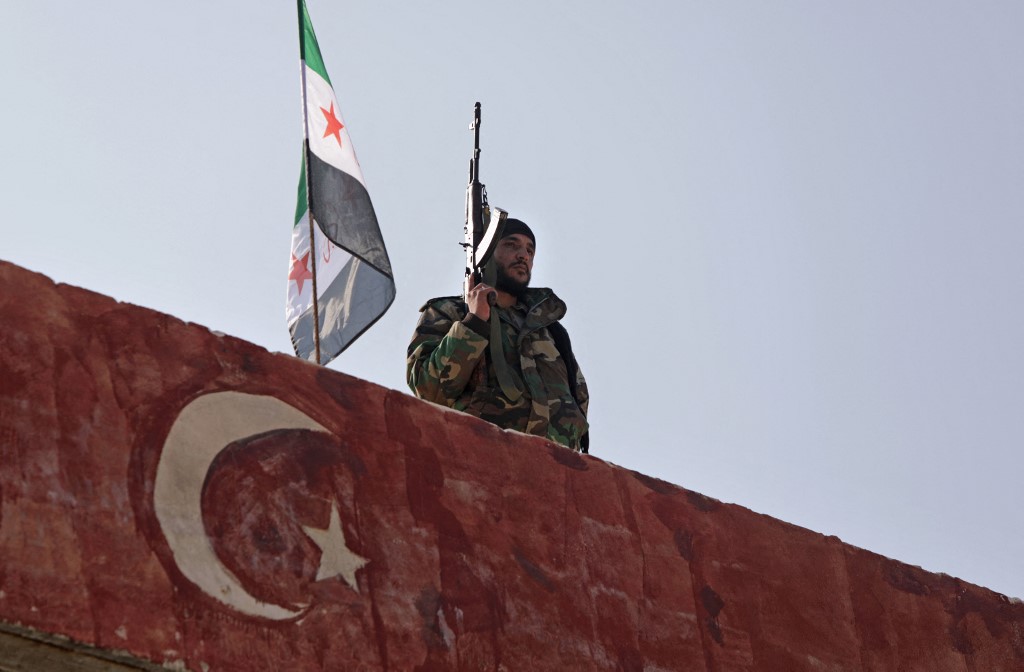

A Turkish intelligence-run prison on the Syrian side of the Hawar-Kilis border crossing between Turkey and northern Syria has been holding inmates in inhumane conditions and subjecting them to torture, according to a New Lines Magazine report citing survivors and sources in Turkish-backed Syrian factions.
The report, published Wednesday by Elizabeth Tsurkov, a Syria researcher and doctoral candidate at Princeton University, focuses on Turkey’s relationship with Syria’s new rulers after the fall of former Syrian president Bashar al-Assad in December 2024.
Tsurkov wrote that Turkey’s National Intelligence Organization (MİT) continues to operate the prison at the Hawar-Kilis crossing, which links southern Turkey with Aleppo province in northern Syria.
New Lines cited survivors of detention and sources in the Syrian National Army (SNA), an umbrella group of Turkey-backed Syrian factions, as saying the prison holds detainees Turkey considers national security threats.
The detainees include people suspected of belonging to the Islamic State group, the Kurdish-led Syrian Democratic Forces (SDF), the SDF’s civilian administration and political detainees opposed to Turkey’s policies in Syria, according to the report.
Syrian army sources told New Lines that several detainees were transferred in mid-2025 to Syrian state custody and moved to al-Rai prison in northern Syria, while others suspected of links to the Kurdistan Workers’ Party (PKK) were taken into Turkey.
The PKK, which has waged an insurgency against Turkey since the 1980s, is designated as a terrorist organization by Turkey and its Western allies.
Turkey also regards the SDF’s main armed component, the People’s Protection Units (YPG), as the Syrian branch of the PKK, while the SDF has been a key US partner in the fight against the Islamic State group.
The New Lines report follows earlier allegations about detention sites operated by Turkey-backed factions in northern Syria.
Syria Direct reported in September 2024 that the arrest of photojournalist Bakr al-Qassem had drawn attention to SNA prisons in northwestern Syria and Turkey’s role in abuses there.
Al-Qassem, who worked with Agence France-Presse, was arrested in northern Aleppo in August 2024 by SNA military police without a warrant or formal charges and was not allowed to contact his family or hire a lawyer, Syria Direct reported.
Activists initially believed he was being held at Hawar Kilis, which Syria Direct described as a prison on the border strip between northern Aleppo and Turkey, before it emerged after his release that he had been detained in another SNA prison in al-Rai.
Syria Direct said Hawar Kilis was described by sources as a facility that unofficially belonged to Turkish intelligence and was guarded by the Sultan Murad Division, an SNA faction accused by rights groups of torturing detainees.
Bassam al-Ahmad, executive director of Syrians for Truth and Justice, told Syria Direct at the time that Turkey-backed factions began using Hawar Kilis as a detention center in early 2019 under the control of the Sultan Murad Division.
Al-Ahmad estimated that the prison held around 300 prisoners and forcibly disappeared people, citing statements of released detainees.
He said detainees at Hawar Kilis faced three main accusations: opposing Turkey’s policy in Syria, dealing with or belonging to the SDF or the Autonomous Administration of North and East Syria, and belonging to the Islamic State group.
Syria Direct also quoted al-Ahmad as saying interrogations were conducted by Turkish intelligence officers with translators and that detainees were subjected to torture and mistreatment, including suspension from the wrists, whipping, sexual assault of male detainees and starvation.
A Syrian lawyer in northern Aleppo told Syria Direct that Hawar Kilis was outside the judiciary and that lawyers could not help prisoners because no local institution had authority over the site.
Human Rights Watch has also documented abuse by Turkey-backed factions and Turkish involvement in detention-related violations in northern Syria.
In a February 2024 report, Human Rights Watch said Turkey bears responsibility for serious abuses and possible war crimes committed by Turkish forces and local armed groups it supports in areas of northern Syria under Turkish control.
The rights group said the abuses included abductions, arbitrary arrests, unlawful detention, sexual violence and torture by SNA factions and the Military Police, a force established by the Syrian Interim Government and Turkish authorities in 2018.
Human Rights Watch also said Turkish armed forces and intelligence agencies were involved in carrying out and overseeing abuses.
The rights group said former detainees reported that Turkish military and intelligence officials were sometimes present during arrests and interrogations and in some cases were directly involved in torture and ill-treatment.
Turkey denied the Human Rights Watch allegations in 2024, with a senior Turkish Foreign Ministry official telling The Associated Press that the report did not reflect realities on the ground and ignored Turkey’s security concerns.
Human Rights Watch said in May 2025 that SNA factions continued to detain, mistreat and extort civilians in northern Syria after Assad’s fall, despite their integration into Syria’s armed forces under the new authorities in Damascus.
The organization called on Syria’s transitional government to investigate abuses by SNA factions and exclude commanders implicated in violations from the new security forces.
It also said Turkey, which continues to oversee former SNA factions and provide weapons, salaries, training and logistical support, bears responsibility for abuses and potential war crimes.
Turkey’s influence in Syria has changed since Assad’s fall because Ankara now deals with a state rather than a rebel force, but Turkish intelligence and military support remain central to the new Syrian security system, according to the New Lines report.
Damascus has sought to reduce its dependence on Ankara by expanding ties with Saudi Arabia, the United Arab Emirates and other regional actors but still relies on Turkey for intelligence, training and security assistance, the report said.