
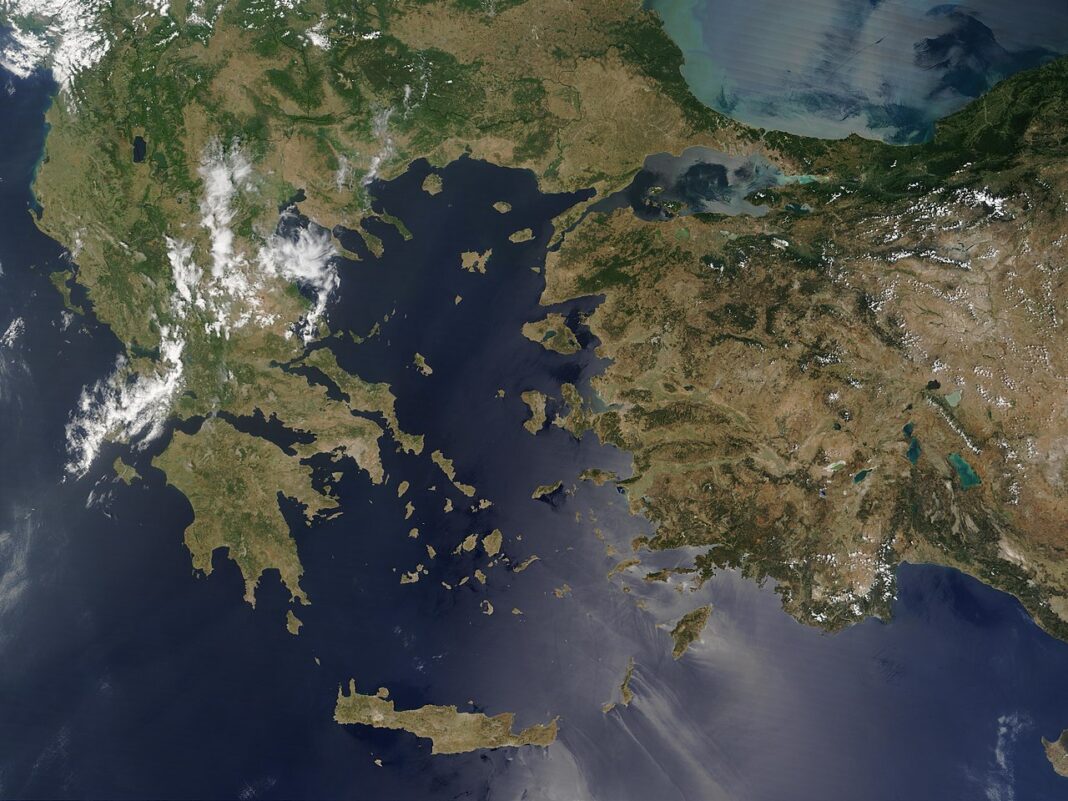

Turkey is drafting legislation to assert maritime jurisdiction in disputed areas of the Aegean and Mediterranean seas, a move that could raise tensions with Greece and Cyprus over offshore energy resources, Bloomberg reported on Friday, citing people familiar with the matter.
The bill would mark a step by Ankara to formalize its claims over waters where Turkey, Greece and Cyprus have competing positions on maritime boundaries and potential natural gas reserves, the report said.
The sources, who spoke to Bloomberg on condition of anonymity, said the bill was intended to strengthen Turkey’s claims and declare ownership over possible natural gas resources.
Turkey’s foreign ministry declined to comment, according to Bloomberg.
The timing of the bill’s submission and debate in parliament remains unclear.
Turkey and Greece, both members of NATO, have long been at odds over the Aegean Sea, where they dispute the extent of territorial waters, airspace, continental shelf rights and the maritime zones generated by Greek islands close to Turkey’s western coast.
Greece argues that islands have rights to continental shelves and exclusive economic zones under international law, while Turkey rejects the view that islands should generate the same maritime claims as mainland territory in all cases.
Turkey is not a party to the United Nations Convention on the Law of the Sea, the main treaty governing maritime zones.
The reported bill would put Turkey’s position into law for the first time.
The issue also affects Cyprus, an eastern Mediterranean island divided since 1974, when Turkey intervened militarily following a coup backed by Greece’s then-ruling military junta that sought to unite the island with Greece.
The Republic of Cyprus, a European Union member, is internationally recognized as sovereign over the entire island, while the Turkish Republic of Northern Cyprus (KKTC) in the north is recognized only by Turkey.
Ankara argues that Turkish Cypriots have rights to offshore energy resources around the island and has repeatedly objected to energy deals and exploration activity involving the Republic of Cyprus.
Devlet Bahçeli, the leader of the far-right Nationalist Movement Party (MHP) and a key ally of President Recep Tayyip Erdoğan, warned this week that Turkey would respond to moves that ignore its maritime claims or the rights of Turkish Cypriots.
Bahçeli’s remarks followed security and energy cooperation among France, Greece, Cyprus and Israel, which Ankara has viewed with concern.
The eastern Mediterranean has become a focus of regional rivalry since the discovery of offshore gas reserves near Cyprus, Israel and Egypt.
Turkey has sought to break what it sees as its exclusion from regional energy arrangements and signed a maritime boundary agreement with Libya’s Tripoli-based government in 2019, a deal rejected by Greece, Cyprus and the European Union.
The EU has previously threatened sanctions against Turkey over drilling and exploration activity in the eastern Mediterranean, after Greece and Cyprus accused Ankara of violating their sovereign rights.
Washington has urged Greece and Turkey to maintain dialogue over disputes involving exploration and maritime jurisdiction, Bloomberg said.
The reported bill comes after Turkey and Greece traded barbs over maritime maps and fishing restrictions in recent months.
Turkey’s foreign ministry in April accused Greece of publishing fishing restriction maps in areas where Ankara says Athens has no jurisdiction, calling the move a violation of Turkish maritime jurisdiction areas.
Greece has rejected Turkish claims as having no legal basis and says its maritime positions are rooted in international law.
The legislation, if submitted, could further test a fragile improvement in relations between Ankara and Athens after years of tension over migration, military activity, energy exploration and territorial disputes.