

Turkey recorded the highest rent increase in Europe in 2025, with prices rising 78 percent, far outpacing other countries, Euronews reported, citing Eurostat data.
Across the European Union, rents rose by an average of 3.1 percent, with most countries seeing single-digit increases. Croatia and Montenegro followed Turkey with increases of around 18 percent, showing how sharply Turkey stands out even among the fastest-rising markets.
Including EU candidates and the European Free Trade Association countries, which consist of Iceland, Liechtenstein, Norway and Switzerland, Turkey remained far ahead of others among 36 countries, with annual rent inflation of 77.6 percent.
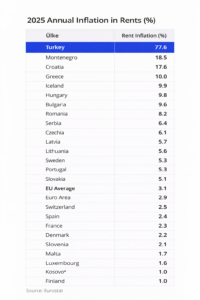
At the other end of the spectrum, rent growth remained minimal in countries such as Finland and Kosovo, at around 1 percent, while Luxembourg saw increases of about 1.6 percent.
The scale of the gap reflects deeper pressures in Turkey’s housing market, where rising costs have pushed more households into renting.
“Inflation is exceptionally high in Turkey, meaning it accounts for a large share of nominal rent growth,” Kate Everett-Allen, head of European residential research at Knight Frank, told Euronews Business.
She added that homeownership has become increasingly unaffordable in Turkey.
Rapid house price increases, high mortgage rates and limited availability of long-term, fixed-rate financing have effectively locked many households out of the housing market, driving demand for rentals higher.
Years of high inflation and a sharp depreciation of the Turkish lira have further fueled the trend. Annual inflation exceeded 60 percent in 2023 and remained elevated in 2024, while the lira has lost significant value against major currencies in recent years. This has reinforced housing as a hedge against inflation and currency losses, pushing both property prices and rents higher.
A temporary rent cap introduced in July 2022 and extended until July 2024 also affected the market. The measure limited annual rent increases for existing tenants to 25 percent, well below inflation and the usual legal benchmark based on the 12-month average consumer price index.
While the cap protected current tenants, it led landlords to sharply increase prices in new contracts to offset losses, widening the gap between existing and newly signed rents.
“Rent controls have had unintended effects,” Everett-Allen said, noting that limits on existing contracts encouraged landlords to raise rents on new leases, pushing overall market prices higher.
Rising financing costs, maintenance expenses and regulatory burdens have also added pressure on landlords, many of whom have passed these costs on to tenants.
Turkey’s rent surge highlights a housing market shaped not only by supply and demand but also by persistent inflation and policy decisions, raising concerns about affordability going forward.