

Syria’s army told Kurdish forces on Tuesday to withdraw from an area they control east of Aleppo after dislodging fighters from two neighborhoods in the city in deadly clashes last week.
The move raises fresh concerns of further fighting between the two sides, as Syria’s Islamist government seeks to extend its authority across the country and progress stalls on integrating the Kurds’ de facto autonomous administration and forces into the central government.
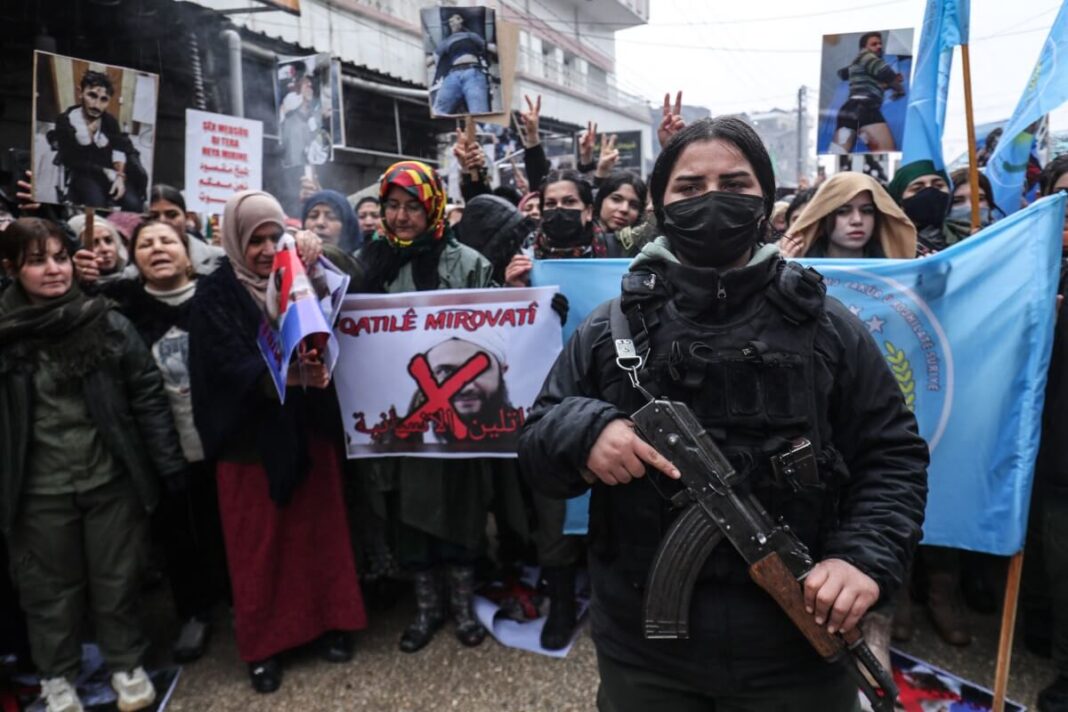
In Qamishli, the main Kurdish city in the country’s northeast, thousands of people demonstrated against the Aleppo violence, some burning pictures of Syrian President Ahmed al-Sharaa, an Agence France-Presse correspondent said.
Syrian state television published an army statement with a map declaring a large area east of Aleppo city a “closed military zone” and said “all armed groups in this area must withdraw to east of the Euphrates.”
The area begins near Deir Hafer, around 50 kilometers (30 miles) east of Aleppo and extends to the Euphrates River further east, as well as towards the south.
On Monday Syria accused the US-backed, Kurdish-led Syrian Democratic Forces (SDF) of sending reinforcements to Deir Hafer and said it sent its own personnel there in response.
The SDF is the de facto army of the Kurds’ semi-autonomous administration and controls swaths of the country’s oil-rich north and northeast, much of which it captured during Syria’s civil war and the fight against the Islamic State group.
An AFP correspondent saw government forces transporting military reinforcements including air defense batteries and artillery towards Deir Hafer on Tuesday.
The SDF denied any build-up of its personnel around Deir Hafer.
‘Bloodshed’
Syria’s government took full control of Aleppo city over the weekend after taking over its Kurdish-majority Sheikh Maqsud and Ashrafiyeh neighborhoods and evacuating fighters to Kurdish-controlled areas in the country’s northeast.
The sides have traded blame over who started the violence last Tuesday that killed dozens and displaced tens of thousands of people.
In Qamishli, thousands of people protested against the Aleppo violence and Syrian leader al-Sharaa, some carrying Kurdish flags or banners in support of the SDF and its chief, Mazloum Abdi.
“Leave, Jolani!” they shouted, referring to al-Sharaa by his nom de guerre as a former Islamist rebel commander, Abu Mohammed al-Jolani.
“This government has not honored its commitments towards any Syrians,” said cafe owner Joudi Ali.
“There has been bloodshed since it took power, like the Alawite and Druze massacres,” the 29-year-old told AFP, referring to sectarian violence last year involving the two minority communities.
Most shops were shut in Qamishli as residents observed a general strike.
Other protesters burned portraits of Turkish Foreign Minister Hakan Fidan, whose country has lauded the Syrian government’s Aleppo operation “against terrorist organizations.”
PKK, Turkey
Turkey has long been hostile to the SDF, seeing it as an extension of the Kurdistan Workers’ Party (PKK) and a major threat along its southern border.
Last year, the PKK announced an end to its armed campaign against the Turkish state and began destroying its weapons, but Ankara has insisted that the move include armed Kurdish groups in Syria.
On Tuesday the PKK called the “attack on the Kurdish neighborhoods in Aleppo” an attempt to sabotage peace moves between it and Ankara.
A day earlier, Ankara’s ruling party called the clashes an attempt by Kurdish fighters to sabotage the efforts.
Turkey has repeatedly called for the Syrian Kurdish forces’ integration into the new government as part of a March deal between Damascus and the SDF that was supposed to have been implemented last year.
The Britain-based Syrian Observatory for Human Rights reported that 45 civilians and 60 soldiers and fighters were killed from both sides in the Aleppo violence.
Neither side has released a comprehensive toll.
Aleppo civil defense official Faysal Mohammad told AFP on Tuesday that emergency workers had pulled 50 bodies from the two Kurdish-majority neighborhoods since the end of fighting, without saying whether they were combatants or civilians.