

Adem Yavuz Arslan*
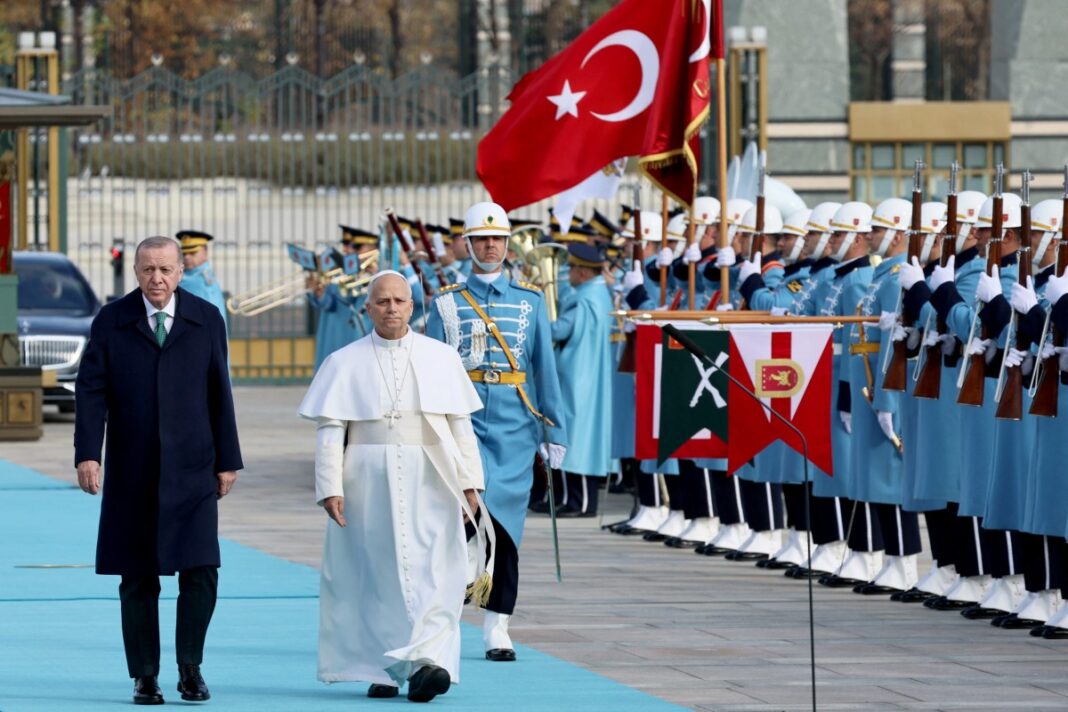
Pope Leo XIV’s visit to Turkey has been wrapped in the language of peace, unity and dialogue. Official ceremonies, symbolic gestures in Nicaea and messages of hope were designed to project harmony. But beyond the carefully arranged optics lies a harder political truth: The values the pope promotes — openness, dialogue, minority protection — run directly counter to the trajectory Turkey has taken under President Recep Tayyip Erdoğan.
Christian unity meets political fragmentation
The pope’s call for Christian unity from Nicaea carries historical and theological weight. Yet it arrives in a country where religious pluralism has steadily eroded. While the Vatican attempts to revive a sense of shared Christian heritage across denominations, Turkey’s ruling establishment continues to frame religious diversity not as a strength but as a threat to national cohesion. The contrast is glaring: The Vatican speaks of universal brotherhood; Ankara’s political rhetoric increasingly emphasizes uniformity, loyalty and centralized control.
Ankara’s attempt to capitalize on the moment
The Erdoğan government has marketed the visit as evidence that Turkey is a “center of dialogue” and a regional stabilizer. In reality, Turkey’s foreign policy in Gaza, Lebanon and Syria has been anything but consistent, and its domestic governance stands at odds with the principles of coexistence the pope endorses. The stage-managed warmth during the visit serves one purpose: to soften Ankara’s international image at a time when its democratic credentials are under growing scrutiny.
The deep irony of ‘dialogue’ in Turkey
Perhaps the greatest irony of the entire visit is Ankara’s invocation of “dialogue.” The term has been systematically hollowed out inside Turkey. Interfaith activities that were once state-supported are now treated as criminal. The faith-based Gülen movement — once praised by Erdoğan himself for its global dialogue initiatives — has been recast as a terrorist entity, with past interreligious events cited as evidence in sweeping prosecutions. In other words Turkey welcomes “dialogue” for international display while punishing those who practiced it domestically.
A country moving away from pluralism
No amount of diplomatic pageantry can conceal the shrinking civic space inside Turkey. Independent journalism faces relentless pressure. Civil society operates under constant threat. Minority communities continue to be treated with suspicion rather than institutional respect. The Halki Seminary remains closed; hate crimes often go unpunished; legal harassment of dissidents is routine. The pope’s moral authority cannot alter these structural realities — and Ankara knows it.
Environmental symbolism, political blindness
An image of the pope praying near the submerged basilica in Lake İznik became symbolic for another reason: The ruins were fully visible because the lake’s water level has dropped sharply in recent years. His visit drew attention to a site that now stands as an unintended marker of environmental strain. While the pope did not directly address Lake İznik’s condition, his broader call for responsible stewardship of the planet clashed with Turkey’s ongoing environmental record.
Environmental degradation in Turkey, driven by aggressive construction, weakened institutions and limited oversight, continues unchecked. The government welcomed the pope’s ecological message while avoiding any discussion of the domestic policies that contributed to the lake’s decline.
A regional signal and a missed opportunity
While the Vatican may see Turkey as a geographic bridge for regional diplomacy, Ankara’s authoritarian drift weakens its credibility as a mediator. A state that criminalizes dissent and suppresses pluralism cannot convincingly present itself as a neutral actor promoting peace abroad. The visit could have been an opportunity for meaningful conversation about rights, freedoms and accountability. Instead, it became another stage-managed showcase divorced from political reality.
The optics cannot mask the system
In the end Pope Leo XIV’s visit highlights a widening gap between the imagery Turkey wants to project and the system it has built. The warm smiles and carefully chosen words cannot mask the country’s accelerating authoritarianism, its shrinking space for civil society or its hostility toward genuine religious and political plurality. The pope came to speak about unity, peace and dialogue. Turkey’s rulers heard only the applause — not the message.
*Adem Yavuz Arslan is a journalist with over two decades of experience in political reporting, investigative journalism and international conflict coverage. His work has focused on Turkey’s political landscape, including detailed reporting on the 2016 coup attempt and its aftermath, as well as broader issues related to media freedom and human rights. He has reported from conflict zones such as Bosnia, Kosovo and Iraq, and has conducted in-depth research on high-profile cases, including the assassination of Turkish-Armenian journalist Hrant Dink. Arslan is the author of four books and has received journalism awards for his investigative work. Currently living in exile in Washington, D.C., he continues his journalism through digital media platforms, including his YouTube channel, Turkish Minute, TR724 and X.
Disclaimer: The views expressed in this opinion piece are those of the author and do not necessarily reflect the editorial stance of Turkish Minute.