
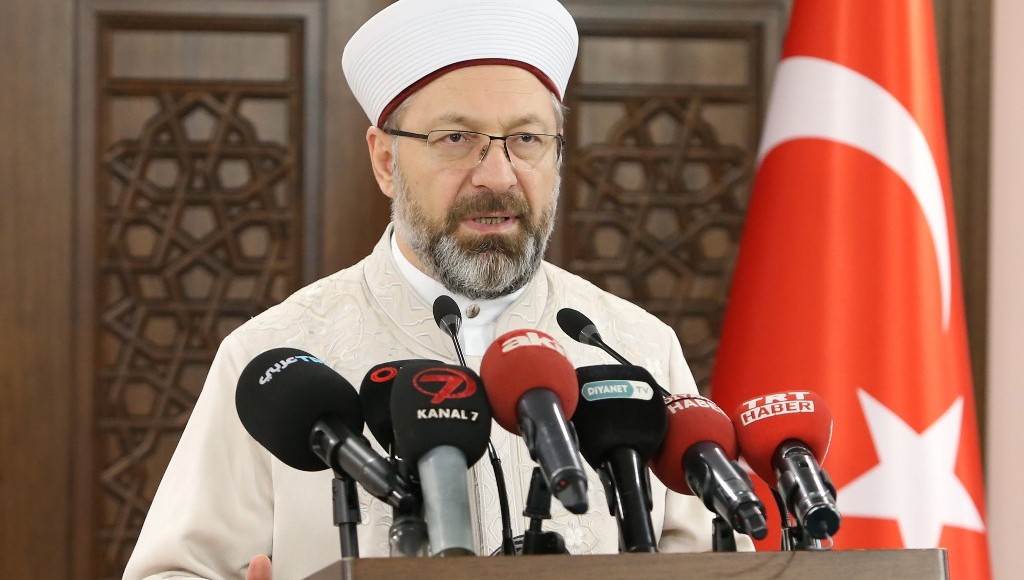
, leaving behind a period defined by heated debates over sermons, symbolism and spending that pushed the institution further into the political spotlight.)
Professor Ali Erbaş has ended his eight-year tenure as head of Turkey’s Religious Affairs Directorate (Diyanet), leaving behind a period defined by heated debates over sermons, symbolism and spending that pushed the institution further into the political spotlight.
Initially appointed in 2017 and reappointed in 2021, Erbaş was accused of blurring the line between religion and politics, prompting backlash from women’s groups, lawyers and rights advocates.
His sermons often sparked outrage. In April 2020 he claimed Islam “curses homosexuality,” linking it to HIV and AIDS. Bar associations and rights groups condemned the remarks as hate speech, while the directorate defended them as religious warnings. In July 2024 he declared that modest attire was “a command of God, not a personal choice.” The following year, he called short or transparent clothing “haram” and described those who wore them as “clothed yet naked.” Feminist writer Berrin Sönmez publicly removed her headscarf in protest, warning of a drift toward compulsory dress codes.
In August Erbaş reignited controversy by opposing changes to Quranic inheritance rules, which grant sons twice the share of daughters, saying altering them without consent violated “divine justice.” Women’s groups said drawing parallels with Turkey’s civil code undermined equality under secular law.
He also declared cigarettes “haram” in 2019, expanding the institution’s reach into public health. Critics said this was beyond its mandate, while supporters framed it as a moral warning.
Symbolism and politicization
Erbaş’s tenure was marked by symbolic acts that critics saw as politicizing religion. In 2020 he delivered the first sermon at Hagia Sophia with a sword in hand, warning against violating a foundation’s will. Many saw the act as an indirect jab at Mustafa Kemal Atatürk, who had converted the site into a museum in 1934, though Erbaş denied the interpretation.

He also attracted criticism for appearing alongside President Recep Tayyip Erdoğan and the head of Turkey’s Supreme Court of Appeals during the opening of the judicial year in 2021, where prayers were held in a setting critics said violated secular principles.
The Diyanet faced further backlash when Atatürk’s name was omitted from sermons on national holidays, including this year’s Victory Day. The institution later issued statements honoring him, but opposition parties accused it of distancing itself from republican values.
Spending, privileges and nepotism
Erbaş frequently faced scrutiny over his use of public resources. His official use of a luxury Audi A8 during an economic crisis sparked outrage, though he later returned it under austerity rules.
This year, reports that he and his wife received luxury services during the Hajj — including personal staff flown from Ankara — drew accusations of hypocrisy. The directorate was also criticized for allowing family members of senior officials to bypass the Hajj lottery system.
Opposition figures talked about nepotism, citing the appointment of his brother-in-law as an adviser who retired without working and his son-in-law’s appointment as a mufti despite lacking qualifications.
Extravagant spending on luxury conferences, overseas trips and reprints of his newspaper columns fueled criticism. Under his leadership, the directorate’s budget — already larger than many ministries — grew rapidly.
He was replaced by Professor Safi Arpaguş, the provincial mufti of İstanbul.
Mission of the Religious Affairs Directorate
The Religious Affairs Directorate was established in March 1924, on the order of Atatürk, as a body attached to the prime ministry, at a time when Turkey had a parliamentary system of governance.
Its duties include overseeing matters related to Islamic belief, worship and morality, informing the public on religion and managing places of worship. In July 2018 it was placed under the presidency after Turkey’s switch to the presidential system of governance.
Article 136 of Turkey’s constitution stipulates that the directorate must act “in accordance with the principle of secularism, remaining outside all political views and ideas, aiming at national solidarity and integration and carrying out the duties assigned to it by its special law.”
The body is responsible for the construction of mosques and the appointment of salaried imams in Turkey. Through the state-run Diyanet Foundation, it also oversees mosque projects abroad.
According to the Court of Accounts’ 2023 audit report, the directorate employed 140,859 people that year. Its 2025 budget is about 130.2 billion lira ($3.1 billion).