
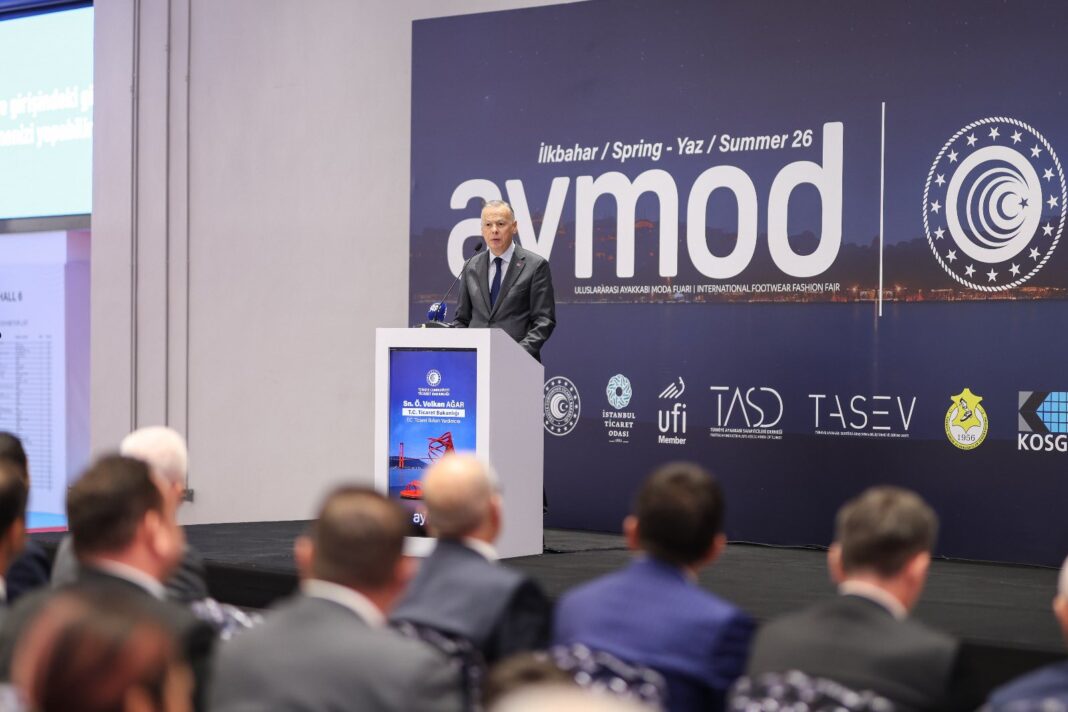

The head of Turkey’s footwear industry group urged the government to adopt a “Trump model” trade policy to counter a surge in imports, warning that domestic producers are being squeezed by rising costs and uncontrolled e-commerce shipments.
Speaking at the opening of the 73rd International Footwear Fashion Fair (AYMOD), held in İstanbul September 2–5, Berke İçten, president of the Footwear Industrialists’ Association of Turkey (TASD), said one out of every three pairs of shoes sold in the country is now imported. He argued that Turkey needs stronger protective measures, similar to those used by US President Donald Trump, to restore balance in foreign trade.
The overall picture at the fair reflected his concerns. Participation was visibly weaker than in previous years, with high production costs, a surge in imports and the upcoming MICAM trade show in Italy all weighing on attendance. The event opened with 252 companies, including 35 from abroad, across four halls covering 40,000 square meters.
Organized by TASD’s exhibition subsidiary, AYMOD brings together more than 500 companies and thousands of brands. Visitors can view collections ranging from men’s, women’s and children’s shoes to handbags and leather accessories. Established 36 years ago, AYMOD is Turkey’s largest and longest-running footwear trade fair.
Speaking at the opening ceremony İçten stressed the fair’s role in international competition. He also noted that in the last two editions, AYMOD has coincided with Italian trade shows, which he described as part of the global rivalry in the sector.
On trade performance, İçten recalled that the industry had recorded a surplus in 2021 and 2022, but the trend reversed in 2023. He said exports fell from a record 377 million pairs in 2022 to 240 million pairs worth $1.16 billion in 2024. Imports, meanwhile, climbed to 76 million pairs valued at $1.71 billion. Around 10 percent of last year’s imports — some 8 million pairs — arrived through China-based e-commerce platforms. The sector posted a $550 million trade deficit in 2024, with a further $437 million gap in the first seven months of 2025.
Addressing cost pressures, İçten pointed out that while a pair of shoes costs about $12 to make in Indonesia or Vietnam, the figure rises to $20 in Turkey. Of the $8 difference, $4–5 comes from overhead and labor, with the rest from raw materials and components. He argued that labor costs cannot realistically be reduced but that duty on key materials such as uppers and soles — many of which are not produced domestically — should be eased. Duty above 100 percent, he said, undermines competitiveness.
İçten also described China-based e-commerce platforms as a major challenge and drew attention to widespread unregistered production in the domestic market. He estimated that about 40 percent of shoes sold in Turkey are counterfeit or off-the-books, creating unfair competition and depriving the state of at least $1 billion in annual tax and social security revenue. He called for urgent measures to curb these practices.
Looking ahead, İçten said AYMOD remains a hub for new business ties. This year the fair is hosting 600 brands from 250 companies, with around 15,000 visitors and buyers expected from 60 countries. TASD has covered the travel and accommodation costs of more than 600 foreign buyers, while over 20 companies from the US and Canada are taking part in business-to-business meetings.
Deputy Trade Minister Özgür Volkan Ağar also addressed the opening, saying that AYMOD improves Turkey’s global brand value. He noted that the ministry continues to support the fair by covering half of booth and rental costs and provided around 70 million lira in subsidies for the two editions held in 2024.