
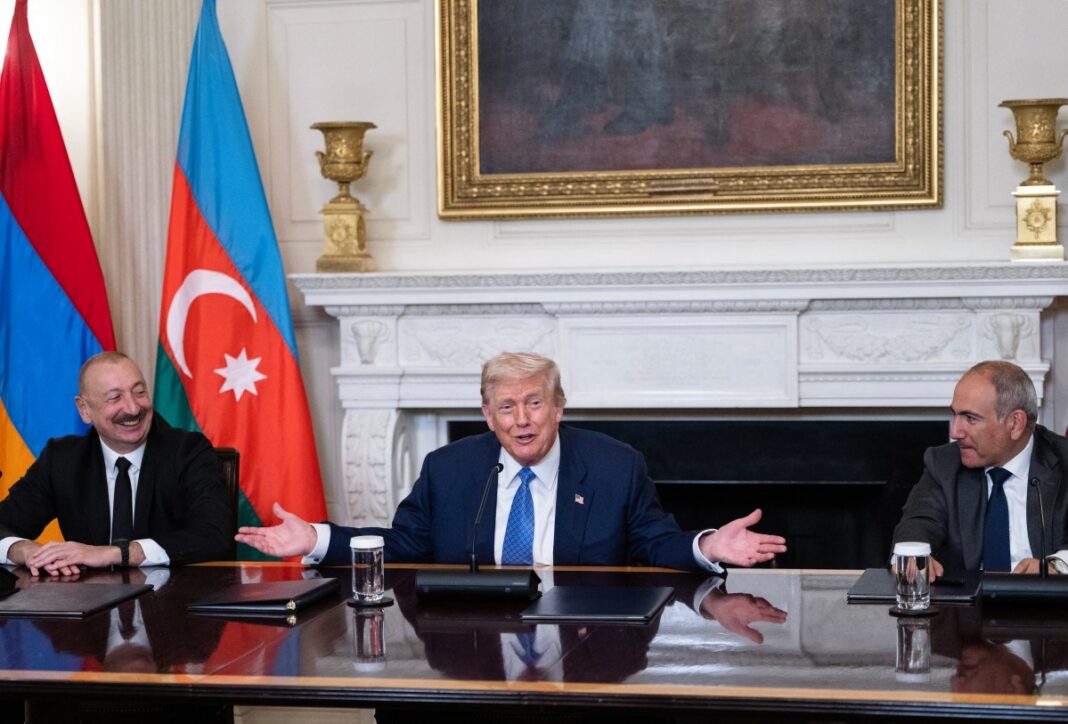

Turkey has welcomed a US-brokered declaration between Azerbaijan and Armenia that both sides say could pave the way for a formal peace treaty and open a strategic transport corridor linking the Caspian to Turkey and Europe.
President Recep Tayyip Erdoğan on Saturday congratulated Azerbaijani President Ilham Aliyev for his role in the peace process during an August 9 phone call, according to official readouts. The two leaders also discussed bilateral ties and regional developments.
Aliyev praised Erdoğan’s support and said the planned link between Azerbaijan and its Nakhchivan exclave would “boost prosperity across the entire region.” Erdoğan reaffirmed Turkey’s commitment to “standing by brotherly Azerbaijan” and to regional stability.
Earlier, the Turkish Foreign Ministry described the declaration as “a historic opportunity” for peace in the South Caucasus, saying the political will shown in Washington comes “at a time when global conflicts are escalating.” Ankara also thanked the US for its mediation.
The announcement, made this week at the White House, is seen as a potential turning point for trade, energy and security in the South Caucasus. It commits both countries to halting hostilities, reopening transport links and working toward full normalization of relations. Armenia and Azerbaijan have fought multiple wars since the late 1980s, most recently in 2020 and again in 2023, when Azerbaijani forces regained control of Karabakh.
Washington summit unveils TRIPP corridor
On August 8, US President Donald Trump hosted Aliyev and Armenian Prime Minister Nikol Pashinyan at the White House, where they signed a joint declaration confirming a draft peace deal. A formal treaty awaits constitutional amendments in Armenia, whose charter still contains territorial claims against Azerbaijan.
The summit also unveiled the “Trump Route for International Peace and Prosperity” (TRIPP) — a 43-kilometer corridor through southern Armenia connecting Azerbaijan with Nakhchivan. Under a 99-year renewable agreement, US companies will develop and manage the route, which could carry road, rail and potentially energy pipelines. Trump, who lifted US military sanctions on Baku, said he was “honored” to have the corridor bear his name.
While the declaration is not a legally binding treaty, it marks a significant diplomatic step toward normalizing ties. The two countries remain technically at war, and the core dispute over Nagorno-Karabakh is unresolved.
Why it matters
The TRIPP corridor would bypass Iran and Georgia, cutting travel time between Turkey and Azerbaijan and improving Turkey’s access to Central Asia. EU officials say it could diversify energy supplies away from Russia, with potential for oil and gas pipelines to run alongside the transport links. The plan would also mark the end of the decades-old OSCE Minsk Group mediation process.
Analyst Mehmet Akif Koç says Ankara supports opening the corridor, Iran opposes it and Russia — while not in favor — has stopped openly resisting. He warns that a stronger US role would tilt the balance against Tehran and Moscow, likely prompting them to seek ways to undermine the project.
Koç describes Pashinyan’s government as politically fragile and urges Baku and Ankara to avoid actions that could weaken him. He also points to Azerbaijan’s growing ties with US pro-Israel lobbying groups, which he says have influenced Washington’s stance. Iran has voiced alarm, warning that the corridor could create a long-term security vulnerability on its northern border.
What’s next
The corridor’s future depends on Armenia passing constitutional amendments, finalizing security arrangements and attracting investment. Construction timelines have not been set, but regional analysts say implementation could begin within two years if political hurdles are cleared.
Erdoğan’s office said Turkey “will continue to contribute to efforts to realize this opportunity and support the devoted efforts of brotherly Azerbaijan.” If completed, the TRIPP corridor could reshape trade and energy flows across the South Caucasus, creating new opportunities — and new tensions — in one of the world’s most contested regions.