
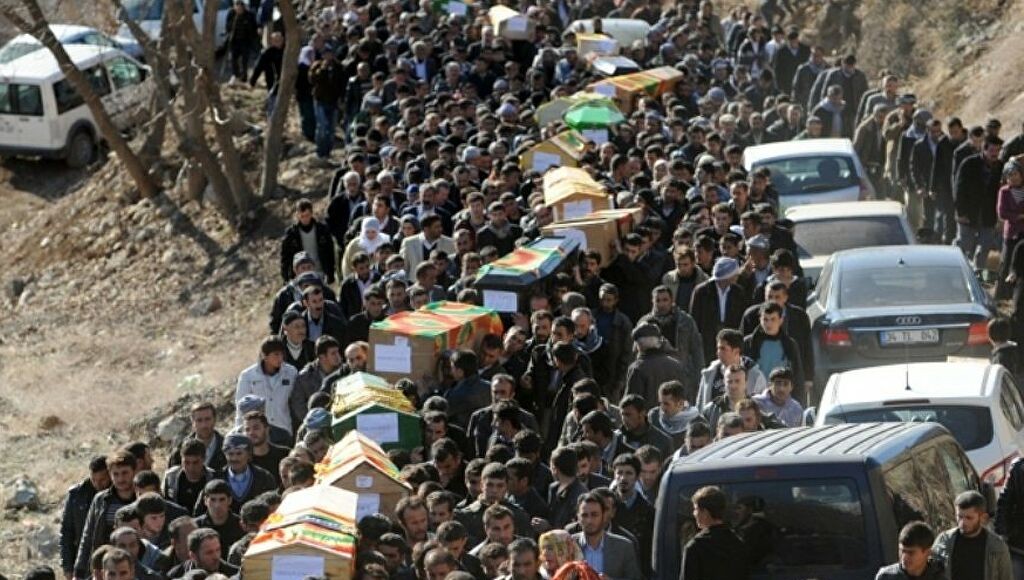

Retired Gen. Akın Öztürk, a former commander of the Turkish Air Force who is being retried for allegedly leading a coup attempt in 2016, told an Ankara court this week that he knows the identity of the official who approved the 2011 Uludere airstrike in which 34 Kurdish villagers were killed but said he would reveal the name “when the time is right.”
Turkey survived an abortive putsch in 2016 that killed over 250 people and wounded more than a thousand. Immediately after the failed attempt, the government along with President Recep Tayyip Erdoğan pinned the blame on the faith-based Gülen movement. The movement strongly denies any involvement in the coup attempt.
The late Islamic scholar Fethullah Gülen, whose views inspired the movement, was cited as the prime suspect in the coup indictment, while Öztürk is listed as the second suspect.
Öztürk’s announcement came during two days of testimony at the Sincan Prison courthouse on Monday and Tuesday, where the coup trial is being reheard following a partial reversal by the Supreme Court of Appeals. The 71-year-old is already serving multiple life sentences for what prosecutors describe as his role as the leader of the coup. He denies the charge and says he followed orders from then–chief of general staff Hulusi Akar throughout the night of July 15, 2016.
What happened at Uludere
The airstrike that Öztürk referenced took place on December 28, 2011 near the village of Ortasu in the Uludere district of Turkey’s Şırnak province. Two Turkish F-16s targeted a cross-border mule convoy that the military said looked like a Kurdistan Workers’ Party (PKK) infiltration column. The attack killed 34 men and boys, most of them high-school students who trafficked diesel fuel, cigarettes and sugar from northern Iraq into Turkey.
Turkey’s General Staff acknowledged the civilian deaths the next morning and said the strike was based on intelligence indicating a likely PKK movement. Subsequent investigations by parliament, the military prosecutor’s office and the Constitutional Court failed to bring any commander to trial. Families of the victims rejected state compensation, called the payments “blood money,” and took the case to the European Court of Human Rights. The Strasbourg court ruled the petition inadmissible in 2014, saying domestic remedies had not been exhausted.
During Tuesday’s hearing Öztürk recounted media reports that have tried to link him to Uludere since his 2016 arrest. He reminded judges that in December 2011 he was a three-star general commanding air force training units in İzmir, far from the Iraqi border. He commanded no armed squadrons at the time and had no role in real-time operations.
“Uludere did not fall under my authority,” he said. “I know who gave the order, but not now; I will say it when the time comes.”
Öztürk referred to the air force’s daily operation logs and claimed they record both the official order and another senior commander’s objection.
When the bombs fell in 2011, Turkey’s defense minister was İsmet Yılmaz and the interior minister was İdris Naim Şahin. Then-chief of general staff Necdet Özel signed off on the official investigation that concluded the strike was a “mistake of identification.” Yaşar Güler, now defense minister in then-prime minister and current President Recep Tayyip Erdoğan’s cabinet, was at the time head of intelligence at the General Staff and later became land forces commander.
Öztürk introduced Uludere while arguing that Turkey’s military leadership needed a scapegoat after the coup night. He says some generals “chose me as the sacrifice” to protect their careers and relationships with the ruling Justice and Development Party (AKP). He added that the same senior officers “shifted blame” for Uludere onto lower-ranking personnel in 2011.
He singled out Akar, now an AKP lawmaker, Defense Minister Yaşar Güler and former air force chief Abidin Ünal, accusing them of “putting everything on my shoulders.” Öztürk demanded their appearance in court and said he would waive any complaint about his nine-year detention if Akar and Güler would “come here and tell the truth.”
Öztürk’s lawyers asked the Ankara 17th High Criminal Court to summon Akar, Güler, Ünal and six other high-ranking officials as witnesses and to admit unedited security camera and flight-tracking footage into evidence. The presiding judge refused. Defense counsel then filed a motion for the panel of judges to recuse themselves, arguing that the refusal violated both Article 201 of Turkey’s Code on Criminal Procedure, which guarantees a defendant’s right to cross-examine, and a 2024 United Nations working-group opinion that called Öztürk’s detention arbitrary and requested his release.
The court denied the motion. The panel adjourned the coup retrial until September 17, when it will continue to hear defense witnesses. Öztürk, meanwhile, remains in Sincan Prison.