
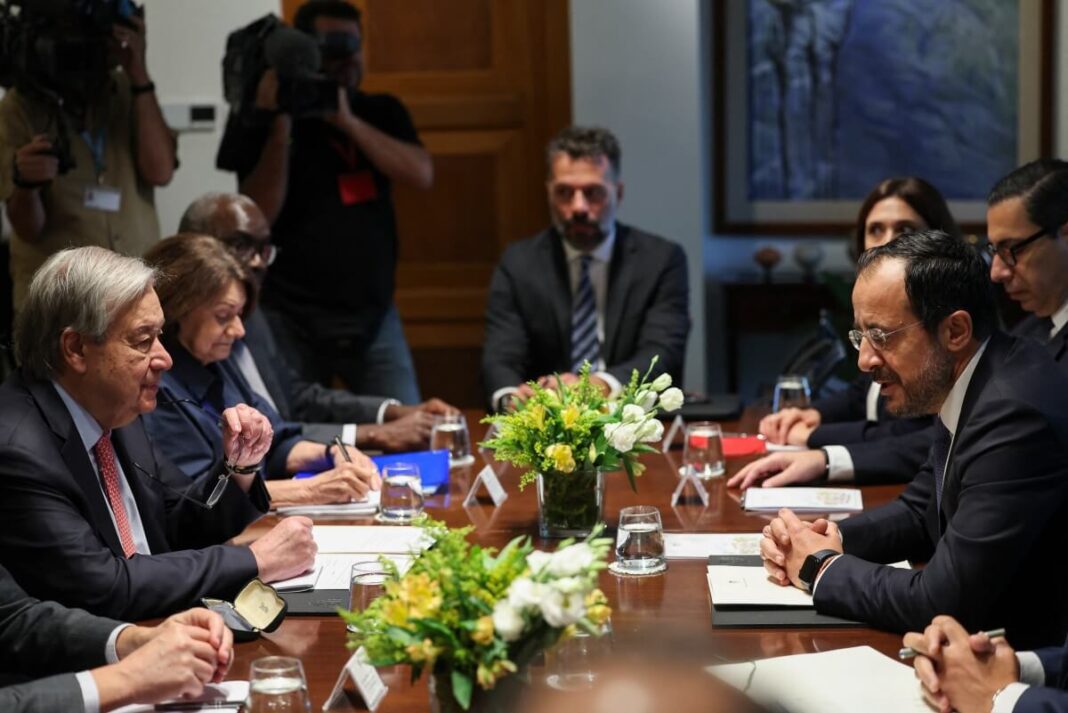

UN Secretary-General Antonio Guterres met separately with the Greek and Turkish Cypriot leaders on Tuesday in an effort to revive negotiations nine years after the last round collapsed, although the parties remain divided over whether a settlement should create a federation or two separate states.
Guterres’ first visit to Cyprus as UN chief comes amid cautious optimism following the election of Turkish Cypriot leader Tufan Erhürman, who favors a federal settlement but says talks should resume only after agreement on political equality and safeguards against another open-ended process.
It is the first visit to the divided Mediterranean island by a UN secretary-general since Ban Ki-moon traveled there in 2010.
“I have just landed in Cyprus to express my commitment to support for Cypriot communities in the search for a comprehensive and sustainable settlement of the Cyprus issue,” Guterres said on X.
“The UN cannot impose peace. Only Cypriots, through their leaders, can build it.”
I have just landed in Cyprus to express my commitment to support for Cypriot communities in the search for a comprehensive & sustainable settlement of the Cyprus issue.
The @UN cannot impose peace.
Only Cypriots, through their leaders, can build it.
— António Guterres (@antonioguterres) July 27, 2026
Guterres first met with Republic of Cyprus President and Greek Cypriot leader Nikos Christodoulides before crossing the UN-controlled buffer zone for talks with Erhürman in the Turkish Cypriot north of the divided capital of Nicosia.
He was also scheduled to meet with civil society representatives before hosting the two leaders for dinner Tuesday evening. The three will hold joint talks Wednesday, followed by a statement to the press.
Cyprus has been divided since 1974, when Turkey invaded the island’s north following a coup engineered by Greece’s then-ruling military junta and aimed at uniting Cyprus with Greece. Turkish forces subsequently took control of roughly a third of the island.
The internationally recognized Republic of Cyprus exercises effective control over the predominantly Greek Cypriot south and represents the island in the European Union. The breakaway Turkish Cypriot administration in the north is recognized only by Turkey.
Decades of UN-backed negotiations have failed to reunify the island. The last major round collapsed in Crans-Montana, Switzerland, in July 2017.
Christodoulides wants negotiations to resume from where they ended in 2017 under the UN-backed model of a bizonal, bicommunal federation.
Erhürman also supports a federal settlement but has said he will not enter another open-ended process without prior agreement on Turkish Cypriot political equality and the rules governing the negotiations.
Sources close to the Turkish Cypriot administration said they were “cautiously optimistic” about the meetings.
Christodoulides and Erhürman held their first meeting in December in the presence of Guterres’ personal envoy for Cyprus, María Angela Holguín, signaling a renewed commitment to efforts to revive the peace process.
Holguín met both leaders Monday ahead of Guterres’ arrival.
“The mission of the secretary-general is to facilitate, encourage the people and the leaders to look forwards to a negotiation. … I hope we can have some progress,” she said.
Erhürman won a landslide victory in elections in northern Cyprus in October 2025, defeating Ankara-backed incumbent Ersin Tatar, who advocated a two-state settlement.
His election raised hopes of a return to the federal model, although significant differences remain over political equality, security guarantees, territory, property rights and the presence of Turkish troops.
Cypriot government spokesman Konstantinos Letymbiotis described Guterres’ visit as “very important” and expressed hope that it would “serve as the starting point” for negotiations.
He said the UN chief’s personal involvement and developments in EU-Turkey relations could create an opportunity for progress.
Any comprehensive agreement would require the involvement of Turkey, Greece and Britain, the island’s three guarantor powers under the treaties accompanying Cyprus’s independence in 1960.
Turkey’s military presence in the north and Ankara’s demand to retain a guarantor role have been among the most difficult issues in previous negotiations. Greek Cypriots oppose continued Turkish military involvement, while Turkish Cypriots regard Turkey’s guarantees as essential to their security.
Ankara has hardened its position in recent years, with President Recep Tayyip Erdoğan insisting on recognition of two states rather than the bizonal, bicommunal federation endorsed by the United Nations.
Ahead of Guterres’ visit, Holguín met with Turkish Foreign Minister Hakan Fidan in Ankara. Fidan reiterated Turkey’s position that “the most realistic solution to the Cyprus issue lies in the coexistence of the two states on the island.”
© Agence France-Presse