
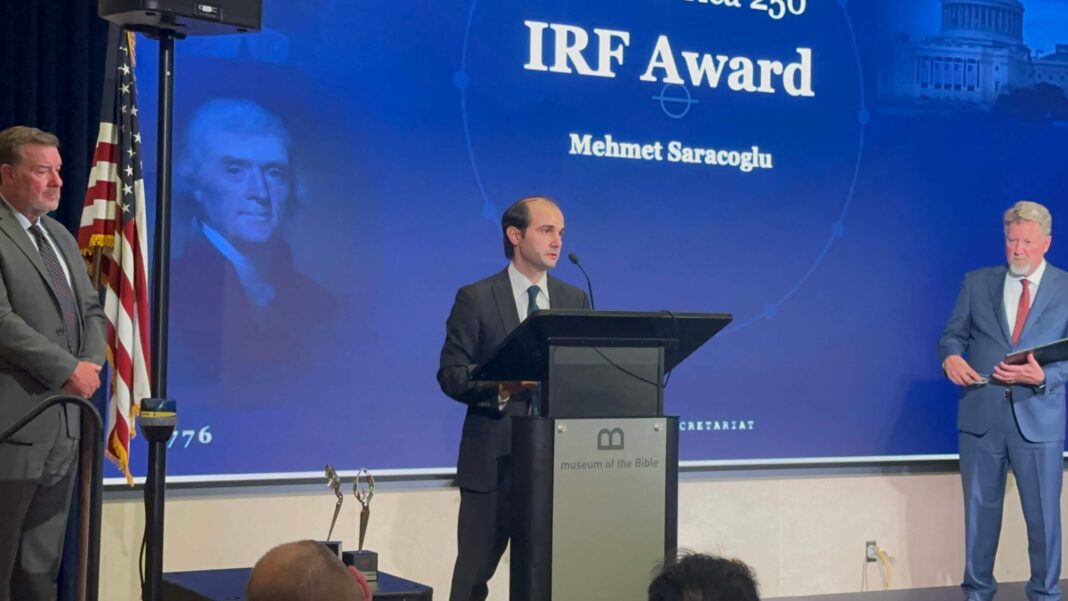

Orhan Sait Berber/Washington, D.C.
A Turkish-American advocate has dedicated a religious freedom award he received in Washington to people imprisoned, forced into exile or separated from their families during Turkey’s decade-long post-coup crackdown.
Mehmet Saraçoğlu, government relations director at the National Council on Civil Advocacy (NCCA), received the America 250 IRF Advocate Award at the 2026 IRF Peace Builders Forum & Awards Dinner, an international religious freedom gathering held in Washington, D.C., on July 16 and 17.
The NCCA is a Turkish-American advocacy group that promotes human rights, democracy and the rule of law in Turkey. The organization says its founders and many of its supporters are inspired by the faith-based Gülen movement, also known as the Hizmet movement.
The two-day forum was organized by the IRF Secretariat in partnership with the Good Faith Partnership and the Alliance of Virtue. It brought together policymakers, civil society leaders and religious freedom advocates to discuss global challenges to freedom of religion or belief.
Accepting the award, Saraçoğlu, who has worked for some two decades in interfaith dialogue, community organizing and religious freedom advocacy, said he viewed it not as a personal achievement but as recognition of years of collective work by colleagues, faith leaders and human rights defenders.
“As we mark the tenth anniversary of the July 15, 2016, attempted coup in Turkey, I would like to dedicate this award to the countless individuals who have been persecuted, imprisoned, exiled, separated from their families, or lost their lives during the sweeping crackdown that followed,” he said.
Much of Saraçoğlu’s advocacy has focused on people targeted following the abortive coup.
The coup left 251 people dead and nearly 2,200 wounded. The Turkish government accuses the Gülen movement, inspired by Muslim cleric Fethullah Gülen, who died in the US in 2024, of orchestrating the coup and designates it as a terrorist organization.
The movement strongly denies involvement in the coup or any terrorist activity. Neither the United States nor the European Union lists it as a terrorist organization.
“Their courage reminds us why this work matters,” Saraçoğlu said. “Their stories call on us to remain steadfast in defending the fundamental right of every person to believe, worship, associate peacefully and live according to their conscience without fear.”
The crackdown Saraçoğlu referred to began under a two-year state of emergency imposed after the failed coup and has continued through mass investigations and prosecutions targeting alleged members of the movement.
Since the coup the Turkish government has dismissed around 120,000 civil servants by emergency decree, while some 24,000 members of the armed forces have been expelled from the military. Hundreds of media outlets, schools, universities, associations and businesses were also closed or seized.
Justice Minister Akın Gürlek said earlier this month that 720,338 people had been investigated on terrorism-related allegations over purported links to the movement. Of those 127,102 were convicted and 124,743 acquitted, while prosecutors issued decisions of non-prosecution concerning 373,594. Investigations or trials involving another 83,404 remain underway.
Saraçoğlu also talked about two campaigns conducted through the IRF Roundtable, beginning with advocacy surrounding a case widely known as Turkey’s “Girls’ Trial.”
The case arose from police operations in İstanbul in May 2024 targeting teenage girls, female university students and mothers over alleged links to the Gülen movement. Prosecutors cited activities such as attending religious study groups, staying in shared apartments, meeting at shopping malls, going to the movies, bowling and ordering food as evidence of an alleged terrorist network.
The trial involved 41 defendants. In September 2025 the İstanbul 24th High Criminal Court convicted 11 defendants of membership in an armed terrorist organization and eight of aiding a terrorist organization. Nineteen were acquitted, while proceedings involving the remaining three defendants were handled separately.
International observers and rights advocates criticized the case as an example of Turkey’s use of counterterrorism laws to criminalize ordinary religious, educational and social activity. All defendants held in pretrial detention had been released by April 2025, before the verdict.
Saraçoğlu said the international campaign produced five multi-faith advocacy letters bearing more than 1,000 signatures and prompted sustained engagement with members of Congress, the US administration and the international religious freedom community.
He said the campaign contributed to the release of the detained defendants and brought international attention to the prosecution of peaceful religious and civic activity.
Saraçoğlu also cited advocacy on behalf of Ali Ünal, an Islamic scholar, Qur’an translator and former columnist for the now-closed Zaman newspaper who has been imprisoned since 2016.
Ünal was sentenced in 2018 to 19-and-a-half years on a charge of establishing and leading an armed terrorist organization due to his alleged links to the Gülen movement.
The UN Working Group on Arbitrary Detention concluded in 2023 that his detention was arbitrary and called for his immediate release.
Saraçoğlu said advocates had worked through the IRF Summit, the IRF Roundtable’s Prisoners of Conscience Working Group and engagement with members of Congress to keep Ünal’s case and those of other prisoners on the international agenda.
Saraçoğlu, who also serves as co-chair of the IRF Roundtable’s Congressional Working Group, said sustained bipartisan engagement was essential to advancing religious freedom.
“Progress is rarely immediate, but every meeting, every letter, every statement and every act of solidarity remind those suffering persecution that they are not alone,” he said.
Referring to Chinese pastor Ezra Jin Mingri, who attended the ceremony after previously being imprisoned for his faith, Saraçoğlu said the pastor’s presence showed that sustained advocacy could produce tangible results.
“My hope is that next year we will celebrate the freedom of even more prisoners of conscience, including Ali Ünal from Turkey,” he said.
Saraçoğlu concluded by thanking the organizers and his family and urging advocates to continue working toward a world where religious freedom is “not simply an aspiration but a reality for all.”
A graduate of İstanbul Technical University and the University of Kentucky, Saraçoğlu previously held several leadership positions at the Rumi Forum and currently directs its Center for Faith, Identity and Globalization.