
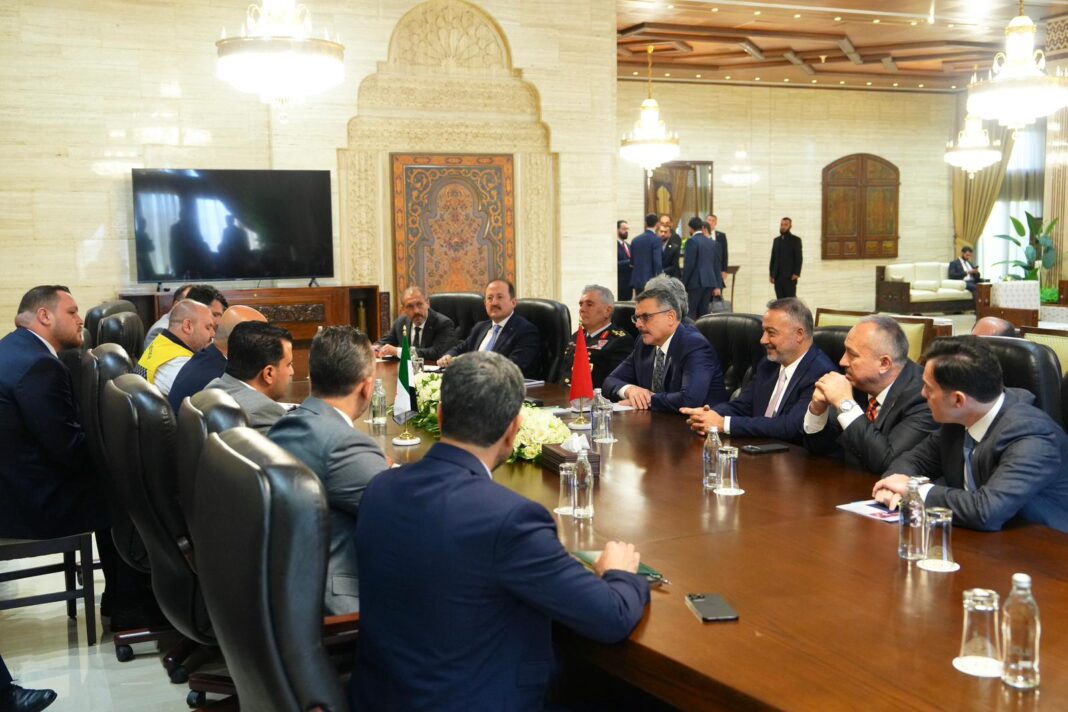

Turkish Interior Minister Mustafa Çiftçi visited Damascus on Tuesday for talks with Syrian officials on security, migration, police training and disaster response, marking another step in Ankara’s outreach to Syria’s new government after the fall of Bashar al-Assad.
Çiftçi and his delegation were received at Damascus International Airport by Syria’s deputy interior minister and officials from the International Cooperation Directorate, Turkey’s state-run Anadolu news agency reported.
Çiftçi later met with Syrian Interior Minister Anas Khattab at Tishreen Palace in Damascus.
The meeting covered cooperation between Turkey and Syria on security, public order and the development of Syrian state capacity, according to Anadolu.
The two sides discussed electronic traffic enforcement systems, license plate recognition, fingerprint technology, passport and identity document production and security equipment.
They also discussed setting up a 112 emergency call and ambulance network, sharing experience in counter-narcotics work and training Syrian police officers.
Turkey’s delegation included Gendarmerie General Commander Gen. Ali Çardakcı, National Police Chief Ali Fidan, Migration Management President Muhammed Selami Yazıcı and Disaster and Emergency Management Authority (AFAD) President Ali Hamza Pehlivan.
Syria was represented by Deputy Interior Minister Abdulqadir Tahan, Deputy Minister for Administrative and Financial Affairs Basim al-Mansour, Deputy Human Resources Minister Hussam Fattouh, Migration and Passport Department Director Osman Hilal and other officials.
Çiftçi said after the meeting that the talks covered relations between the two countries and their interior ministries, security cooperation, terrorism, drug trafficking, transnational crime, border security, migration and voluntary returns.
He said Turkey could provide technical support to Syrian authorities for the printing of identity cards, driver’s licenses, passports and family records.
A Syrian request for visa facilitation for Syrians seeking to travel to Turkey for education and trade was also raised during the meeting, Çiftçi said.
Çiftçi later met with Syrian Emergency and Disaster Management Minister Raed Salih in Damascus, with the two ministers signing a memorandum of understanding on cooperation in disaster and emergency management.
The visit comes as Turkey seeks closer ties with Syria’s new authorities after 13 years of civil war and the fall of Assad’s government on December 8, 2024.
Ankara backed the Syrian opposition during the war, hosted millions of Syrians who fled the conflict and carried out military operations in northern Syria against Kurdish forces it links to the outlawed Kurdistan Workers’ Party (PKK).
The PKK, which has waged an insurgency against the Turkish state since 1984, is designated as a terrorist organization by Turkey and its Western allies.
Turkey regards the Kurdish-led Syrian Democratic Forces, a US partner against the Islamic State group, as an extension of the PKK.
Çiftçi’s visit came as migration remains one of the main issues in Turkey’s Syria policy.
Çiftçi said Turkey would continue to support the voluntary, safe, dignified and orderly return of Syrians.
He said Ankara expected Syria’s government to develop policies that support and encourage returnees and to address problems they may face, including security and housing.
As stability improves in Syria, returns have gained momentum, Çiftçi said.
He said the returns matter for Syria’s recovery and reconstruction and that Turkey would continue to support a process based on voluntariness and security.
Çiftçi said many Syrians who returned had lost identity documents, family records, housing papers and land ownership documents, adding that legal support for those without documents would encourage returns.
A total of 1,439,228 Syrians have returned from Turkey since 2017, including 699,225 since December 8, 2024, Çiftçi said, adding that Turkey still hosts 2,255,031 Syrians under temporary protection.
He stressed that returns are voluntary. “We are not forcibly sending back any of our Syrian brothers,” Çiftçi said.
The Turkish government has faced pressure at home over the number of Syrians in the country, where refugee returns have become an issue in elections and domestic politics.
Rights groups have in the past raised concerns about coerced returns from Turkey.
Turkey says improved conditions in Syria are needed for Syrians to return and has called for Syria’s territorial integrity, reconstruction and state institutions to be strengthened.