
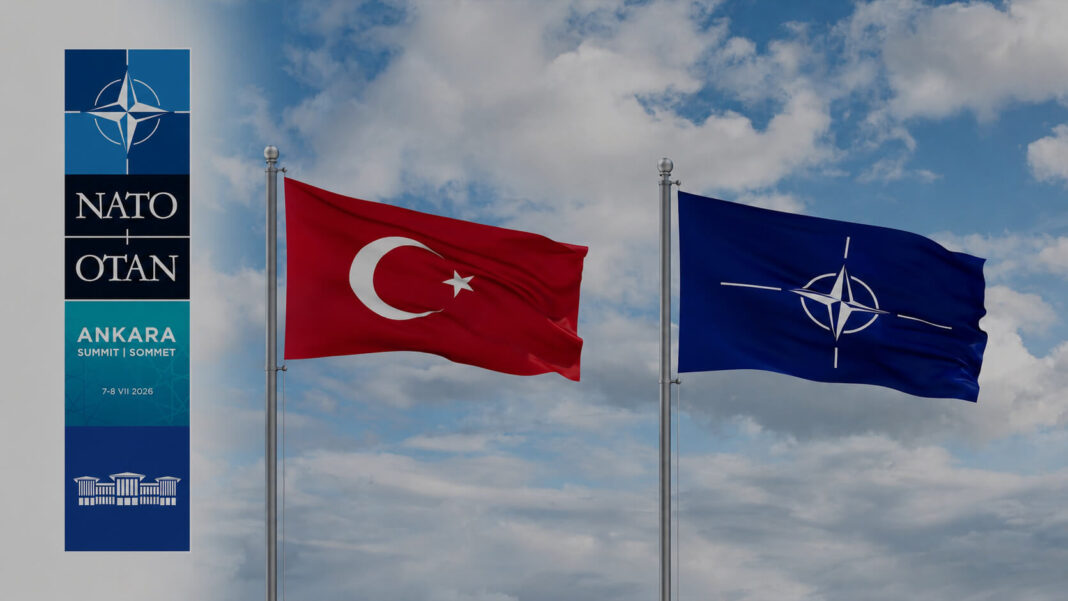

NATO said Thursday it relies on host countries for assessments of local journalists at summits held outside its headquarters, as Turkish press groups, rights advocates and opposition politicians criticized the refusal to accredit some Turkish media outlets and journalists for the alliance’s upcoming summit in Ankara.
The statement added to questions over whether Turkish authorities played a role in the rejection of applications from independent and critical Turkish media organizations.
The NATO summit is scheduled to take place in the Turkish capital on July 7-8.
NATO spokesperson Allison Hart said on X that the alliance has “long-standing media accreditation procedures for major events” and relies on the host country to provide assessments on journalists from that country for summits and ministerial meetings held outside NATO headquarters.
“We are in contact with Turkish authorities on accreditation for the NATO Summit in Ankara,” Hart said, adding that it was “very important for NATO that media can attend major events in person.”
NATO has long-standing media accreditation procedures for major events. For summits and ministerial meetings held outside NATO Headquarters, NATO relies on the host nation to provide assessments on journalists from their country to ensure access to the meeting site. We are in…
— NATO Spokesperson (@NATOpress) June 25, 2026
Her statement came after several Turkish media outlets and journalists said their applications to cover the summit had been rejected by NATO without explanation.
The outlets whose applications were rejected include İlke TV, the Cumhuriyet daily, NOW TV and Medyascope, İlke TV reported on Wednesday.
Opposition lawmaker Turhan Çömez later said in a parliamentary question that Halk TV, Sözcü, BirGün, Evrensel, Nefes, the Anka news agency, T24 and YetkinReport, run by journalist Murat Yetkin, were also among outlets whose applications were reportedly denied.
The rejection notices were sent by email by NATO Accreditations, part of the alliance’s Office of Strategic Communications. The message did not give a reason for the refusal.
“I regret to say that your request for media accreditation cannot be granted this time. I cannot discuss the reasons for this decision, which is final,” the email said.
Turkey’s Press Council on Thursday condemned what it called NATO’s “unacceptable bans and accreditation restrictions” on media outlets and journalists seeking to cover the summit and urged the Turkish government to take action.
“These bans are also contrary to the principles of democracy and the rule of law that NATO has always defended. We expect Turkish authorities to take action before NATO to reverse this mistake as soon as possible,” it said in a statement on X.
Ülkemizde 7-8 Temmuz 2026 tarihlerinde düzenlenecek NATO zirvesi, güvenlik ve askeri işbirliği kararlarından çok medyaya getirilen yasak ve akreditasyon sınırlamalarıyla gündeme gelmiştir. NATO'nun Ankara'daki toplantıyı izlemek isteyen medya kuruluşlarına ve gazetecilere…
— Basın Konseyi (@BasinKonseyi) June 25, 2026
Çömez, group deputy chairman of the İYİ (Good) Party, submitted a parliamentary question to Vice President Cevdet Yılmaz about the refusals.
He said media reports showed that many outlets with independent or critical editorial lines had been denied accreditation, while there were claims that pro-government media organizations had not faced similar problems.
He also sought clarification on whether Turkish authorities had any role in the accreditation process and whether the Presidency’s Communications Directorate, the foreign ministry, the interior ministry or any other public institution had sent NATO opinions, assessments or recommendations about media outlets or journalists.
The rejected applicants were told they could follow the public parts of the meeting on NATO’s website and contact the alliance through its website’s contact form with questions about NATO’s work.
Çömez also asked how many media outlets and journalists had been denied accreditation, which outlets were rejected, what criteria were used and whether any appeal or review mechanism had been made available.
He said the exclusion of a large part of the Turkish press from a summit hosted by Turkey raised questions about press freedom, the public’s right to information and transparency.
Reporters Without Borders (RSF) Turkey representative Erol Önderoğlu also criticized the refusals, saying it was hard to understand an accreditation approach that closes the NATO summit to a significant part of the Turkish media.
Önderoğlu said RSF did not accept a procedure that gives no reason for rejection and allows no right of appeal, adding that a transparent process was needed because of the Turkish public’s right to information.
Veteran journalist Deniz Zeyrek also said he had been denied accreditation despite decades of experience covering diplomacy.
“I have been a journalist for 32 years and spent many of those years as a diplomatic correspondent. I have covered numerous NATO meetings and summits, including those held in Washington and Brussels. Unfortunately, due to NATO’s accreditation restrictions, I will not be able to cover the NATO Summit taking place in my own city, Ankara. This shame is yours Allison Hart @NATOpress,” Zeyrek said on X, referring to the NATO spokesperson.
The controversy comes against the backdrop of Turkey’s long-disputed accreditation practices.
The government of President Recep Tayyip Erdoğan has for years been accused of using press accreditation to restrict access for journalists and media outlets seen as critical of the government.
Reporters for opposition and independent outlets have frequently been excluded from official events, presidential programs and government briefings, while press cards have been denied, canceled or left pending for long periods of time.
Press freedom groups say such practices have contributed to an already difficult media environment in Turkey, where most mainstream outlets are owned by companies close to the government and independent journalists face lawsuits, arrest and pressure over their reporting.
The government denies that it targets journalists for their work and says accreditation decisions are made in line with security and administrative rules.
Despite those denials, press freedom groups continue to rank Turkey among the world’s worst-performing countries for media freedom.
Turkey was ranked 163rd out of 180 countries in the 2026 World Press Freedom Index published by Reporters Without Borders, down from 159th place the previous year, with RSF warning that media pluralism in the country is increasingly under threat.
The accreditation dispute also comes amid sweeping security measures in Ankara ahead of the summit.
According to Communications Director Burhanettin Duran, nearly 3,000 journalists, television crews, photojournalists, digital media representatives and international broadcasters from around the world applied for accreditation to cover the summit.
Türkiye, Ankara'da düzenlenecek 36. NATO Zirvesi kapsamında, İttifak üyesi 32 devlet ve hükümet başkanının yanı sıra, çok sayıda davetli lidere, 100'e yakın bakana, birçok üst düzey diplomata, uluslararası kuruluş temsilcilerine ve binlerce yabancı misafire ev sahipliği yapacak.… pic.twitter.com/cQCJVkwqpG
— T.C. İletişim Başkanlığı (@iletisim) June 24, 2026
Duran said the accreditation process was being carried out by NATO, while Turkish authorities had prepared hotels, transportation and a media center in Ankara for accredited foreign journalists.
Meanwhile, the Ankara Governor’s Office has banned all meetings, demonstrations, press statements and protest activities in the city from June 28 to July 10, citing summit security and public order.
Duran also said 56,288 security personnel would be deployed for the summit, including 48,841 police officers and 7,447 gendarmes.
The summit is expected to bring together leaders from NATO’s 32 member states.