
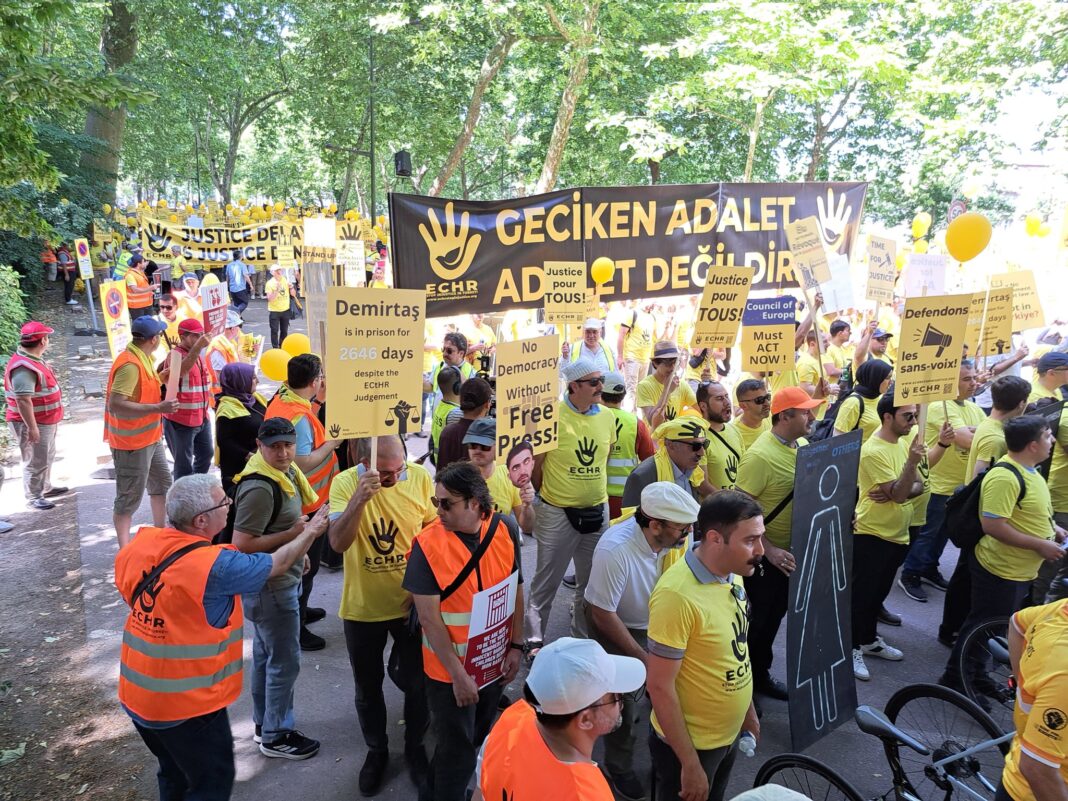
 and the Council of Europe to act over Turkey’s failure to implement rulings affecting thousands of people caught in the country’s post-coup crackdown.)
Rights advocates, purge victims and Turkish expatriates from across Europe are expected to gather in Strasbourg on Wednesday to call on the European Court of Human Rights (ECtHR) and the Council of Europe to act over Turkey’s failure to implement rulings affecting thousands of people caught in the country’s post-coup crackdown.
The demonstration, organized by the Peaceful Actions Platform with the support of 17 civil society organizations, will take place in front of the Council of Europe, the 46-member rights body responsible for supervising the implementation of European court judgments through its Committee of Ministers.
Organizers say the protest will focus on Turkey’s refusal to comply with rulings involving Yüksel Yalçınkaya, a former teacher convicted of terrorism over alleged links to the faith-based Gülen movement; Osman Kavala, a philanthropist and civil society figure imprisoned since 2017; and Selahattin Demirtaş, the jailed former co-chair of the pro-Kurdish Peoples’ Democratic Party (HDP).
The rally is expected to give particular attention to the Gülen movement, which has been the main target of Turkey’s crackdown since a failed coup on July 15, 2016.
Turkish President Recep Tayyip Erdoğan has targeted followers of the movement, inspired by the late Muslim cleric Fethullah Gülen, since corruption investigations in December 2013 implicated him as well as some members of his family and inner circle. He dismissed the probes as a Gülenist conspiracy and later designated the movement as a terrorist organization in May 2016, intensifying a crackdown after the coup attempt, which he accused Gülen of orchestrating. The movement describes itself as a civic initiative focused on education, dialogue and charity and denies involvement in the attempted coup or any terrorist activity. Other governments and major international bodies, including the US and the European Union, do not recognize Turkey’s terrorist designation.
According to the latest figures from Turkey’s Justice Ministry, more than 126,000 people have been convicted for alleged links to the movement since 2016, with 11,085 still in prison. Legal proceedings are ongoing for more than 24,000 people, while another 58,000 remain under active investigation nearly a decade later.
The government also declared a state of emergency after the coup attempt, which remained in effect until July 19, 2018. During that period it purged state institutions through emergency decrees not subject to ordinary judicial or parliamentary scrutiny. More than 130,000 civil servants, including 4,156 judges and prosecutors as well as more than 24,000 members of the armed forces, were summarily removed from their jobs over alleged links to terrorist organizations.
Many dismissed civil servants were also barred from public employment and denied passports, while social security records made it harder for them to find formal work in the private sector. Rights advocates say many were pushed into uninsured jobs, poverty or exile.
The Yalçınkaya case has become central to criticism of Turkey’s mass terrorism prosecutions. In September 2023 the European court’s Grand Chamber found violations of his rights to a fair trial, no punishment without law and freedom of association, saying the case pointed to a systemic problem affecting thousands of similar applications.
The ruling challenged Turkish courts’ reliance on alleged use of ByLock, an encrypted messaging app, as near-automatic proof of membership in the Gülen movement. It also raised questions about convictions based on ordinary acts such as having an account at the now-closed Bank Asya or membership in associations and unions that had operated legally before the coup attempt.
Turkish courts later convicted Yalçınkaya again, a decision rights advocates say showed Ankara’s refusal to apply the Grand Chamber ruling in substance.
Organizers also cite the court’s Yasak ruling, saying it reinforced the principle that no one can be convicted of terrorism on the basis of conduct that was not individually criminal, foreseeable and supported by evidence of personal guilt.
The case concerned Şaban Yasak, who was convicted of membership in a terrorist organization over alleged links to the Gülen movement and was held for years in overcrowded prison conditions.
In May the Grand Chamber of the ECtHR, in Yasak v. Turkey, found that Turkey violated the principle of “no punishment without law” as well as the prohibition of inhuman or degrading treatment.
The ruling is expected to affect hundreds of similar applications pending before the Strasbourg court.
The organizers argue that the Yalçınkaya and Yasak decisions strike at the legal basis of thousands of convictions built on retroactive assumptions rather than acts of violence or direct involvement in a crime.
The Strasbourg program will include a march, the delivery of a letter to the Council of Europe, speeches, victims’ statements and video messages from European politicians, journalists and academics. Organizers say final European court judgments are binding and that Europe’s rights system loses its strength when member states ignore them without consequence.