
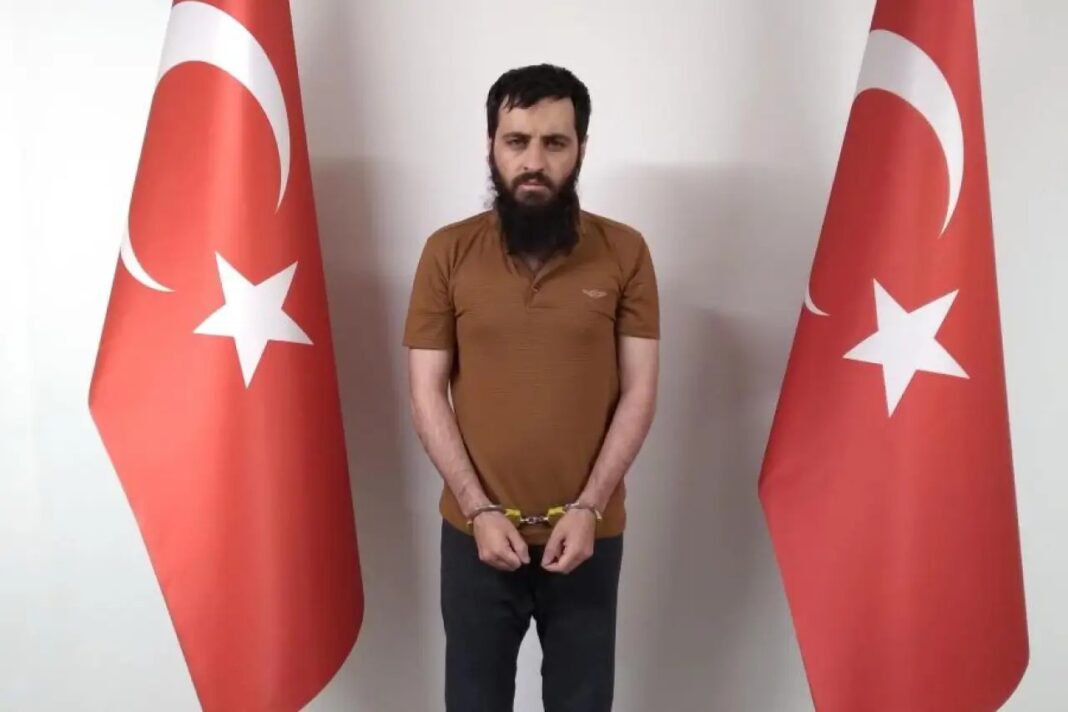
 suspect who was recently captured in Syria and brought to Turkey has claimed in a police statement that the extremist group was in talks with the Turkish government at the time of the 2015 Ankara train station bombing, the deadliest terrorist attack in modern Turkish history, the Evrensel daily reported.)
An Islamic State in Iraq and the Levant (ISIL) suspect who was recently captured in Syria and brought to Turkey has claimed in a police statement that the extremist group was in talks with the Turkish government at the time of the 2015 Ankara train station bombing, the deadliest terrorist attack in modern Turkish history, the Evrensel daily reported.
Ömer Deniz Dündar, also known by the code name “Ammar,” gave the statement to counterterrorism police in Ankara on June 18, seeking to benefit from a Turkish law that allows sentence reductions for suspects who cooperate with authorities.
Dündar is a defendant in the case concerning the October 10, 2015, bombing outside Ankara’s main train station, where twin suicide blasts targeted a Labor, Peace and Democracy rally, killing 104 people and injuring hundreds.
In his statement Dündar said the attack was carried out at the initiative of Yunus Durmaz, ISIL’s Gaziantep chief at the time, without approval or funding from the group’s senior command.
The indictment in the Ankara bombing case identified the suicide bombers as Yunus Emre Alagöz, a Turkish national from the eastern province of Adıyaman whose brother carried out another deadly bombing in the Suruç district of Şanlıurfa province in July 2015, and an unidentified Syrian national.
The Suruç attack killed 33 people, most of them young activists.
The two men traveled from a safe house in Gaziantep the night before the Ankara attack with help from ISIL operatives, according to summaries in the case file.
Dündar claimed that after the bombing, an ISIL official sent senior figures a report explaining which groups had been targeted, but said the attack had not received prior approval or funding from the organization’s higher command.
No organization has ever claimed responsibility for the Ankara train station attack.
According to Dündar, ISIL did not claim responsibility for the bombing because it was engaged in talks with the Turkish government at the time and that ISIL’s leadership later turned against its Gaziantep and Adıyaman networks over the attack.
The bombing drew condemnation from across Turkey’s political spectrum, with the ruling Justice and Development Party (AKP), the main opposition Republican People’s Party (CHP) and the Nationalist Movement Party (MHP) describing it as an attempt to divide the country.
Opposition leaders, however, accused the government of failing to prevent the attack, while the pro-Kurdish Peoples’ Democratic Party (HDP), whose supporters were among those targeted, directly blamed the AKP government.
Dündar said he served under Durmaz from the summer of 2015 until early 2016 and claimed that another ISIL official, identified as Ebu Seyf Mısri, did not authorize or finance the Ankara attack. “The attack took place entirely on Yunus Durmaz’s own decision,” he was quoted as saying.
His claims could not be independently verified.
Alleged plots that were never carried out
Dündar’s police statement also included claims about several ISIL plots that were planned but not carried out.
He claimed that a plan to assassinate Ekrem İmamoğlu, the jailed mayor of İstanbul and a leading opposition figure, was proposed by ISIL figure Mustafa Dokumacı but shelved before any preparations were made.
İmamoğlu, a senior figure in the CHP who is seen as the most powerful political rival of President Recep Tayyip Erdoğan, has been behind bars since March 2025 in a case widely criticized by the opposition and rights groups as politically motivated.
Dündar also claimed ISIL planned an attack on hot air balloons in Cappadocia in central Turkey, but the plan failed after the person assigned to carry it out was detained.
He said the order came from Kasım Güler, an ISIL figure previously captured and brought to Turkey.
According to Dündar’s statement, ISIL also planned to assassinate US pastor Andrew Brunson in the western province of İzmir, but the plan was dropped after Brunson was released and left Turkey.
Brunson, an evangelical pastor who had lived in Turkey for more than two decades, was arrested after a failed coup in 2016 on terrorism-related charges that he denied.
His arrest caused a major diplomatic crisis between Ankara and Washington, prompting the United States to impose sanctions on two Turkish ministers and contributing to a sharp fall in the Turkish lira before Brunson was released in 2018 and returned to the United States.
Dündar further claimed that ISIL planned an attack on an LGBT group over social media posts it viewed as insulting Islam. He said the order came from Dokumacı and that a person who supplied weapons for the planned attack was later detained in İstanbul.
Dündar said he spent about 12 years in ISIL, joining the group in 2013 through a religious discussion group in Adıyaman.
Adıyaman and Gaziantep have appeared in several investigations into ISIL cells in Turkey, including the network linked to the Ankara bombing.
Dündar, who was wanted in Turkey on a terrorism watch list, was captured in Syria and brought to Turkey this year.
Turkish state media reported in May that 10 Turkish citizens accused of ISIL membership and wanted on INTERPOL Red Notices had been detained in a joint operation by the Turkish and Syrian intelligence services, with nine of them brought back to Turkey.
At the time state media said one of the suspects was accused of links to the perpetrators of the Ankara train station bombing.
Dündar is expected to testify at the next hearing of the Ankara bombing trial on June 30.
The case remains a source of deep anger for victims’ families. In April Turkey’s Constitutional Court rejected an appeal filed on behalf of the victims, ruling the application inadmissible.
Lawyers for the families said the ruling ignored possible state negligence and failed to address why public officials were not held accountable despite prior warnings received by police and intelligence agencies before the attack.
In the main trial nine defendants were sentenced to aggravated life in prison on charges including attempting to overthrow the constitutional order, premeditated murder and attempted murder. Nine others received prison sentences on terrorism-related charges. Sixteen suspects remain at large.
Turkey’s Supreme Court of Appeals upheld the life sentences of nine ISIL members in 2024 but confirmed that former intelligence and police officials would not face prosecution after the Ankara Governor’s Office refused to authorize an investigation.
The bombing took place during a period of high political tension in Turkey. Four months earlier President Erdoğan’s AKP had lost its parliamentary majority in the general election.
A fragile peace process with the outlawed Kurdistan Workers’ Party (PKK) collapsed that summer, and attacks by both ISIL and the PKK surged before a repeat election in November 2015.