
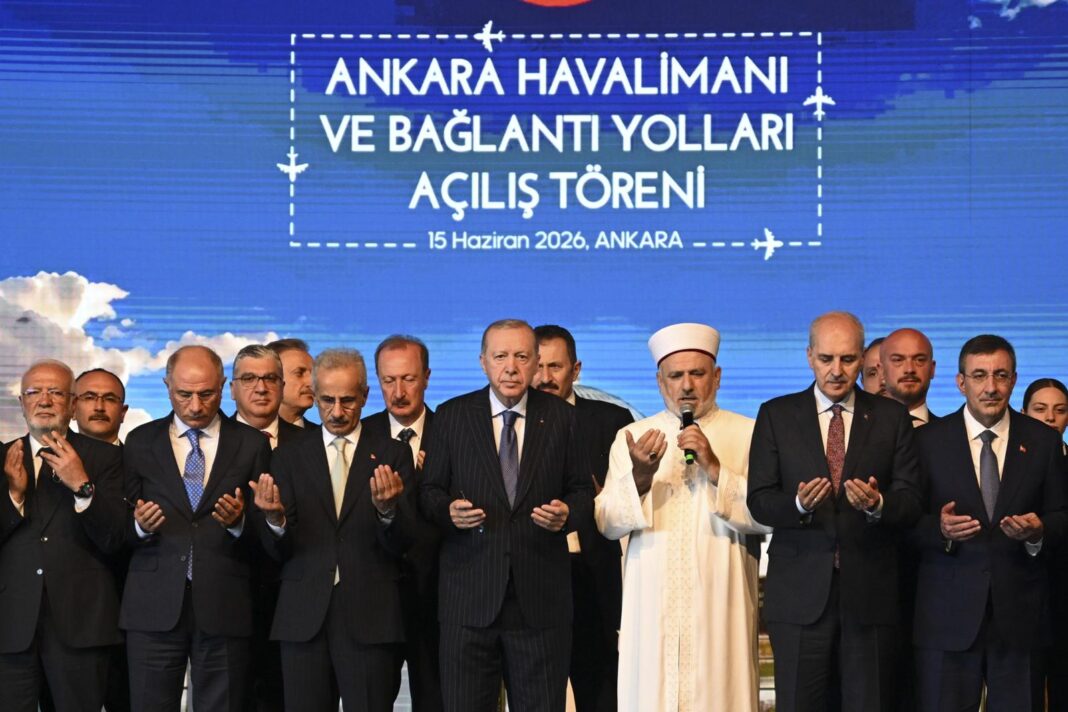

Turkish President Recep Tayyip Erdoğan on Monday inaugurated a VIP airport near his presidential complex in Ankara ahead of next month’s NATO summit, following a multi-billion lira expansion of a former military air base.
The airport, officially named Ankara Airport, was developed through the expansion of the former Etimesgut Military Air Base, which is located about eight kilometers from the presidential complex. While Esenboğa Airport, Ankara’s main commercial aviation hub, is some 25 kilometers away.
The airport is expected to serve foreign leaders and official delegations arriving for the NATO summit in Ankara on July 7-8 and later accommodate state and VIP flights. Turkish media reports said it is also expected to be used by Erdoğan and other senior state officials after the summit.
Transport and Infrastructure Minister Abdulkadir Uraloğlu said the project transformed the military airfield into an international facility capable of handling large passenger aircraft. According to the ministry, the runway was extended from 2,450 meters to 3,000 meters and widened from 42 meters to 60 meters within eight months, which allows wide-body aircraft to land and take off.
The government also built a new 160,000-square-meter apron with capacity for 44 aircraft, a 4,800-square-meter state guesthouse and an open parking area for 310 vehicles.
At the opening ceremony Erdoğan said the airport would strengthen Ankara’s position as a diplomatic center and help ease traffic at Esenboğa Airport, which handled more than 380,000 passengers during the recent Eid holiday period. He also said the project restored a historic airfield that had originally been established as a military aviation center in 1933.
Government officials have put the project’s cost at around 10 billion lira (about $220 million). Public procurement records reviewed by Turkish media show that three contracts awarded through negotiated tenders in 2025 carried a combined value of approximately 9.5 billion lira (around $205 million). The largest items included runway and apron work, new taxiways, the state guesthouse and road connections linking the airport to surrounding areas. The contract for access roads was awarded to SNH İnşaat for 3.97 billion lira (around $85 million), according to procurement documents.
The project also included the construction of the Başkent Havacılık Bridge and 12.5 kilometers of new and upgraded roads. Speaking at the opening ceremony Erdoğan said a dedicated three-kilometer connection road would provide direct access for delegations attending the NATO summit.
The expansion has also drawn attention to the nearby Ankara Sugar Factory complex, which is a state-owned industrial site established in the late 1950s and operational since 1962. The campus previously included worker housing, a research institute, a cinema, a restaurant, a school and sports facilities as part of a broader industrial settlement.
According to Turkish media reports, worker housing within the complex was evacuated in late 2025, with several residential blocks later demolished as part of the airport expansion. Reports also said that B and C housing blocks and other administrative structures were removed during the work. Parts of the complex had previously been subject to a 2021 court-backed protection decision, raising questions about how demolition approvals were issued.
Önder Algedik, an energy and climate policy expert, said on X that the airport was designed primarily for presidential use rather than public transportation needs. He said the runway expansion required the use of land belonging to the Ankara Sugar Factory and claimed that new infrastructure included an access point toward the presidential complex.
Algedik also said public transportation routes in the area were altered or removed as part of the project, warning that residents of nearby districts such as Batıkent and Eryaman could face increased aircraft noise from VIP and diplomatic flights.
“This used to be a military airfield and was used for logistics. But now it’s becoming his personal airfield,” Algedik wrote on X.
The airport will remain under military ownership while being operated by the General Directorate of State Airports Authority (DHMİ) for designated state, diplomatic and VIP flights.