
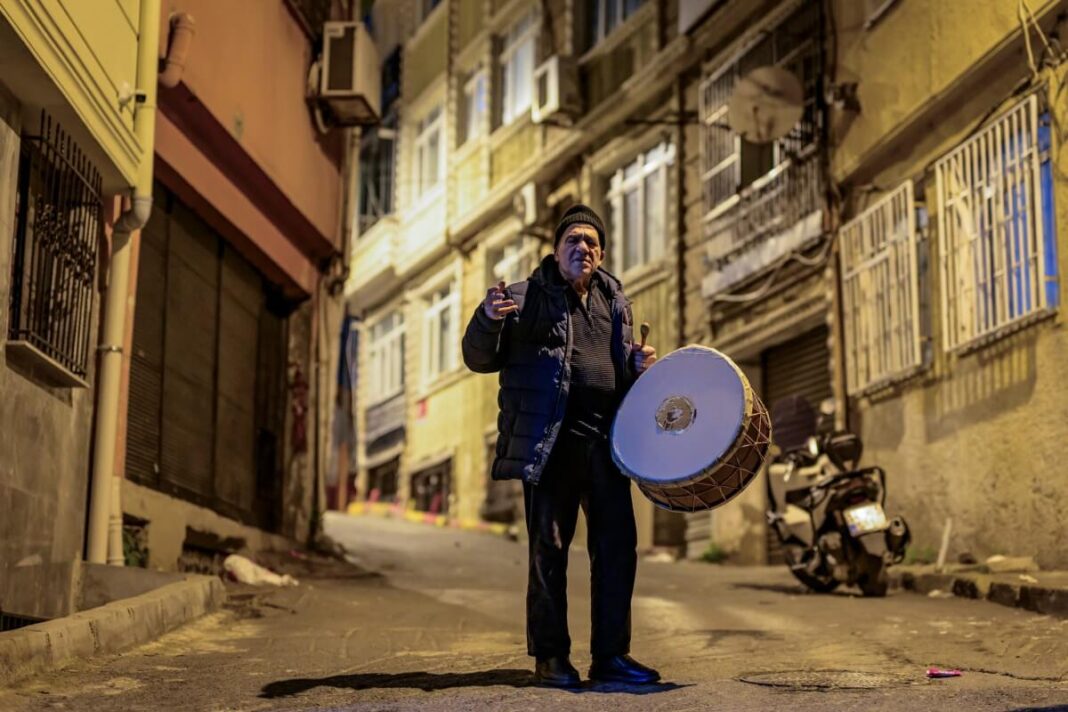

It’s 3:30 a.m., and lights are slowly coming on in the homes lining a narrow İstanbul street as people are woken up by the rhythmic thump of a drum.
Emerging onto a balcony, Sibel Savaş and her grandson look down as the drummer — or davulcu in Turkish — wanders through the Ayvansaray neighborhood, his drumbeat waking the faithful for a last meal before the daily Ramadan fast begins at sunrise.
For the past 55 years, Hakan Özbingöl has got up at 3:00 a.m. every day during Ramadan to play his davul, a large double-headed drum carried with a strap and played while walking through the streets.
He inherited the role from his father, with whom he started venturing out when he was 10.
Although their nightly sortie is purely voluntary, local residents traditionally give a tip at the end of the month, says Özbingöl, who is now 65.
If once this amounted to enough to buy the children a nice gift, these days it’s barely enough “to buy them clothes or to cover the bills,” he says, as people struggle to cope with Turkey’s bitter economic crisis.
But for him, it’s not a job but more of a sacred duty.
“As long as it’s to do with Allah, this drum will never fall silent. We’re doing Allah’s work, it’s our duty,” he said hoarsely, trudging with bent back through the winding streets.
Ottoman roots
According to Harun Korkmaz, a music historian at İstanbul University, the Ramadan drum rite “dates back to the end of the 19th century” when the Ottoman military bands, or mehters, performed several times a day, setting the pace of daily life.
“The davulcu are continuing this tradition,” he told Agence France-Presse, referring to a tradition that began in İstanbul and spread to the rest of the country.
As well as drumming, “real” davulcu will also chant “mani,” or short rhythmic poems, under people’s windows to flatter a sleepy audience, Özbingöl explained.
“In Turkey, there are few davulcus who know how to sing mani. It’s not enough to pick up the drum and bang on it while walking around,” he said, proudly tapping his temple to show where he keeps this knowledge.
The tradition began in the Fatih district near İstanbul’s historic peninsula, and most of today’s Ramadan drummers come from Turkey’s Roma community, who today number around 2.7 million, research figures show.
As the davulcu walks the street where clothes lines vie for space with Turkish flags draped from the facades of the tall buildings, he is warmly greeted by a pensioner called Zafer, who is also a musician.
“If the Roma weren’t here there would be nothing. They are the musicians and İstanbul’s Ramadan drummers,” the 71-year-old told AFP.
‘A tradition that must not die’
Still holding her grandson, Sibal Savaş says she has no alarm clock and relies on the early-morning drum rite to wake her up.
“This tradition is important to us this. It comes from our ancestors,” she told AFP.
In a nearby street, another drummer, 58-year-old Yurdaer, is trying to play a little more quietly as he passes the home of an elderly neighbor who has heart problems.
Across İstanbul, Turkey’s largest city, there are a total of 3,000 davulcu who go out nightly to wake the faithful in 961 neighborhoods, explains Selami Aykut, who heads an organization representing the megacity’s local mayors.
Since the pandemic, when the nightly rite was briefly halted, the authorities doubled the number of accredited drummers.
“We have increased the number we work with in order to better pass on our Ottoman traditions to young people, so that they can feel the excitement of Ramadan,” Aykut told AFP.
With street vendors hawking traditional foods increasingly scarce across the city’s streets, their services replaced by supermarkets, the davulcu is one rare tradition not at risk of disappearing due to his unique role at Ramadan.
“There are no more people selling boza [a fermented, cereal-based drink], no more yoghurt sellers, nor other street vendors — they’ve almost all disappeared,” said Özbingöl.
“Only the davulcu are left,” he murmurs, wandering off up the street.
© Agence France-Presse