

Turkey has pressured the Syrian government to cancel a planned meeting in Paris with Kurdish leaders, disrupting US-backed efforts to negotiate a political settlement in northeast Syria, according to a report by Al-Monitor published on Thursday.
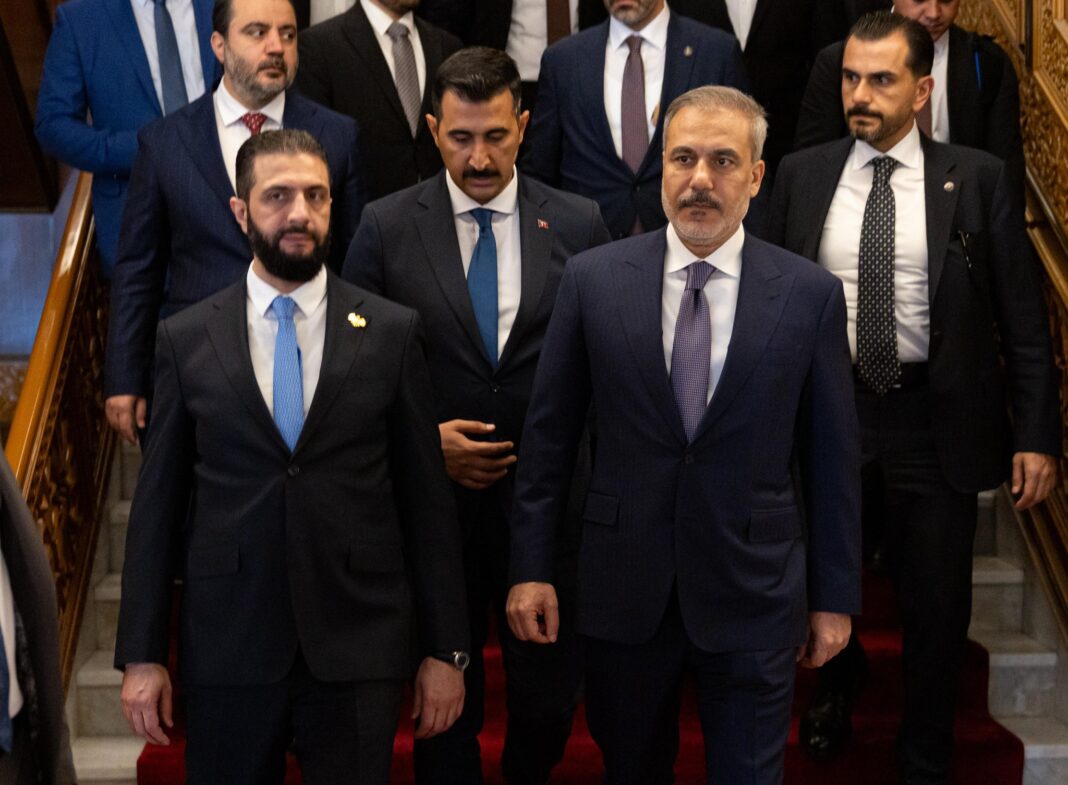
Citing three unnamed regional officials, the report says Turkish Foreign Minister Hakan Fidan’s Thursday visit to Damascus was aimed in part at convincing Syrian authorities to abandon the Paris meeting. The talks, backed by the United States and France, were intended to advance a March 10 framework deal between interim Syrian President Ahmed al-Sharaa and Syrian Democratic Forces (SDF) commander Mazloum Abdi. The agreement outlines Kurdish integration into Syria’s central government, both politically and militarily.
A July 25 session in Paris was already canceled at the last minute, just as a Kurdish delegation was preparing to travel from Erbil, reportedly on a flight arranged by Kurdistan Region President Nechirvan Barzani. While Damascus cited security concerns tied to recent Druze-Bedouin clashes in Suwayda, Al-Monitor’s sources said the real reason was Turkish pressure. Ankara reportedly demanded prior Kurdish concessions on Deir ez-Zor, a majority-Arab province currently administered by the Kurdish-led Autonomous Administration. The Kurdish side agreed to joint governance in those areas but refused to surrender control over local security until a broader national deal is reached.
Turkey has opposed holding the talks in Paris, fearing France’s pro-Kurdish stance could influence the outcome. Ankara instead proposed Amman as a neutral alternative. According to one source, “The Turks resent their exclusion from the talks and believe they will have less influence over their direction if they are held in Paris.” The same source said al-Sharaa “is forced to listen to Turkey even if it displeases him.”
France has maintained long-standing ties with Kurdish groups across the region. French Foreign Minister Jean-Noel Barrot met with Abdi in Erbil in April and has said Kurdish rights must be considered in Syria’s transition. “France has a pro-Kurdish position that upsets Turkey,” Fabrice Balanche, a France-based Syria expert, told Al-Monitor. He added that France’s invitation to al-Sharaa for a February conference was meant to counter Turkish influence and gain access to post-war reconstruction projects.
The rivalry between France and Turkey also extends to other regions, including the eastern Mediterranean and West Africa, where both governments compete for military and economic influence.
The US envoy responsible for Syria, Tom Barrack, had been pushing for the Paris talks to go ahead and met with al-Sharaa in Damascus on Wednesday to announce multibillion dollar reconstruction deals. While the talks were tentatively rescheduled for August 10 and 11, no new date has been confirmed. Abdi told pro-Kurdish media this week that he remains ready to attend the meeting. In a separate interview with Saudi outlet al-Hadath, he suggested Saudi Arabia could step in as a mediator if the Paris venue remains blocked.
Turkey, which has over 10,000 troops stationed in northern Syria, views the SDF and its main component, the People’s Protection Units (YPG), as affiliates of the Kurdistan Workers’ Party (PKK), which has fought an armed insurgency in Turkey since the 1980s. The PKK’s jailed leader, Abdullah Öcalan, had long been based in Syria under Hafez al-Assad’s protection until 1998. Turkey captured him in 1999 and is now using him again in its current strategy.
Ankara says Öcalan’s February 27 call for the PKK to lay down arms applies to the YPG as well, although SDF officials dispute this. Leaked minutes from a recent internal PKK meeting suggest that Öcalan only supports giving up arms if a deal is reached with the Syrian government.
A Turkish parliamentary commission is working on legal frameworks for a broader PKK demobilization, amnesty and repatriation. Defense Minister Yaşar Güler, Interior Minister Ali Yerlikaya and intelligence chief İbrahim Kalın are expected to brief the 51-member commission on Friday. The question of Syrian Kurdish fighters, including Turkish nationals in the SDF, is expected to be part of the agenda.
While Ankara aims to dismantle the Kurdish-led self-rule project in northeast Syria, the delay in talks may be buying the SDF more time. Al-Monitor notes that the Kurdish leadership believes any postponement weakens al-Sharaa’s position and improves their negotiating leverage.