


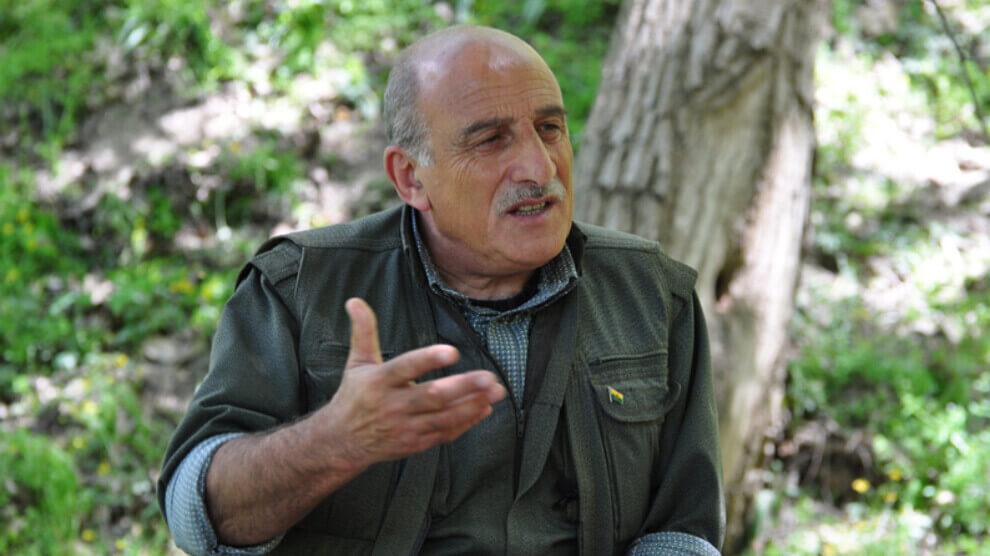
A senior figure in the outlawed Kurdistan Workers’ Party (PKK) has said only the group’s imprisoned founder, Abdullah Öcalan, can implement its announced disbandment and persuade its armed members to accept the transition, warning that the organization will not disperse while Turkey delays the required legal framework, in an interview with Medyascope published Friday.
Duran Kalkan, speaking to Medyascope Editor-in-Chief Ruşen Çakır in the Qandil Mountains of northern Iraq, said the decision adopted by the PKK’s 12th congress had not been put into practice and could not be carried out by the group’s current leadership.
“We adopted the decisions you asked us to adopt, but only Öcalan can lead and manage their practical implementation,” Kalkan said, describing a message sent to Öcalan after the congress. “We cannot put them into practice. We do not have the power.”
“No one other than Öcalan can make the PKK take such a decision,” he added. “No one else can persuade this fighting force in a process like this.”
Kalkan said the PKK had formally decided to disband and had ended its strategy of armed action against Turkey, but he drew a distinction between adopting the decision and dismantling the organization in practice.
“We made a decision, but these people do not evaporate,” he said. “If anyone expects years to pass and the organization to disperse, they are mistaken. This organization will not disperse.”
Kalkan maintained that the PKK would not carry out armed operations against Turkey unless a new congress of the group adopted another strategic change.
He said its forces would defend themselves if attacked and repeated near the end of the interview that there would be no fighting unless the group came under attack.
Öcalan called on the PKK to lay down its arms and disband on February 27, 2025. The group held its congress in May and later announced that it was ending its armed campaign and dissolving its organizational structure.
A group of 30 fighters burned their weapons at a ceremony in northern Iraq on July 11, 2025, as a symbolic first step.
The PKK launched an insurgency against the Turkish state in 1984, and the conflict has killed more than 40,000 people.
The group is designated as a terrorist organization by Turkey and its Western allies.
Legal framework nears parliament
Kalkan said the disbanding could take effect only through a political and legal transition that addresses the status of the group’s members.
He rejected an approach limited to the rehabilitation of individual militants and argued that former members must be allowed to organize and participate in politics under their own identities.
“If there will be no right to engage in politics, no right to organize and no identity of their own, then under Turkey’s current laws the only place awaiting us is prison,” he said.
Kalkan also described contacts surrounding the planned legislation, claiming that Öcalan submitted written views on May 24 while the ruling Justice and Development Party (AKP) and the pro-Kurdish Peoples’ Equality and Democracy Party (DEM Party) were preparing proposals.
He said the parties had discussed reconciling three texts after the Muslim holiday of Eid al-Adha, sending the resulting proposal to İmralı prison island and obtaining the PKK’s views through Öcalan.
Kalkan complained that the plan was not carried out on schedule, while the AKP and DEM Party have not publicly confirmed the sequence he described.
President Recep Tayyip Erdoğan said in June that his government was preparing legislation to accelerate the PKK’s disbandment. Officials familiar with the work said Friday that the draft was nearing completion and could be submitted to parliament next week.
Officials said passage was possible by the end of July or early August before parliament begins its summer recess.
DEM Party lawmakers Pervin Buldan and Mithat Sancar met with AKP Deputy Chairman Efkan Ala on Wednesday and Nationalist Movement Party (MHP) leader Devlet Bahçeli on Thursday as talks continued.
Buldan declined to disclose the content of the meetings.
Turkish media reported Friday that the DEM Party delegation was expected to visit Öcalan on İmralı Island on July 23, with the proposed legal framework likely to be discussed, although the party had not officially confirmed the date.
Earlier reports indicated that the planned law would have a limited duration, establish a mechanism to verify the laying down of arms and regulate the return of some members. The emerging proposal was not expected to change Öcalan’s prison status in its initial stage.
Kalkan said the PKK would examine any law passed without prior consultation and make its decision afterward.
Involvement before the bill reaches parliament, he argued, would make the group part of the process and increase the prospect that the legislation could be implemented.
Senior PKK figures could enter legal politics
Asked whether he and other senior figures, including Cemil Bayık and Murat Karayılan, could return to Turkey and take part in legal politics, Kalkan replied, “Why not?”
He did not claim that an agreement had been reached or identify a timetable.
Kalkan said the priority was to enable Öcalan to participate in politics and lead the transition but argued that changes once considered impossible could become possible through a settlement.
Kalkan also called for the release of imprisoned Kurdish politicians, including former Peoples’ Democratic Party (HDP) co-chair Selahattin Demirtaş, and said former Kurdish lawmakers and mayors living abroad should be among the first able to return if the process advances.
Syria and regional alliances
Turning to Syria, Kalkan criticized the Kurdish-led administration in the country’s northeast for treating its ties with the United States and Israel as strategic alliances.
He described the relationships as temporary arrangements formed during the campaign against the Islamic State in Iraq and the Levant (ISIL).
Kalkan argued that Syrian Kurdish officials suffered because they failed to prepare for changes in outside support and relied too little on their own forces.
He also acknowledged communication gaps between Öcalan and PKK leaders during developments in Aleppo, saying the two sides would not have developed different positions if information had reached İmralı in time.
Asked whether Israel had sought direct contact with the PKK, Kalkan did not provide a direct answer.
He said Israel, Iran and Turkey were all seeking relationships with Kurdish actors as the regional balance changed, while maintaining that the PKK favored a settlement among the peoples and states of the Middle East rather than reliance on outside powers.