


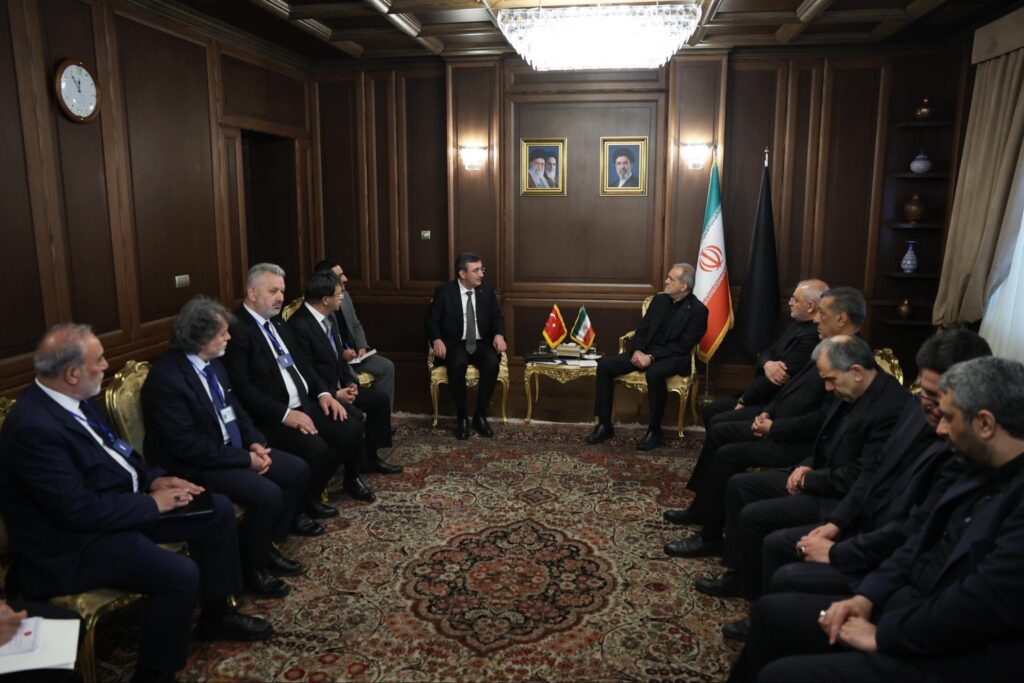
Turkish Vice President Cevdet Yılmaz and representatives from several conservative parties attended a state funeral ceremony in Tehran on Friday for Iran’s late Supreme Leader Ayatollah Ali Khamenei, who was killed in US and Israeli airstrikes in February at the start of the war in the Middle East.
Yılmaz represented President Recep Tayyip Erdoğan at the ceremony at Imam Khomeini Grand Mosalla, a prayer complex in Tehran, where Iranian officials and foreign delegations gathered for the first public stage of a week of funeral events.
A Turkish delegation that included representatives from Erdoğan’s ruling Justice and Development Party (AKP), the New Welfare Party (YRP), the Future Party, the Felicity Party, HÜDA PAR and civil society organizations also attended, Turkish media reports said.
The reports identified YRP leader Fatih Erbakan and Future Party deputy parliamentary group chairman Selçuk Özdağ among the attendees.
Yılmaz met with Iranian President Masoud Pezeshkian at Saadabad Palace before the ceremony and offered condolences for Khamenei and others killed in the attacks.
“The pain of the Iranian people is our pain,” Yılmaz told reporters in Tehran, adding that Turkey wanted peace, stability and a postwar process of normalization in the region.
Yılmaz said Turkey would continue to support efforts to strengthen diplomatic channels and turn a recent US and Iran memorandum into lasting peace.
Khamenei, 86, led Iran from 1989 until February 28, when US and Israeli airstrikes killed him and several senior Iranian figures.
The strikes sparked criticism from Ankara, which described them as a violation of international law while also calling on all sides to stop attacks and pursue diplomacy.
Turkey’s presence at the funeral reflected Ankara’s effort to keep channels open with Tehran while maintaining its position inside NATO.
Turkey and Iran share a border and have energy and trade ties, but they have also backed rival sides in regional conflicts, including in Syria.
The attendance of both ruling and opposition parties from Turkey’s Islamist camp showed that opposition to the US and Israeli campaign against Iran is one of the few points of overlap in an otherwise polarized political landscape.
Erbakan, the son of the late Islamist prime minister Necmettin Erbakan, had condemned Khamenei’s killing in March and urged Ankara to take political and military steps against what he called a threat from Zionism.
HÜDA PAR, an Islamist party that has cooperated with Erdoğan’s AKP in recent elections, also issued condolences after Khamenei’s death.
Iran is holding funeral ceremonies and processions in several cities after delaying Khamenei’s burial because of the war.
Khamenei’s body is expected to be taken to Qom, Najaf and Karbala before burial at the Imam Reza shrine in Mashhad on July 9.
Foreign delegations from Russia, China, Pakistan, India and several other countries also attended or were expected to attend the ceremonies.
The funeral comes as Iran seeks to project continuity under Khamenei’s son and successor, Mojtaba Khamenei, whose public absence since the February strike has fueled questions about Iran’s leadership in a time of crisis.