


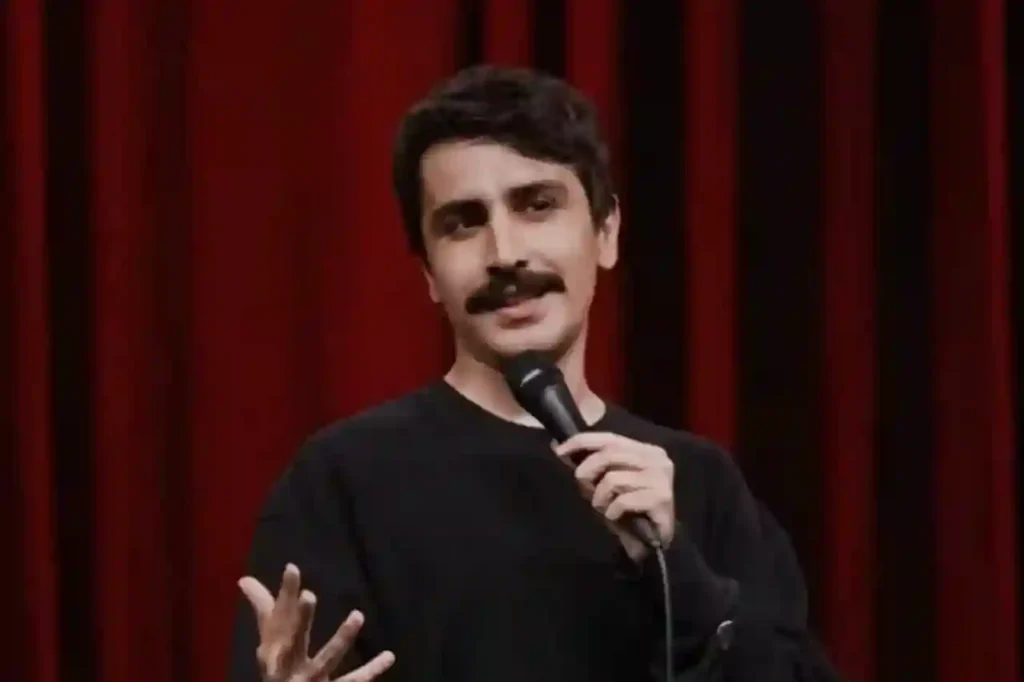
Turkish comedian Deniz Göktaş was detained at İstanbul Airport on Thursday on his return from abroad as part of an investigation into allegations that he insulted religious values in his viral stand-up show “Ölü Deniz,” the Anka news agency reported.
Göktaş, 32, was detained during passport control at İstanbul Airport and taken to a police station to give a statement.
The İstanbul Chief Public Prosecutor’s Office said in a statement on Thursday that Göktaş was “caught” at İstanbul Airport on July 2, although he had returned to Turkey voluntarily from a previously planned trip abroad.
The prosecutor’s office said in its Thursday statement that it had reviewed 185 complaints filed through CİMER, the presidential communication center, about Göktaş and his show as part of the same case.

The comedian’s detention came days after prosecutors launched an investigation into remarks in “Ölü Deniz,” a 90-minute stand-up performance uploaded to his YouTube channel on June 24, on suspicion of “publicly insulting religious values adopted by a segment of the public” under Article 216 of the Turkish Penal Code.
The show had been viewed more than 8.5 million times in about a week.
The performance includes satirical comments on a wide range of subjects, including Turkish politics, President Recep Tayyip Erdoğan, jailed İstanbul Mayor Ekrem İmamoğlu, universities, public protests, Turkish intellectuals, nationalism and the secular children of conservative families.
Göktaş also jokes about the possibility of being investigated or imprisoned because of his remarks, making legal pressure on comedians one of the themes of the performance.
The stage features a large sculpture of Göktaş’s head, a visual element that reinforces the show’s sense of personal risk.
Before the launch of the investigation into Göktaş, pro-government media outlets and conservative social media users accused him of mocking the Quran, the Muslim holy book, in his show.
The part cited by critics involved a joke about holy books and the Quran being regarded in Islam as the final holy book.
Göktaş had said on June 28 that he was abroad on a previously planned vacation and would return on the first flight if his presence in Turkey was required.
In another statement a day later, he said he had received no official notice and had no plans to live or perform stand-up outside Turkey.
“The full show is still on YouTube,” he said at the time. “If there is any official information, I will share it here.”
Before his detention, Turkey also blocked access to X posts carrying clips from the same show, citing threats to national security and public order after Şamil Tayyar, a former member of the ruling Justice and Development Party’s (AKP) top decision-making body, accused Göktaş of insulting Erdoğan.
The posts were made inaccessible to users in Turkey by X under Article 8/A of Law No. 5651, the Freedom of Expression Association (İFÖD) announced last week.
Göktaş’s detention sparked criticism from artists and opposition parties.
Actor Şevket Çoruh criticized the detention in a social media post, saying the state had treated humor as a criminal matter.
The Workers’ Party of Turkey (TİP) called for Göktaş’s release, saying it stood with people who showed courage against what it described as attempts to intimidate critical voices and humor.
The Labor Party (EMEP) said the detention confirmed the show’s criticism of authoritarian rule.
The case comes amid growing concern over criminal investigations and online restrictions targeting satire, stage performances and political expression in Turkey.
In May prosecutors filed an indictment seeking up to three years in prison for comedian Tuba Ulu over a joke she made about Ottoman Sultan Suleiman the Magnificent during a performance.
Ulu was accused of “inciting hatred and enmity among the public” after a clip from her show circulated on social media. She had earlier been detained on accusations of “insulting historical, national and moral values” and was later released under judicial supervision.
Free speech advocates and fellow performers criticized the case, saying comedians should not face criminal prosecution over stage performances.
Turkey has long faced criticism over restrictions on freedom of expression, with artists, journalists, academics and social media users frequently targeted in criminal investigations due to their remarks.
International monitors continue to rank Turkey poorly on freedom of expression and media freedom. Freedom House classifies the country as “Not Free,” while Reporters Without Borders ranked it 163rd out of 180 countries in its “2026 World Press Freedom Index.”