
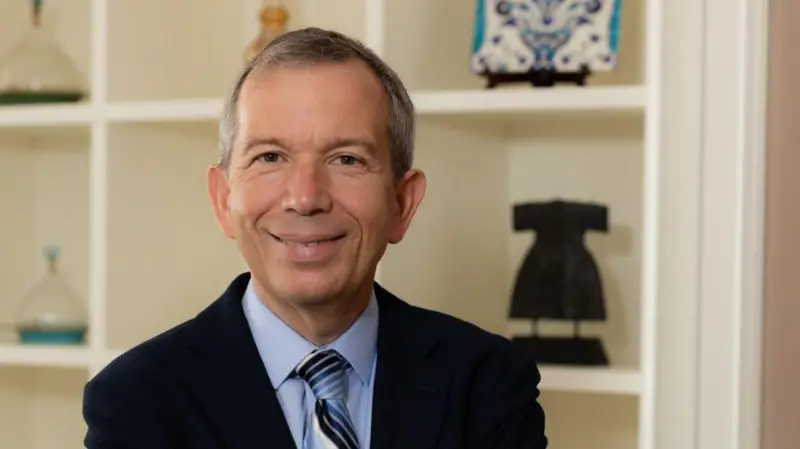

A Turkish court on Tuesday ordered the release of former İstanbul Bilgi University rector Remzi Sanver, head of the Grand Lodge of Free and Accepted Masons of Turkey, after eight months in pretrial detention as part of an investigation into Can Holding, the state-run Anadolu news agency reported.
Sanver had been jailed since October 17, 2025, in the second phase of an investigation conducted by the İstanbul Chief Public Prosecutor’s Office into Can Holding, a large private conglomerate whose companies include media outlets, schools and a university.
The investigation concerns allegations including tax evasion, fraud and money laundering.
In October a court ordered the arrest of 11 people, including Can Holding Chairman Kenan Tekdağ and Sanver, after 25 people were detained in raids carried out as part of the probe.
Sanver was not the first person released in the case.
Kenan Tekdağ, former chairman of Can Yayın Holding, and Kemal Can, former chairman of Can Holding, were previously released under judicial supervision in the same investigation.
Sanver is a prominent Turkish academic who taught and conducted research at universities in Turkey and Europe and served as rector of İstanbul Bilgi University from 2011 to 2015.
He later served as secretary-general and spokesperson for the board of directors of the Galatasaray Sports Club between 2021 and 2022.
During Sanver’s time in pretrial detention, the Grand Lodge of Free and Accepted Masons of Turkey reportedly faced a management crisis after its general assembly could not convene within the period required under its bylaws.
Ali Rıza Aral, a member of the Masonic organization, applied to a court seeking the appointment of a trustee, saying there was a management vacuum.
The İstanbul Civil Court of Peace later ordered the temporary appointment of a trustee to the grand lodge.
Its management denied claims that it had been taken over by trustees, saying the appointment was a temporary measure.
Prosecutors have said evidence in the Can Holding investigation showed that several companies within the group issued fake invoices to evade taxes and generate illegal profit, alleging that the transactions involved “no actual movement of goods.”
Investigators said they found 88 billion Turkish lira ($1.9 billion) in suspicious financial activity between 2020 and 2021 in the accounts of Can Holding and 121 affiliated companies.
The first operation on September 11, 2025, led to the appointment of Turkey’s Savings Deposit Insurance Fund (TMSF) as trustee to 121 companies, including broadcasters Habertürk TV, Show TV, Bloomberg HT and HT Spor, which Can Holding had acquired in 2024, as well as İstanbul Bilgi University and the nationwide Doğa College network.
The TMSF is a state body that manages companies and assets put under trustee control by courts.
Bilgi University, long known for its liberal academic environment and international programs, was briefly closed by presidential decree in May, months after it was put under trustee management as part of the Can Holding investigation.
The closure, which affected more than 20,000 students and about 1,000 academics, was reversed two days later following protests by students and faculty members.
TMSF control expands amid corporate probes
The wave of corporate investigations and trustee appointments accelerated in 2025, unsettling Turkey’s business community and fueling concerns about property rights and the government’s use of financial-crime probes.
Can Holding, glassmaker Ciner Group and the İstanbul Gold Refinery were among the high-profile companies targeted in 2025 in investigations that significantly expanded the number of firms put under the management of the TMSF.
According to current data on the TMSF website, the fund acts as trustee for 1,121 companies, including 1,034 under full trusteeship and 87 under supervisory trusteeship, across sectors including construction, food and agriculture, energy, media and finance.
The sharp rise in seizures has fueled fears that anti-corruption investigations are being used to facilitate politically motivated asset transfers and tighten government control over key parts of the economy.
Since a failed coup in 2016, Turkish authorities have put hundreds of businesses under state control, often citing links to alleged criminal networks or terrorism financing.
Regulations adopted in February expanded the powers of the TMSF, allowing courts to appoint the fund as trustee to companies based on a “strong suspicion” of financial crimes such as money laundering.
Legal scholars and watchdog groups have warned that Turkey’s use of trusteeships and asset confiscations has eroded property rights and created a climate of uncertainty for investors.
They argue that the measures have also been used to curb political dissent and bring influential media outlets and schools under tighter state control.