


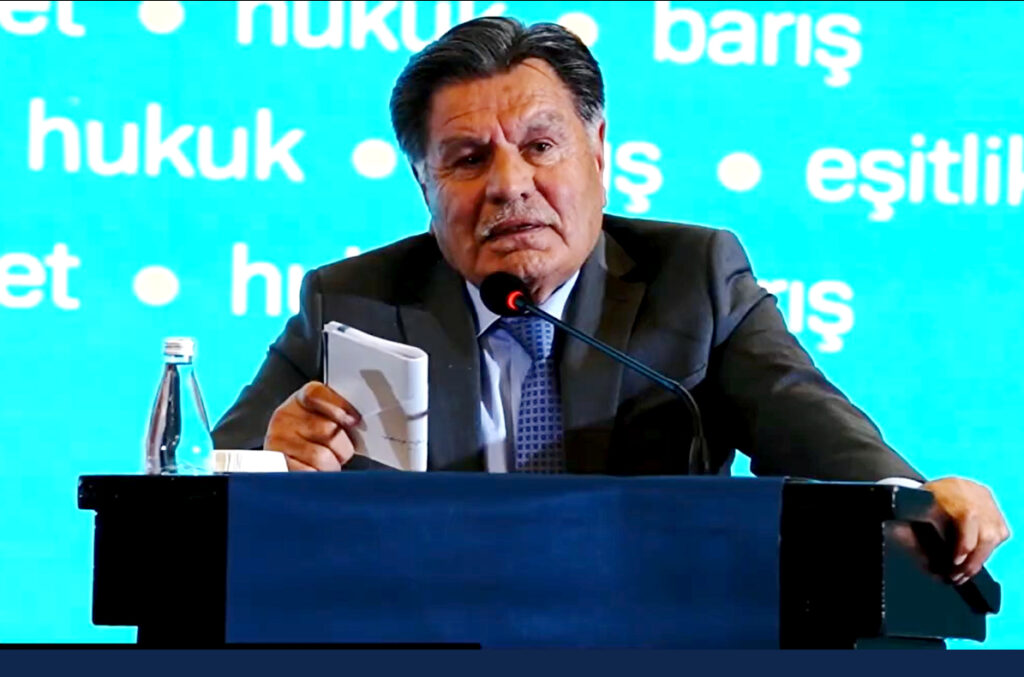
Former Constitutional Court president Haşim Kılıç has warned that foreign investors will avoid Turkey unless they can trust its courts, citing the detention of the head of the country’s top business group while the government was trying to attract investment from abroad, the Karar daily reported on Monday.
Speaking at a conference organized by the Democracy Platform, a civic initiative that advocates democratic governance, the rule of law and fundamental rights in Turkey, Kılıç said the erosion of judicial independence had damaged confidence among judges, businesspeople and academics.
“When the finance minister is asking Gulf countries for money, the president of TÜSİAD is detained in this country,” Kılıç said, referring to the Turkish Industrialists and Businessmen’s Association, one of Turkey’s most influential business groups.
“If investors cannot trust the law and the courts, no investment will come to this country,” he added.
Kılıç was referring to a 2025 investigation into TÜSİAD Chairman Orhan Turan and Ömer Arif Aras, head of the group’s high advisory council, after they criticized the government’s economic management, executive control over the judiciary and the weakening of the rule of law.
The two business leaders were taken to the İstanbul Chief Public Prosecutor’s Office by police, questioned for hours and later released under a travel ban.

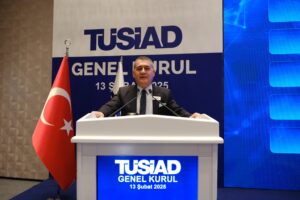
A Turkish court in March handed down suspended prison sentences to both men for “publicly spreading misleading information” while acquitting them of attempting to influence the judiciary.
Kılıç, who became a member of the Constitutional Court in 1990 and served as its president between 2007 and 2015, linked Turkey’s economic problems to the state of the judiciary.
He said investor confidence depends on an independent and impartial court system.
Turkey has been trying to restore foreign investor confidence since Treasury and Finance Minister Mehmet Şimşek returned to economic policymaking in 2023, after years of policies that investors blamed for high inflation, a weak lira and declining confidence.
The US State Department’s 2025 investment climate report said Turkey needs significant new foreign direct investment (FDI) to meet its development goals and finance its current account deficit.
It said FDI capital inflows rose to $6.7 billion in 2024 from $5.9 billion in 2023.
Judiciary under political pressure
Kılıç devoted much of his speech to Turkey’s top judicial bodies and the election authority, criticizing the composition of the Constitutional Court, the Council of Judges and Prosecutors (HSK) and the Supreme Election Board (YSK).
He said the three bodies form the backbone of the judiciary and cannot be expected to deliver justice without pluralism in their membership.
Kılıç said most members of the 15-member Constitutional Court are appointed by the president, while the rest are chosen by parliament, a structure he described as problematic.
He also criticized the selection of HSK members, saying the council plays a decisive role in appointing members of the Supreme Court of Appeals and the Council of State.
Those members, in turn, help shape the YSK.
Kılıç’s latest remarks follow earlier criticism in April, when he warned that freedom of expression in Turkey had deteriorated and said society had moved from exercising the right to free speech to resorting to the “right to remain silent.”
Turkey has faced growing criticism over the state of judicial independence and its failure to comply with rulings from the European Court of Human Rights and the Constitutional Court, particularly in politically sensitive cases involving opposition figures, activists and government critics.
Turkish authorities deny allegations of political interference in the judiciary and maintain that courts operate independently.