
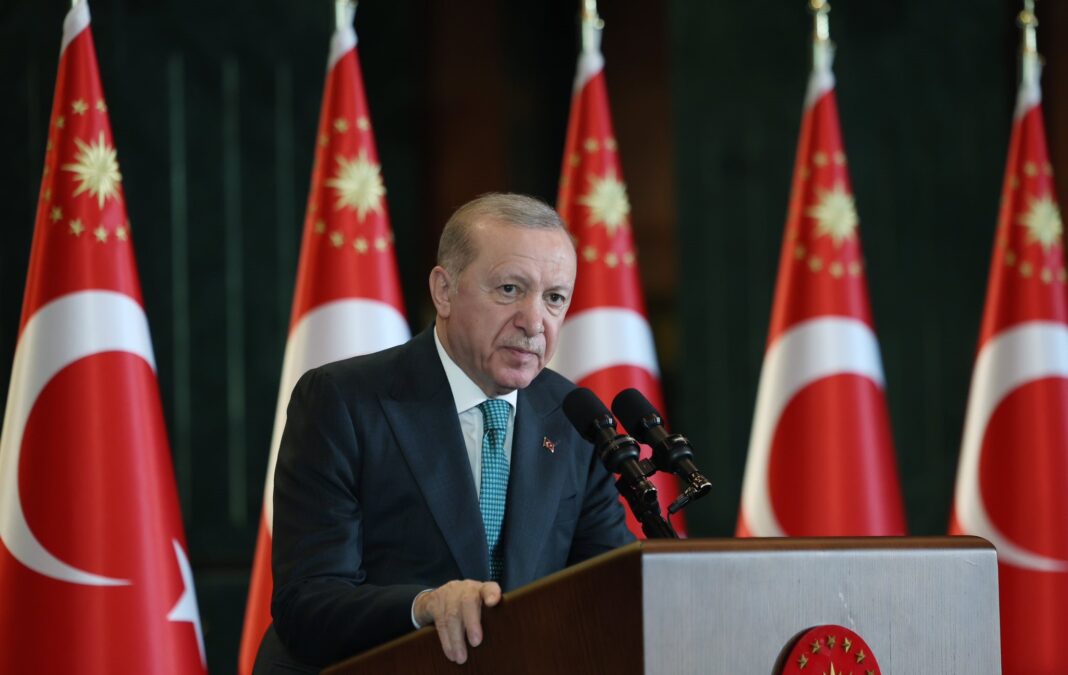

A senior adviser to Turkish President Recep Tayyip Erdoğan has proposed holding Turkey’s next presidential and parliamentary elections on April 16, 2028, saying a parliamentary decision to call elections before their scheduled date could allow Erdoğan to seek another term.
Mehmet Uçum, a chief presidential adviser and deputy chair of the Presidential Legal Policies Council, made the proposal in an article published Monday by the state-run Anadolu news agency amid renewed debate over whether Erdoğan can run again.
Turkey’s constitution limits presidents to two five-year terms but allows another candidacy if parliament decides to renew the elections during a president’s second term.
Such a decision requires the support of at least 360 lawmakers in the 600-seat parliament.
Erdoğan’s ruling Justice and Development Party (AKP) and its ally, the far-right Nationalist Movement Party (MHP), do not currently have enough seats to reach that threshold on their own, meaning they would need support from opposition parties.
Turkey’s next elections are normally expected to be held on May 7, 2028, according to Uçum.

He said the country does not currently need an early election but claimed that the constitution already provides a path for Erdoğan’s candidacy if parliament votes to renew the elections before the end of his current term.
Uçum described this possibility as an “exceptional candidacy,” saying it would become available if parliament decides to renew the elections ahead of the normal election date.
He said parliament could make such a decision in late 2027 or early 2028, allowing Erdoğan, if he chooses, to run for president “for the last time.”
Symbolic day
Uçum also suggested April 16, 2028, as a possible election date because it would fall on the 11th anniversary of the 2017 constitutional referendum, which replaced Turkey’s parliamentary system of governance with an executive presidency.
The new system granted sweeping powers to Erdoğan and eliminated many traditional checks and balances, according to critics.
Some analysts say it has concentrated excessive authority in a single office, weakened institutional oversight and contributed to declining trust in political institutions.
“If parliament takes such a decision, holding the general elections on April 16, the day of the referendum in which the presidential system of governance was adopted, in other words on the 11th anniversary of the referendum, would also carry strong symbolic meaning,” Uçum said.
He said that if parliament votes to renew the elections on any day between February 9 and 15, 2028, the vote would be held on April 16 under the election law, which requires elections to take place on the first Sunday after the 60th day following a renewal decision.
Uçum also objected to the use of the term “early election,” saying the constitution refers instead to the “renewal of elections.”
He said Turkey is not facing extraordinary political conditions that would currently require such a decision.
The debate over Erdoğan’s eligibility has become one of the most contentious issues in Turkish politics ahead of 2028.
The government argues that Erdoğan’s 2018 election was his first under the executive presidential system introduced by the 2017 referendum and that his 2023 re-election was therefore his second. Opposition figures and some legal experts dispute this interpretation, saying Erdoğan has already been elected president three times — in 2014, 2018 and 2023 — and that another candidacy would raise constitutional concerns unless parliament renews the elections.
Uçum described another Erdoğan candidacy as a national need, saying, “President Erdoğan does not need to become president again, but Turkey needs President Erdoğan once again.”
Opposition leaders have repeatedly called for early elections, citing a deepening cost-of-living crisis and what they describe as mounting judicial pressure on opponents of the government.
Republican People’s Party (CHP) leader Özgür Özel, who was ousted by a May 21 court decision that reinstated former chairman Kemal Kılıçdaroğlu and his team, said in late April that elections could be held by October 2027 and urged his party to prepare as if a vote could take place at any moment.
The CHP has faced an ongoing series of investigations and detentions targeting its municipalities since the party’s strong performance in the 2024 local elections.
Critics and rights groups describe the cases as part of growing pressure on Turkey’s main opposition, while the government denies interfering in the judiciary and says Turkish courts act independently.
The court decision that removed Özel and the continued imprisonment of İstanbul Mayor Ekrem İmamoğlu have deepened concerns among government critics about judicial pressure on the opposition ahead of the next presidential election.
Erdoğan and leaders of the ruling alliance have repeatedly dismissed calls for early elections, saying the vote will be held as scheduled in 2028.
MHP leader Devlet Bahçeli has also ruled out any immediate change to the election timetable, although he has previously supported steps that would allow Erdoğan to run again.
Erdoğan has governed Turkey since 2003, first as prime minister and later as president, making him the longest-serving leader in the history of the Turkish Republic.