


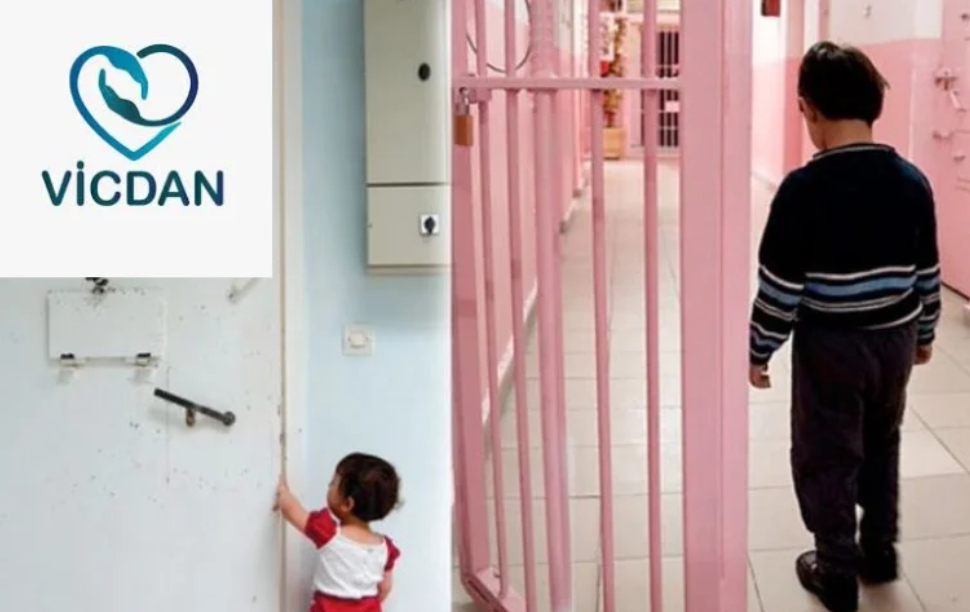
Nearly four in five children under the age of 6 living with their mothers in Turkish prisons show signs of developmental delay, while more than 81 percent suffer psychological harm, according to a new report by the Vicdan Foundation.
The report said children’s needs were largely ignored during detention and judicial proceedings, with 73.1 percent of participants saying no special arrangements were made for mothers with children and more than three-quarters saying children’s needs were completely disregarded by authorities.
The foundation, established in 2023 by human rights advocate and Peoples’ Equality and Democracy Party (DEM Party) lawmaker Ömer Faruk Gergerlioğlu, based the report on interviews with 100 women imprisoned with their children, 97 percent of whom were jailed on terrorism or organized crime charges.
Gergerlioğlu said there are 891 young children under the age of 6 are living in Turkish prisons with their mothers, who are either jailed pending trial or serving sentences.
The report found several shortcomings in children’s daily living conditions, with 94 percent of respondents saying children lacked adequate space for play, 87 percent reporting physical safety risks inside prison wards and nearly nine in 10 saying wards were overcrowded beyond their official capacity.
Access to basic care was also limited, with more than three-quarters of respondents saying children could not be fed in a way appropriate for their age and nearly 70 percent reporting inadequate hygiene conditions.
The report linked those conditions to serious developmental problems, saying 78 percent of children showed signs of developmental delay, 62.3 percent experienced delayed speech development and more than half faced restrictions affecting normal physical movement.
Psychological impacts were also widespread, with more than 81 percent of respondents saying their children were negatively affected, nearly three-quarters reporting symptoms of separation anxiety during incarceration and 69.5 percent observing excessive dependency.
The effects often continued after release, with more than 83 percent of children experiencing separation anxiety and feelings of insecurity, 72.6 percent suffering persistent sleep disturbances and nearly 59 percent struggling to adapt to social environments.
The foundation said children living in prison with their mothers should not be viewed merely as accompanying family members but as direct victims of rights violations, warning that the principle of the “individuality of punishment” is being undermined.
The report warned that incarceration during early childhood can have consequences extending far beyond the prison term, disrupting childhood development and violating the principle of the best interests of the child.
The number of children accompanying their mothers in prison in Turkey skyrocketed in the aftermath of a coup attempt on July 15, 2016, when thousands of women were arrested due to their alleged links to the faith-based Gülen movement.
Turkish President Recep Tayyip Erdoğan has targeted followers of the Gülen movement, inspired by the late Muslim cleric Fethullah Gülen, since corruption investigations in December 2013 implicated him as well as some members of his family and inner circle. He dismissed the probes as a Gülenist conspiracy and later designated the movement a terrorist organization in May 2016, intensifying a sweeping crackdown after the failed coup in July of the same year that he accused Gülen of orchestrating. The movement denies involvement in the coup attempt or any terrorist activity.
Under Turkish law, women who are pregnant or who have given birth within the past 18 months cannot be made to serve prison sentences. Article 16(4) of the Law on the Execution of Sentences stipulates that incarceration must be postponed for the duration of pregnancy and until the child is 18 months old.
However, these protections apply only after a sentence has become final. In practice, courts have ordered the pretrial detention of pregnant women while their cases are still under appeal, arguing that the postponement rule does not extend to pretrial custody.
Critics say this interpretation undermines both the spirit of the law and international standards such as the United Nations’ “Bangkok Rules,” which call for non-custodial measures for pregnant women and mothers with young children.
This article is republished from the Stockholm Center for Freedom.