
.)
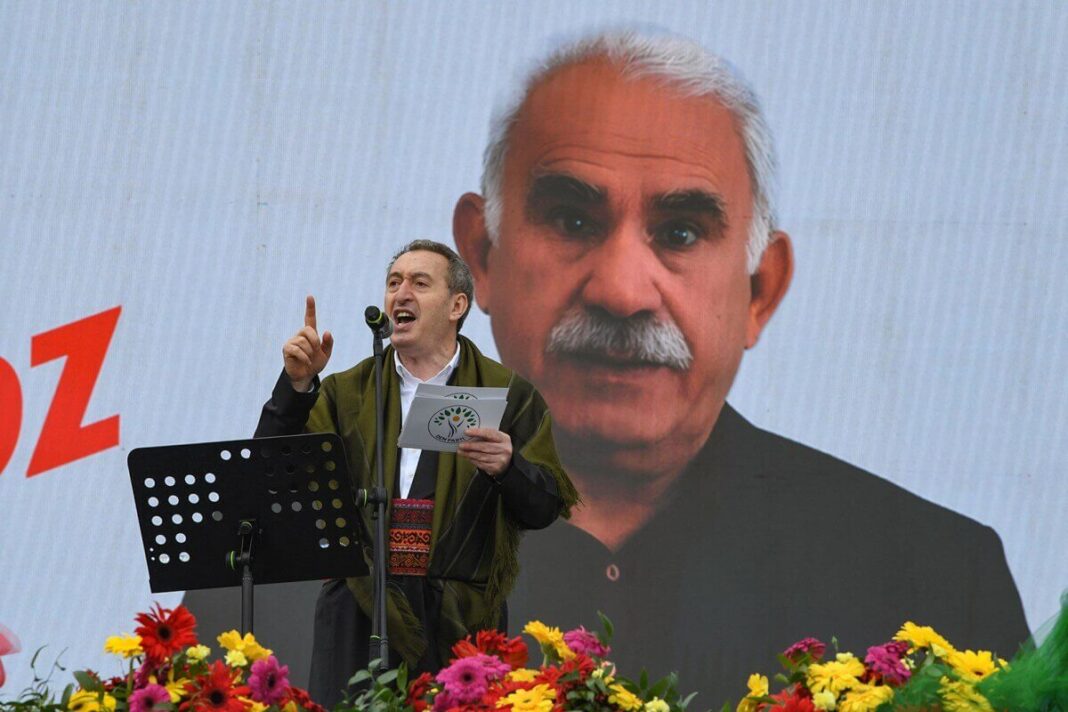
Turkey’s main pro-Kurdish party has announced rallies in four cities on June 27 and 28 to demand the release of Abdullah Öcalan, the jailed founder of the Kurdistan Workers’ Party (PKK), as debate grows over his legal status during a peace initiative aimed at ending the group’s armed conflict with the state.
The Peoples’ Equality and Democracy Party (DEM Party) said the rallies will take place in the eastern city of Van and the Mediterranean port city of Mersin on June 27, followed by events in the southeastern city of Diyarbakır and İstanbul on June 28.
The schedule was announced Monday during a “Freedom Rally Declaration” event in Diyarbakır attended by DEM Party Co-chair Tuncer Bakırhan, Democratic Regions Party (DBP) Co-chairs Çiğdem Kılıçgün Uçar and Keskin Bayındır, lawmakers and municipal officials.
The DBP is a Kurdish political party that works with the DEM Party, the third-largest group in the Turkish Parliament.
Organizers presented the rallies as part of a campaign for Öcalan’s release and for progress in the efforts to resolve Turkey’s Kurdish conflict through political talks.
The campaign had originally planned a single rally in Diyarbakır on January 4, but organizers postponed it until January 25 because of severe winter weather.
The Diyarbakır Governor’s Office later imposed a four-day ban on outdoor meetings, demonstrations and similar events from January 23 through January 26, citing risks to public order and security.
Organizers then postponed the rally for a second time.
The new schedule expands the campaign from one rally in Diyarbakır to events in four of Turkey’s largest Kurdish-populated cities and metropolitan areas.
Separately, 82 Nobel laureates sent a new letter to the Committee of Ministers of the Council of Europe calling for the implementation of a 2014 European Court of Human Rights judgment concerning Öcalan and people serving aggravated life sentences in Turkey.
The laureates urged the committee to take steps to guarantee what is known as the “right to hope,” a legal principle under which prisoners serving life sentences must have access to a mechanism that can review their sentences and offer a realistic possibility of release.
They described Öcalan as one of the initiators of the current peace effort and called for his release and for him to be allowed to participate freely in efforts to end the conflict.
The letter was the third appeal sent by Nobel laureates to the Committee of Ministers concerning Öcalan in the past three years.
In its 2014 judgment in Öcalan v. Turkey No. 2, the European rights court found that his life sentence without any possibility of review or conditional release violated Article 3 of the European Convention on Human Rights, which prohibits torture and inhuman or degrading treatment.
The ruling did not order Öcalan’s immediate release.
It required Turkey to establish a mechanism under which an aggravated life sentence could be reviewed after a minimum period, taking into account factors such as rehabilitation and whether continued imprisonment remained justified.
The Committee of Ministers, which supervises the implementation of European court judgments, said in September 2025 that Turkey had still not adopted the required legislative or other measures.
The committee called on Ankara to act without further delay and requested information about progress by the end of June 2026.
Öcalan has been imprisoned on İmralı Island in northwestern Turkey since 1999.
His legal status has become one of the main issues in the latest effort to end the conflict between Turkey and the PKK, which is designated as a terrorist organization by Turkey and its Western allies.
The current initiative began in October 2024 when Nationalist Movement Party (MHP) leader Devlet Bahçeli, a key ally of President Recep Tayyip Erdoğan, called on Öcalan to instruct the PKK to lay down arms and disband.
Bahçeli also suggested that Öcalan could benefit from the “right to hope” if the group ended its armed campaign.
Öcalan issued a statement on February 27, 2025, calling on the PKK to lay down its weapons and dissolve itself.
The group announced in May 2025 that it had decided to end its armed campaign and disband, while 30 PKK members burned their weapons at a ceremony in northern Iraq in July.
A parliamentary commission established in August 2025 approved a report in February outlining proposed legal reforms connected to giving up arms, the reintegration of former militants and compliance with rulings from Turkey’s Constitutional Court and the European Court of Human Rights.
The initiative has since faced delays over the order in which the PKK’s laying down of weapons and legal reforms should take place.
The Turkish government says the PKK’s giving up of arms must be verified before broader legal and political steps are taken, while Kurdish political representatives have called for legal guarantees and changes in Öcalan’s prison conditions.
The conflict, which began in 1984, has killed more than 40,000 people and affected Turkey as well as neighboring areas of Iraq and Syria.