


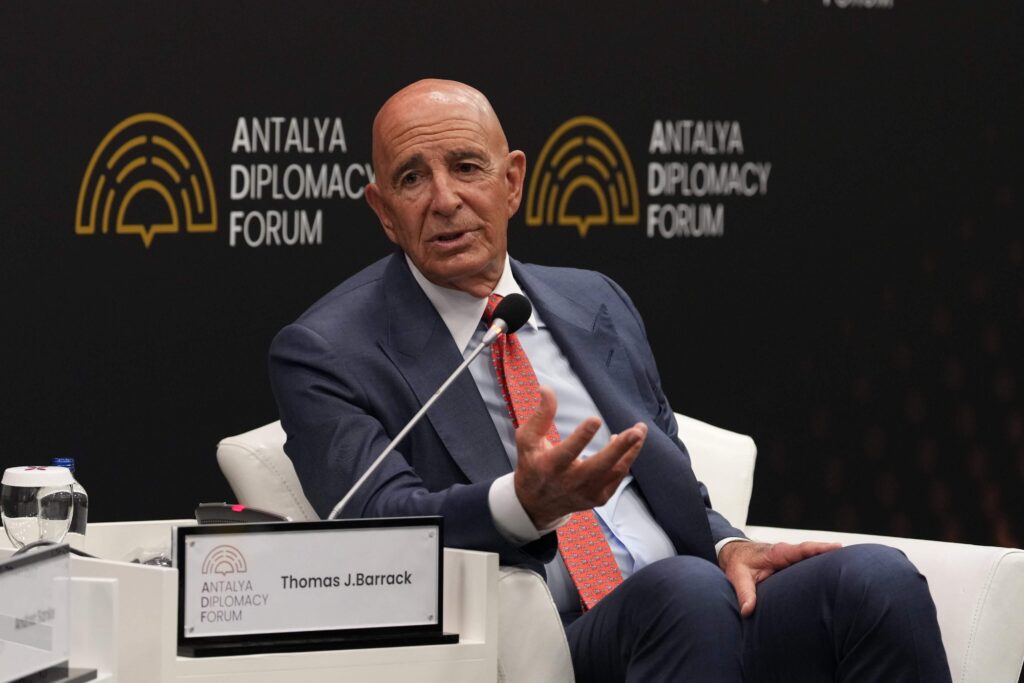
US Ambassador to Turkey Tom Barrack said Friday that Washington and Ankara are close to resolving a long-running dispute over US sanctions imposed on Turkey following its purchase of Russian S-400 missile defense systems, the state-run Anadolu news agency reported.
“I think you are going to see the S-400 situation solved soon. From my boss’s point of view, acceptance into an F-35 program is fine,” Barrack said at the Antalya Diplomacy Forum, which kicked off on Friday in a Mediterranean resort in southern Turkey.
The sanctions, imposed under the Countering America’s Adversaries Through Sanctions Act (CAATSA), were triggered by Turkey’s 2019 acquisition of the Russian-made air defense system, which the United States said posed a risk to NATO security and the F-35 stealth fighter program.
In his speech Barrack also voiced skepticism about sanctions as a policy tool.
“Sanctions, in my humble opinion, don’t work. The sanctioned country becomes so smart, so ingenious, they figure out ways around them,” he said.
As a result, Turkey was removed from the F-35 Joint Strike Fighter program and faced restrictions targeting its defense procurement agency.
Barrack, who assumed his post in May 2025, said ties between the two NATO allies are improving, pointing to ongoing discussions on defense cooperation and the Justice Department’s decision in March to reach a deal with Turkey’s state-run Halkbank to resolve a long-running criminal case over alleged Iran sanctions violations.
“President Trump and President Erdoğan sat down. Halkbank is now fine. F-16s — renegotiating again. The alliance is being rebuilt,” he said.
The Halkbank case dates back to 2019, when US prosecutors charged the bank with fraud, money laundering and conspiracy, accusing it of helping Iran evade sanctions through a complex scheme involving roughly $20 billion in oil and gas proceeds.
The funds were allegedly moved through the US financial system using front companies and disguised transactions, including fictitious food trade deals.
Under the terms of the March settlement, Halkbank would commit not to engage in transactions benefiting Iran and would accept oversight from an independent monitor to ensure compliance with US sanctions and anti–money laundering rules.
If the bank meets these conditions, the charges are expected to be dismissed. No financial penalty is included in the deal.
Barrack has recently raised the possibility of Turkey rejoining the F-35 program on several other occasions.
Speaking at a conference in Abu Dhabi in late 2025, he said Turkey has already addressed Washington’s concerns over the operability of the Russian-made S-400 missile system because the hardware is not currently in use. But he noted that Turkey’s continued possession of the system remains a central point of tension between the two countries.
“My belief is that those issues will be resolved in the next four to six months,” he said.
When asked whether Turkey was getting closer to disposing of the Russian system, Barrack replied, “Yes.”
In another statement around the same time he made on X, he said discussions between the two countries have become more constructive in recent months, thanks to what he described as an improved personal relationship between US President Donald Trump and Turkish President Recep Tayyip Erdoğan.
“As laid out in U.S. law, Turkiye must no longer operate nor possess the S-400 system to return to the F-35 program,” Barrack said, noting that the legal requirement remains unchanged despite the renewed diplomatic engagement after nearly a decade of deadlock.
Since its expulsion from the F-35 program, Ankara has lobbied for reinstatement, arguing that its expulsion was unfair. The issue has resurfaced amid reports of renewed contacts between Ankara and Washington on fighter jet cooperation.
Any sale of advanced US military systems also requires congressional approval, giving lawmakers significant authority over the process at a time when both Israeli and Greek officials have voiced concerns about Turkey’s potential return to the program.
President Trump and President Erdoğan discussed the S-400 missile system during their meeting at the White House in September 2025.
At the time Trump said he might be open to allowing Turkey to rejoin the F-35 program, saying Erdoğan was “going to do something for us,” without offering details.
Turkey’s purchase of the Russian-made S-400 system was worth an estimated $2.5 billion at the time and included two full batteries and more than 120 long-range 48N6 missiles. It is not yet known whether Moscow would be prepared to buy the systems back at a similar price, or whether Ankara would agree to sell them.
A complete removal of the S-400 infrastructure from Turkey, which would be possible through a resale to Russia, will clear one of the main obstacles to Ankara’s return to the F-35 program and reopen the possibility of acquiring the fifth-generation jets.
Before being removed from the consortium in 2019, Turkey had planned to buy 100 F-35As. Its current request is for 40 aircraft, as the country has since shifted part of its focus to developing its own stealth fighter, the fifth-generation KAAN fighter jet, which is expected to enter service in 2028. Turkey is also seeking to purchase Eurofighter Typhoons and US-made F-16s to bolster its air force.
The United States and Turkey have the two largest armies in NATO, providing critical military capabilities to the alliance.