


Russia has threatened companies supporting Ukraine’s drone production by publishing their addresses and warning of “unpredictable consequences,” with two firms in Turkey also named among potential targets, Deutsche Welle Turkish service reported on Thursday.
A statement released by the Russian Defense Ministry on Wednesday said European countries had decided to increase the production and supply of unmanned aerial vehicles (UAVs) to Ukraine, a move Moscow described as escalating the conflict and turning Europe into a “strategic rear” for Kyiv.
“Reportedly, on 26 March 2026, the leadership of a number of European countries took a decision to increase production and supply of unmanned aerial vehicles (UAVs) to Ukraine for launching strikes on Russian territory,” the ministry said on its Telegram channel, adding that increased funding for “Ukrainian” and “joint” enterprises would significantly boost drone output.
🇷🇺 @mod_russia:
On March 26, leaders of several European countries decided to increase production & supply of UAVs to Ukraine for use in strikes on Russian territory
❗️ These actions by European leaders risk drawing their countries into war with Russiahttps://t.co/gMg1Sv9Jal pic.twitter.com/zcMgtEiEFC
— MFA Russia 🇷🇺 (@mfa_russia) April 15, 2026
European leaders did meet on that date. Leaders of the Joint Expeditionary Force (JEF), a UK-led multinational security coalition made up of 10 northern European countries gathered in Helsinki on March 26, reaffirming their commitment to European security and stability, as well as their support for Ukraine and continued pressure on Russia.
In their statement, the leaders addressed the growing threat posed by unmanned aerial vehicles, highlighting “an urgent need for investment” in drone detection and interception capabilities as well as exploring options for a collective response. The statement did not include any explicit decision to expand drone production for strikes on Russian territory.
The Russian Defense Ministry’s statement warned that such steps would lead to “a sharp escalation of the military and political situation on the entire European continent” and could result in “unpredictable consequences.”
It also accused European leaders of “increasingly dragging these countries into the war with Russia” rather than improving their security.
In a controversial move, the ministry also published a list of companies involved in producing UAVs and components for Ukraine, including their full addresses, saying the European public should “know the addresses, as well as the location of ‘Ukrainian’ and ‘joint’ companies producing UAVs.”
Countries listed included Germany, Israel, the United Kingdom, Spain, Italy and Poland, as well as Turkey, where two locations in Ankara and Yalova in northwestern Turkey were identified.
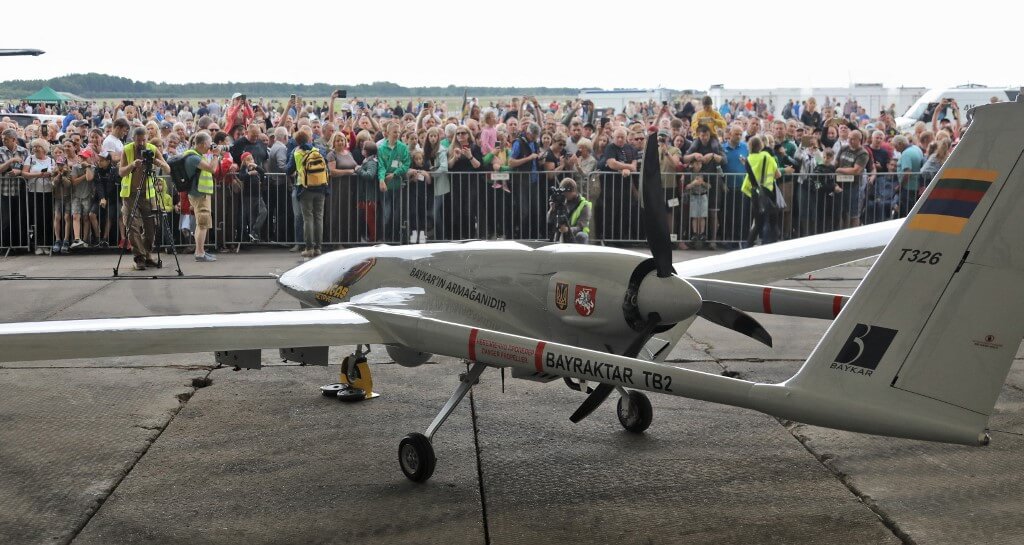
Turkey has been a key supplier of armed drones to Ukraine since the early stages of the war, particularly the Bayraktar TB2, which gained prominence for its role in countering Russian forces in 2022. The drones, produced by Turkish defense contractor Baykar, have been widely credited with helping Ukraine target armored units and logistics lines.
Former Russian president and current Deputy Chairman of the Security Council Dmitry Medvedev described the list as a military warning.
“Russian Defense Ministry’s statement must be taken literally: the list of European facilities which make drones & other equipment is a list of potential targets for the Russian armed forces,” Medvedev said on social media. “When strikes become a reality depends on what comes next. Sleep well, European partners!”
Russian Defense Ministry’s statement must be taken literally: the list of European facilities which make drones & other equipment is a list of potential targets for the Russian armed forces. When strikes become a reality depends on what comes next. Sleep well, European partners!
— Dmitry Medvedev (@MedvedevRussiaE) April 15, 2026
Russia’s ambassador to international organizations in Vienna, Mikhail Ulyanov, also questioned whether European governments understood Moscow’s warnings, suggesting that Russia could take measures against drone manufacturers if attacks on Russian territory continue.
As tensions escalate, the warnings have also drawn attention to broader regional security risks linked to drone activity.
In December three separate drone incidents were reported in Turkey, including one shot down by F-16 jets after entering airspace from the Black Sea and two others found crashed in northwestern provinces.
Defense analyst Arda Mevlütoğlu said the drones had fallen near strategically sensitive locations, including military bases and defense industry facilities, and warned the incidents could have been designed to test Turkey’s military readiness or provoke an escalation.
Turkish President Recep Tayyip Erdoğan has repeatedly warned against the Black Sea becoming an “area of confrontation” between Russia and Ukraine, both of which border the sea opposite Turkey.
Meanwhile, the threats from Russia come as it intensifies its attacks on Ukraine. Ukrainian authorities said at least 16 people, including a 12-year-old boy, were killed in recent strikes, with more than 100 wounded.
Ukrainian President Volodymyr Zelensky said the scale of the attacks showed that Moscow remained committed to the war.