


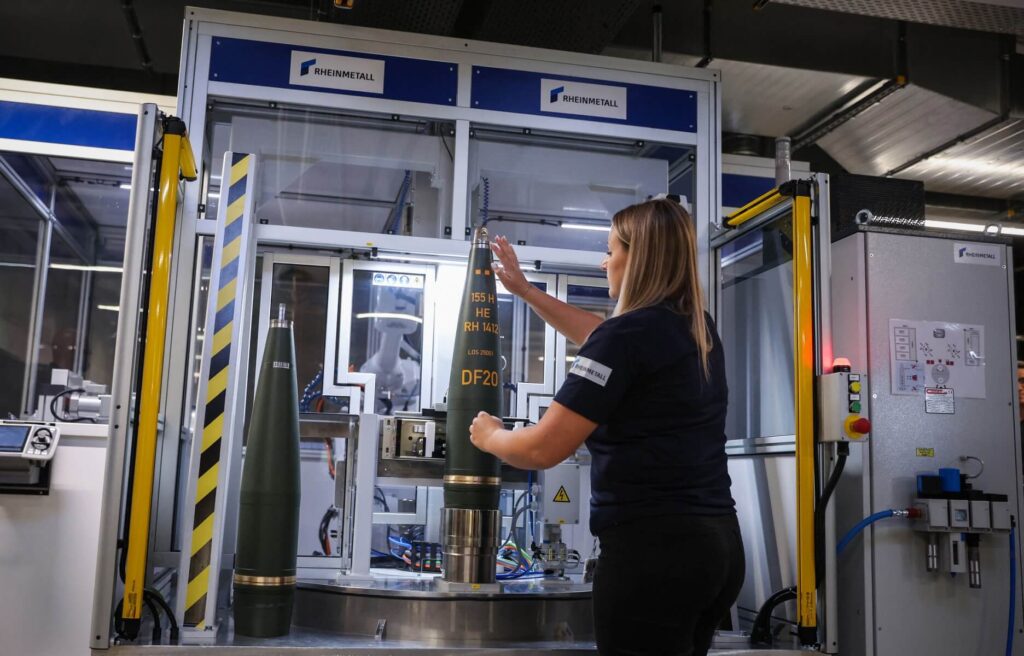
Turkey was among the largest buyers of German arms in 2025, a year in which Germany approved a record €13.11 billion ($15 billion) in weapons and military equipment exports.
The figures were first reported by the German Rheinische Post newspaper, citing a government response to a parliamentary question from the opposition Left Party (Die Linke) that has not yet been officially published by Berlin.
The total value of export licenses approved in 2025 exceeded the €12.83 billion ($14.7 billion) authorized in 2024, marking the highest annual figure on record.
Ukraine was the largest buyer of German arms in 2025, receiving export approvals worth €2.27 billion ($2.6 billion).
Other major recipients included Norway, Sweden, Turkey and Singapore, although the report did not specify the value of export licenses granted to the countries.
Most of the export approvals went to European Union countries and NATO members, reflecting Germany’s continued focus on supplying allied states.
Under German law, defense contractors must obtain government approval before selling weapons and military equipment developed in the country to foreign buyers. The German government evaluates these applications based on international law and current political conditions, with arms sales to NATO member states typically receiving expedited consideration.
Of the total export approvals, €5.62 billion ($6.4 billion) covered war weapons, including systems such as tanks, combat aircraft, fully automatic firearms and warships.
The remaining €7.49 billion ($8.6 billion) consisted of what Germany classifies as “other military equipment,” including pistols, revolvers, hunting and sporting rifles as well as radar and communications systems.
The German government rejected 12 export applications in 2025, with a combined value of about €700,000 ($806,057), the report said. Some of the rejected requests involved exports to Saudi Arabia and the United Arab Emirates.
Cansu Özdemir, foreign policy spokesperson for the Left Party, criticized the government’s export policy, saying Berlin was acting like “an approval machine for the arms industry.”
She said the defense sector was generating billions of euros in revenue with political backing at a time when global conflicts were increasing.
Turkey’s position in global arms trade
A report published this week by the Stockholm International Peace Research Institute (SIPRI) found that Turkey’s arms exports increased by 122 percent in the 2021–2025 period compared with the previous five years, making the country the world’s 11th largest exporter of major arms with a 1.8 percent share of global exports.
The same report said Turkey ranked as the world’s 24th largest arms importer in 2021–2025, with its share of global imports declining from 1.5 percent in 2016–2020 to 1.2 percent in the most recent five-year period.
Germany was Turkey’s largest supplier of major arms during that period, accounting for 31 percent of Turkish arms imports, followed by Spain with 29 percent and Italy with 19 percent.
SIPRI also found that Germany ranked as the world’s fourth-largest arms exporter in 2021–2025, accounting for 5.7 percent of global arms exports.