
, as talks in Damascus have stalled and clashes are spreading again in northeastern Syria.)
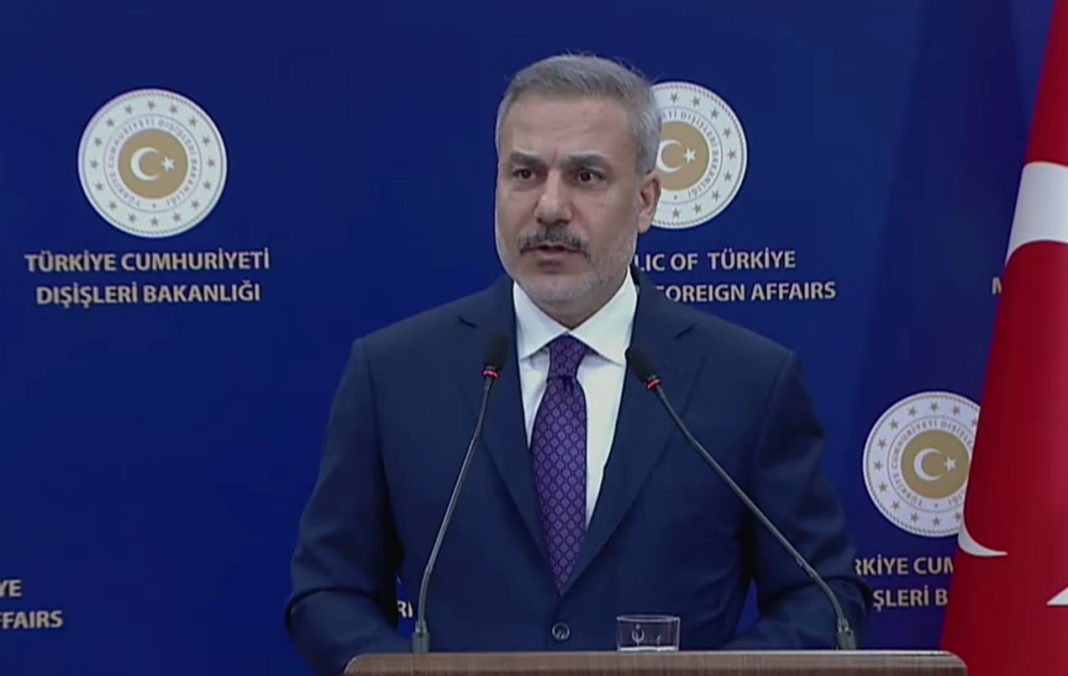
Turkish Foreign Minister Hakan Fidan said Tuesday that Ankara supports a ceasefire and integration plan between Syria’s transitional government and the Kurdish-led Syrian Democratic Forces (SDF), as talks in Damascus have stalled and clashes are spreading again in northeastern Syria.
Fidan was speaking after meeting with US Ambassador to Turkey Tom Barrack, who also serves as the US special envoy for Syria, in Ankara on Tuesday morning. He told Turkey’s state broadcaster TRT that Turkey views Sunday’s agreement between Damascus and the SDF as a priority policy choice and believes it can help preserve Syria’s unity and territorial integrity despite what he described as major obstacles.
Fidan said Barrack had held separate talks with both the Syrian government and the SDF, and that the parties also met in a trilateral format in Damascus.
“There were meetings with the SDF side, the Damascus administration and America coming together. Long meetings,” he said.
The ceasefire and integration plan, announced on Sunday, was expected to end nearly two weeks of fighting that erupted after Syrian government forces launched an operation on January 6 and expanded into areas long held by the Kurdish-led alliance.
The agreement is designed to bring the SDF’s military and civilian structures under the Syrian state, including control over border crossings, oil and gas sites and detention facilities holding Islamic State prisoners.
But reports over the past 24 hours have pointed to an unraveling of the deal on the ground.
Kurdish officials have said talks between SDF commander Mazloum Abdi and Syria’s transitional president, Ahmed al-Sharaa, produced no progress, while fighting has continued in and around Hasaka province and other parts of northeastern Syria.
The SDF has also accused Damascus-aligned factions of violating the ceasefire and escalating attacks, while Syrian officials have accused the SDF of undermining state authority and using the Islamic State detainee issue as leverage.
Fidan said Ankara was concerned about what he described as recurring “Islamic State games” in Syria, language used by Turkish officials to suggest the militant group is being exploited to influence the battlefield and political bargaining.
Turkey has positioned itself as the strongest foreign backer of Syria’s new authorities and has pushed for the dismantling of Kurdish-led self-rule along its border. Ankara views the SDF as tied to the Kurdistan Workers’ Party (PKK), a militant group that has fought a decades-long insurgency inside Turkey and is designated as a terrorist organization by Turkey and its Western allies.
The SDF was the main US partner in the ground fight against the Islamic State group in Syria and has controlled wide areas in the northeast since civil war erupted in 2011. That territory includes detention sites holding thousands of suspected Islamic State members and sprawling camps where families of militants are held, a long-running security burden that Western governments have warned could fuel a militant resurgence if the region destabilizes.
Reports from Kurdish outlets and regional media also suggested on Monday that Damascus is now pressing for harsher terms after battlefield shifts, including demands that the Kurdish-led administration dismantle its governing structures and hand over authority more quickly and more fully than Kurdish leaders expected.
Those claims reflect a growing gap between what the deal outlines in principle and what each side wants in practice, particularly over whether Kurdish forces will be absorbed into Syria’s army as individuals or retain a unified command structure.
Fidan said Turkey has been on the front lines of the campaign against the Islamic State group and would continue working closely with Syria’s new authorities, framing Ankara’s position as support for stability and state control.
His remarks came as protests inside Turkey have expanded in response to the Syrian offensive. Turkey’s main pro-Kurdish party has organized demonstrations at the border and accused Ankara of backing an assault that targets Kurdish communities.