


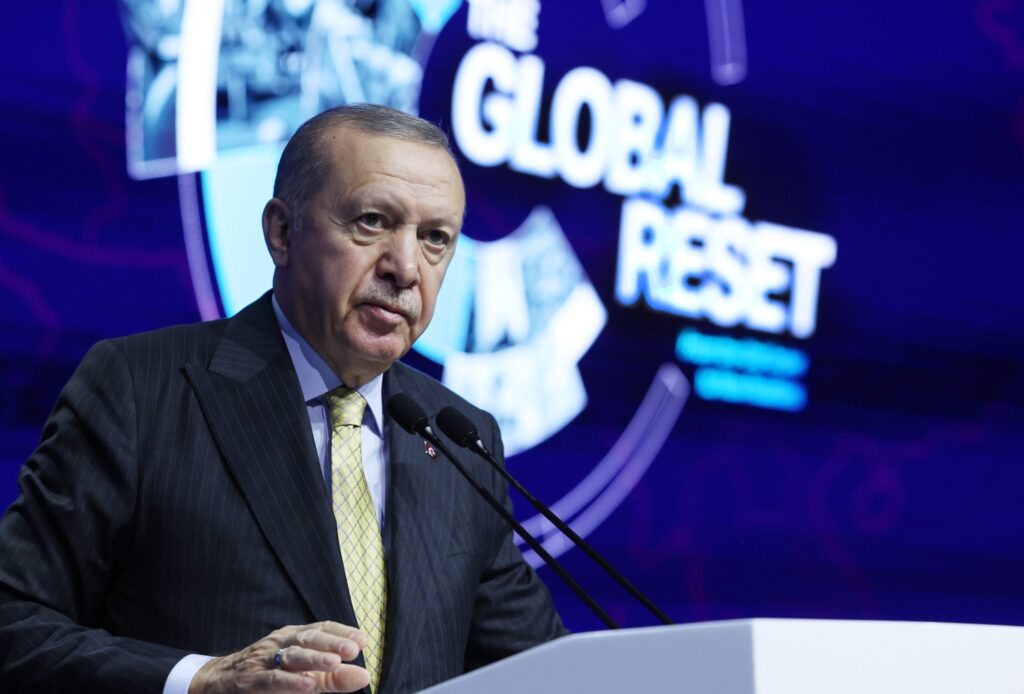
Ankara’s effort to lock in outcomes across the border after Bashar Assad’s fall in Syria and İstanbul prosecutors’ relentless detentions that analysts say are aimed at increasing pressure on rivals in order to secure a hand-picked successor to President Recep Tayyip Erdoğan marked the year 2025, as Turkey sought to end its decades-long conflict with Kurdish militants while trying to play the mediator around the globe.
Ankara and the post-Assad map
Assad’s fall in December 2024 ended a regional status quo that had shaped Turkish policy for more than a decade. Turkey had backed armed opposition groups, controlled a belt of territory along Syria’s north and hosted millions of Syrian refugees. When Damascus changed hands, Ankara moved quickly to turn battlefield gains into state-to-state leverage.
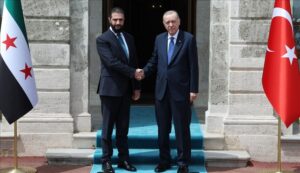

Turkey’s goal was clear. It wanted a friendly government in Damascus that would not tolerate an armed Kurdish force along Turkey’s border. It also wanted a Syrian state structure that could absorb or dismantle militias without creating a vacuum that could draw in the Islamic State group or invite Israel, Iran or Russia to set terms.
In August Turkey signed a military cooperation accord with Syria that included providing weapons systems and logistical tools and training for the Syrian army. Syrian soldiers would be allowed to use Turkish military bases for training and Syrian students would attend Turkish military academies.
That posture put Turkey at the center of Syria’s rebuild, not only through contracts and trade but through security doctrine.
The hardest test was the Syrian Democratic Forces (SDF), the Kurdish-led force that worked with the US against the Islamic State group and held wide areas of northeastern Syria. Turkey sees the group’s core militia as linked to the Kurdistan Workers’ Party (PKK), which Ankara and its Western allies designate as a terrorist organization.
A March agreement between the new Syrian government and the Syrian Democratic Forces (SDF) aimed to integrate the force into state structures by the end of 2025. By December, that deadline became a countdown clock with no signs of implementation of the deal.
According to Ankara the SDF did not intend to make progress toward integration despite the fact that Ankara warned of military action if the deal failed. Turkey’s foreign minister, Hakan Fidan, said Turkey wanted to avoid force but that its patience was running out.
A friendly government in Syria, as opposed to the hostile Assad regime, meant that a buffer between Turkey and Israel was no more.
Immediately after Assad’s fall, Israel carried out hundreds of airstrikes across Syria, effectively decimating the Syrian military. Coupled with territorial expansion in the south, Israel’s belligerent moves raised the risks of a confrontation with Turkey, as the latter endorsed the new Syrian government and sought to stabilize and empower it.
Ankara and Tel Aviv entered 2025 with strained ties, shaped by Israeli military campaign in Gaza and by competing aims in Syria. As Turkey built a new relationship with Damascus, Turkish officials described Israel as a factor that could pull Syria apart through local partners and covert ties.
In Syria the result by year’s end was an unfinished integration deal, a Turkish-backed security build for Damascus and a warning that kept the risk of new cross-border action on the table.
The CHP crackdown and the criminal law of politics
While Ankara shaped Syria, İstanbul shaped Turkey.
The center of gravity was the main opposition Republican People’s Party (CHP), the force that beat Erdoğan’s ruling Justice and Development Party (AKP) in the March 2024 local elections. In 2025 the judiciary targeted CHP-run municipalities, party figures and networks tied to İstanbul’s mayor, Ekrem İmamoğlu.

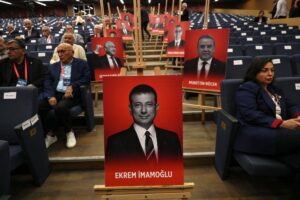
In March İmamoğlu was jailed pending trial on charges that included graft. The CHP rejected the case and called it a coup attempt.
The arrest triggered the largest street protests in a decade, with a wave of detentions. Turkey detained thousands of people during weeks of protests. In the following months, the crackdown expanded beyond the symbolic weight of İmamoğlu and led to the jailing of 17 CHP mayors and hundreds of others including municipal staff as well as businesspeople with close ties to CHP municipalities.
In September, tens of thousands protested in Ankara against a court case that could have ousted the head of the CHP.
The government’s case relied on familiar claims: corruption, procurement fraud and, at times, links to terrorism. Erdoğan was using the courts to remove political rivals he could not beat at the ballot box.
Prosecutors in Turkey can open sweeping investigations that trigger mass detentions before indictments. Courts can impose pretrial detention that keeps elected officials in jail for months. Central authorities can replace local officials through legal steps that critics say sidestep voters.
In 2025 those tools shaped politics as much as campaigns did.
İstanbul drug probe and succession signals
İstanbul prosecutors did not just target the CHP in 2025. A narcotics investigations that involved celebrities, media figures and business elites turned into a story about factions vying to secure control over what happens after Erdoğan.

Just last week Sadettin Saran, the president of the Fenerbahçe Sports Club, was detained as part of a drug investigation after state media said he tested positive for narcotics in a forensic hair sample. The investigation involved prominent figures in entertainment and media and included accusations that ranged from drug trafficking to facilitating narcotics use.
The arrest of Mehmet Akif Ersoy, a television presenter tied to pro-government media circles, exposed internal power struggles and fueled speculation about succession fights within the ruling camp.
Erdoğan has dominated politics for more than two decades. He built a governing system centered on the presidency and on loyal control over the judiciary, police and state bureaucracy. A post-Erdoğan transition would test that system.
In that context the high-profile drug probe is interpreted by analysts as an attempt to keep elites in line and weaken figures tied to rival factions. It can reshape who controls key platforms, including television networks and sports clubs that can serve as political stages in Turkey, where civil society is at its lowest point and organized dissent is already reduced to political parties.
The state’s new bargain with the PKK
Another track moved in parallel: the Kurdish conflict and the start of the PKK’s disbandment.
For decades Turkey’s fight with the PKK drove military operations in southeastern Turkey and cross-border strikes in northern Iraq and Syria. The conflict killed tens of thousands and gave the state a lasting justification for emergency powers and security-first politics.
In 2025 that conflict entered a new phase.
On July 11, 30 PKK militants burned their weapons in northern Iraq in a first step of abandoning arms after a May decision following a February call by Abdullah Öcalan, the jailed founder of the PKK. The ceremony took place near Sulaymaniyah in Iraq’s Kurdistan region.
The event did not end the conflict in a day. It did not settle questions about prison releases, Kurdish language rights or local governance. It did not resolve Ankara’s demand that Syria’s Kurdish forces dismantle their armed structure.
But it appeared to ease security fears for parts of the electorate, lowered the temperature in the southeast and open space for parliamentary steps.
The peace efforts can also reshape regional policy. If the PKK is no more, Ankara can argue that its main remaining security risk is in Syria, not at home, which ties back to Turkey’s push to force an integration of the SDF into a Damascus chain of command.
The forever crackdown
In 2025 Ankara continued its relentless crackdown on the faith-based Gülen movement that increased exponentially after a coup attempt on July 15, 2016, sweeping up tens of thousands.
The Gülen movement, inspired by Islamic scholar Fethullah Gülen who lived in exile in the United States until his death in October 2024, is renowned worldwide for its contributions to education, social welfare and interfaith dialogue.
The Turkish government, however, accuses the movement of orchestrating the failed coup, a charge the movement strongly denies.
Erdoğan has been targeting followers of the Gülen movement, since the corruption investigations of December 17-25, 2013, which implicated then-prime minister Erdoğan, his family members and his inner circle.
Dismissing the investigations as a Gülenist coup and conspiracy against his government, Erdoğan began to target the group.
Erdoğan’s government labeled the group as a “terrorist organization” in May 2016, before the failed coup took place, a designation not recognized by other governments and major international bodies, including the United States and the European Union.
The movement’s followers, also known as Hizmet (Service) supporters, say they have been unfairly targeted in a campaign of political persecution aimed at silencing dissent and consolidating power. The post-coup purge has seen hundreds of thousands investigated and tens of thousands imprisoned on terrorism-related charges widely viewed as politically motivated.
According to the figures from the Justice Ministry released in July, more than 126,000 people have been convicted of alleged links to the movement since 2016, with 11,085 still in prison.
The dragnet did not slow in 2025. Interior Minister Ali Yerlikaya said last week that courts had arrested 1,601 people in 2025 over alleged links to the Gülen movement. He said 1,524 others were released under judicial supervision.
Erdoğan’s government still frames the entire episode as an existential fight, which is not against people accused of taking part in any violence but against teachers, judges, civil servants, journalists and businesspeople on grounds that can be as thin as a bank account, a workplace record, a trade union membership or downloading a certain messaging app.
In addition to the thousands who were jailed, scores of other Gülen movement followers had to flee Turkey to avoid the government crackdown.
You cannot summarize a year in Turkey without writing a book.
Wages fell behind prices for months. Housing and education slipped further out of reach. Disasters such as the Kartalkaya hotel fire revived anger over deaths many Turks saw as preventable and over a state that polices politics more quickly than it enforces safety.
The year changes with Turkey in a chokehold. Civil space shrinks, the cost of living bites and Erdoğan designs a regime that can maintain its grip after his last day in office.