
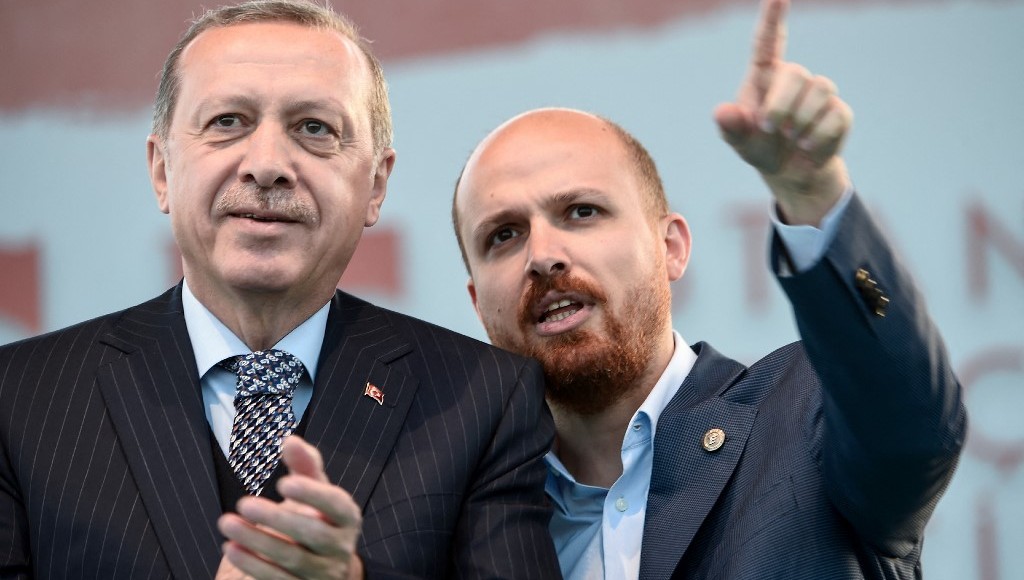
 after the end of President Recep Tayyip Erdoğan's term in office puts his younger son Necmettin Bilal Erdoğan in third position, behind two senior government figures.)
A recent survey on who could lead Turkey’s ruling Justice and Development Party (AKP) after the end of President Recep Tayyip Erdoğan’s term in office puts his younger son Necmettin Bilal Erdoğan in third position, behind two senior government figures, highlighting the gap between growing succession talk and voter preference.
The poll, conducted last week by Turkish pollster Refleks Data and Research, surveyed 2,386 respondents on who should take over leadership of the AKP after Erdoğan.
Turkish Foreign Minister Hakan Fidan, the former head of Turkey’s National Intelligence Organization (MİT), ranked first with 33.4 percent, followed closely by AKP MP and former interior minister Süleyman Soylu at 32.5 percent. Bilal Erdoğan received 14.2 percent support, while Selçuk Bayraktar, chairman of Turkish defense contractor Baykar and son-in-law of President Erdoğan, polled at 12.9 percent and parliamentary speaker Numan Kurtulmuş at 7 percent.
📍Recep Tayyip Erdoğan'dan sonra AK Parti Genel Başkanı olarak kimi görmek istersiniz?
➡️Hakan Fidan: % 33,4
➡️Süleyman Soylu: % 32,5
➡️Bilal Erdoğan: % 14,2
➡️Selçuk Bayraktar: % 12,9
➡️Numan Kurtulmuş: % 7📊Araştırma 2386 Kişi ile CATI yöntemiyle yapılmıştır. pic.twitter.com/r4m76ao1wn
— Refleks Veri & Araştırma (@T_Refleks) December 22, 2025
The results showed a striking disparity between Bilal Erdoğan and the leading contenders, Fidan and Soylu, both of whom attracted more than twice the level of support received by Erdoğan’s son.
Spotlight on Erdoğan’s son amid succession talk
The findings come amid increased public and media attention on Bilal Erdoğan, which critics say has fueled speculation about a possible family-based succession plan. Although he holds no elected office and does not serve in the Cabinet, Bilal Erdoğan, 44, has become a recurring subject of political debate.
Observers note a visible shift in how his public appearances and statements are covered, with more frequent headlines, video clips and commentary treating him as a political actor rather than solely as the president’s son. Supporters describe this as a natural outcome of his civil society work, while critics argue it reflects an effort to normalize the idea of dynastic continuity in Turkish politics.
Bilal Erdoğan’s public profile mixes civil society work, youth and education networks and periodic involvement in controversies that have appeared in international reporting since the December 2013 corruption investigations that shook Turkish politics.
He became international news in February 2014, when recordings circulated online that appeared to capture then-prime minister Erdoğan telling his son to remove large sums of money from his home, with the context suggesting that Turkey’s strongman was trying to prevent his son from being caught by police with substantial amounts of cash, as were several officials and sons of ministers on December 17, 2013.
The recordings surfaced after police raided the houses of a number of prominent figures in Erdoğan’s inner circle as part of a corruption probe launched by İstanbul prosecutors.
On December 25 one of those prosecutors ordered Bilal’s detention, an order unprecedentedly ignored by law enforcement at the behest of the interior minister in open defiance of the law.
The cases later collapsed as the government purged police and prosecutors involved in the investigation and described the operation as a plot to overthrow the government.
In Turkish political shorthand that episode is still called the “December 17 and 25” investigations, a reference to two series of raids and planned follow-ups.
The detention order as well as the leak tied Bilal’s name to a narrative of Erdoğan’s web of corruption supported by his close family.
In 2015 Bilal Erdoğan again drew international attention after Russia accused Turkey’s leadership and the president’s family of benefiting from illegal oil smuggling from Islamic State–held territory. He denied the allegations, and no criminal case was opened.
A year later, Italian prosecutors investigated claims that he had brought large amounts of cash into Italy while studying in Bologna, raising suspicions of money laundering. The case was later dropped, and Bilal Erdoğan denied wrongdoing.
More recently a 2023 Reuters report said anti-corruption authorities in Sweden and the United States were reviewing a complaint alleging a plan to pay bribes to entities linked to Bilal Erdoğan in exchange for business advantages in Turkey. He denied the claims through his lawyer, while Turkish authorities dismissed the report as disinformation.
Bilal Erdoğan has been active in foundations and youth programs, mostly operating in civil society, steering clear of electoral politics.
Two Turkish foundations tied to his public identity are the Turkey Youth Foundation (TÜGVA) and the Turkey Youth and Education Service Foundation (TÜRGEV).
Bilal Erdoğan has not announced a run for office or taken a formal role in his father’s AKP.
Speaking to Russian state agency TASS earlier this year, he said he doesn’t want to become Turkey’s next president and that he is more focused on nongovernmental work.
But his name remains central in debates about what Turkey’s ruling system would look like after President Erdoğan and whether a republican structure can resist dynastic logic under the pressure of one family’s dominance.