


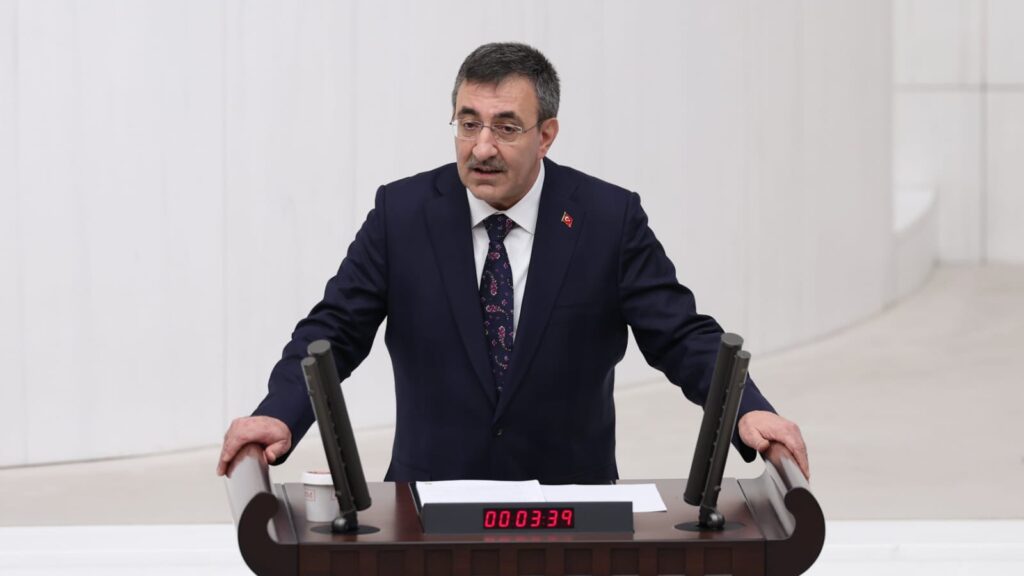
Turkish Vice President Cevdet Yılmaz told parliament on Tuesday that the government will start a pilot income “top-up scheme” for low-earning families in 2026, before expanding it across the country in 2027.
The program, formally called the Income Supplementary Family Support System, is known in Turkey as a “citizenship salary.” It will set a threshold income for each household and pay the difference when a family’s earnings stay below that line. Yılmaz said all major social support programs will be brought under this single model.
“We have implemented social policies much stronger than many parties that call themselves social democratic in the last 23 years,” Yılmaz said, adding that welfare programs played an “important role” in the ruling Justice and Development Party’s (AKP) election victories.
Yılmaz said the new scheme will support families whose income is below a threshold but “will not be of a nature that discourages labor markets,” arguing that it is a structural reform in social assistance. He also defended the use of the Unemployment Insurance Fund, saying 61 percent of its spending goes directly to workers and jobless people, 36 percent to efforts to preserve and increase jobs and about 3 percent to administrative costs, which he said matches the law.
Critics say the new “citizenship salary” may deepen voter dependence on the ruling party in a country where millions already rely on social assistance.
Past research on Turkey’s welfare system by scholars such as Denizcan Kutlu has described social assistance as a “non-wage income for the poor” that helps manage discontent under inequality and can strengthen ruling party support in poor districts.
In a column last month writer Murat Fidan asked whether the project is “a real social state policy, a charity policy or an election investment,” arguing that the government’s design looks like a conditional, temporary handout rather than a universal right. He said the plan “manages poverty” instead of ending it and risks keeping low-income families dependent on state aid.
Supporters of the late politician Haydar Baş and his small opposition party, which has long promoted its own “citizenship income” idea, also accuse the government of copying their plan while keeping the payments limited to low-income households and linking them to employment status rather than offering a universal income to every citizen.