


Abdülhamit Bilici*
This year’s Rumi Peace and Dialogue Awards ceremony was held at Washington, D.C.’s Meridian House, one of the finest examples of European classical architecture in the United States, on November 18. Built by famous architect John Russell Pope in the 1920s for Irwin Boyle Laughlin, who served as US ambassador to Greece and Spain, the house today hosts the Meridian International Center, an important hub for global diplomacy.
The Rumi Peace and Dialogue Awards, hosted annually by the Rumi Forum, honor those individuals who have committed their life’s efforts to advocating ideals of peace, democracy and inclusion. The awards serve to recognize successful practitioners who have championed the causes of dialogue, education, social justice and community service.
It was meaningful that an event centered on peace and dialogue took place in a venue that has, for decades, welcomed world leaders, diplomats and communities from diverse cultures, fostering conversations around international understanding.
Held on the first anniversary of the passing of Rumi Forum’s honorary chair, Turkish-Islamic scholar Fethullah Gülen, whose life was dedicated to the ideals of intercultural, inter-civilization and interfaith dialogue, the ceremony carried added significance. In a world marked by pessimism, tension and conflict, celebrating those who insist on hope, mutual understanding and peace felt especially important. In contrast to the tragic headlines that dominate the news cycle, the evening brought together scholars, religious leaders, human rights defenders, peace activists and community figures inspired by the inclusive vision of Rumi and the Hizmet (also known as Gülen) movement’s emphasis on tolerance, creating an unmistakably uplifting atmosphere.
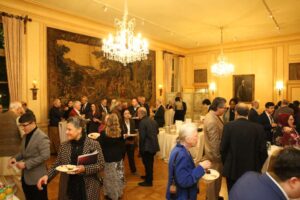
This year’s Dialogue Award was presented to Professor John Borelli, a historian of religions and theologian from Georgetown University who has actively promoted inter-religious dialogue and understanding in various teaching and staff positions for years. Last year the award was presented to Imam Dr. Talib Shareef, a widely respected figure in Washington who embodies inclusivity and harmony. In 2023 it was awarded to Micah Hendler, the Yale-trained Jewish musician who founded the Jerusalem Youth Chorus, a choir uniting Palestinian and Israeli children. The award that year was presented by Aziz Abu Sarah, a Palestinian Muslim who, despite losing his brother during the intifada, committed himself even more deeply to the cause of peace and became one of Hendler’s closest collaborators.
An evening of Georgetown professors
After the opening remarks by Rumi Forum Chairman Professor Ori Z Soltes of Georgetown University, who reflected on the universal messages of Rumi and Fethullah Gülen, another Georgetown professor took the stage to present the award.
The presenter, theology professor Leo Lefebure, is himself a prominent pioneer of peace and inter-religious dialogue. Known especially for his efforts to counter the Islamophobia and interfaith tensions that escalated after the September 11, 2001 attacks in the US, Lefebure introduced his colleague Professor Borelli, describing him as “one of the most steadfast and thoughtful architects of the Catholic Church’s relationship with other religions.”
Three defining events in a single year
In his acceptance speech, Borelli reflected on lessons from a life devoted to dialogue, weaving together his personal journey with the broader historical trajectory of interfaith relations.
He recalled that 1965 was a turning point in Christian–Muslim relations in the United States, marked by three developments that permanently reshaped religion’s role in society and interreligious engagement: The assassination of Malcolm X, the signing of the Immigration and Nationality Act and the Second Vatican Council’s landmark declaration Nostra Aetate, which reshaped the Catholic Church’s relationship with non-Christian religions, particularly Judaism and Islam.
Although one of the leading experts on Nostra Aetate, Borelli did not shy away from noting its limitations. The document, he explained, was pioneering but still “pre-dialogue,” addressing Islam without mentioning the Qur’an or the Prophet Muhammad and addressing Judaism without reference to the Holocaust, the State of Israel or contemporary Jewish life.
“It opened the door,” Borelli said, “but it left the task of entering to future generations.”
Borelli also talked about how the 1965 Immigration and Nationality Act transformed the religious landscape of American cities, prompting the Catholic Church in the 1980s to develop a more institutional interfaith structure. Before the law, American Muslims were predominantly African American; afterward, immigration brought a far wider diversity of Muslim communities.
Following the 9/11 attacks, Borelli said, Catholic, Muslim, Jewish and Protestant leaders intensified their cooperation to counter growing fear and misunderstanding. He emphasized late Pope John Paul II’s call for “purification of the memory,” describing it as essential not only for reconciliation but for the health of society itself.
Although the ceremony celebrated Borelli’s achievements, it held symbolic weight as the first event after the passing of Gülen at the age of 83 in Pennsylvania in October 2024. Speakers noted that Gülen’s lifelong emphasis on dialogue, education, humility and peaceful service shaped the Rumi Forum’s founding mission and continues to sustain its work.
The role of Thomas Michel
Borelli devoted part of his speech to Jesuit priest Thomas Michel, describing him as a pioneering figure in Catholic–Muslim relations, particularly through his work in Turkey and his research on the Sufi tradition. Michel introduced Catholic leaders to Islamic mysticism inspired by Rumi and supported early dialogue initiatives associated with the Hizmet movement. Borelli noted that his 84-year-old friend is currently battling serious illness in Thailand and asked participants to keep him in their prayers.
Bridges of peace
In his closing remarks, Rumi Forum Executive Director İbrahim Anlı highlighted the efforts of Hizmet volunteers around the world, who organize community dinners, seminars, trips and educational workshops to foster mutual understanding, tolerance and dialogue. He thanked all those who participate in and support this work, which continues to uplift communities.
The evening honoring Professor Borelli and reflecting on Gülen’s legacy ended with a shared affirmation that dialogue is not merely a theory but a practical necessity. As populist rhetoric and polarizing politics divide people across the globe, from social media to national leadership, the need for bridges of respect and peace has never been greater.
*Abdülhamit Bilici is the former editor-in-chief of the now-defunct Zaman daily who currently lives in exile in Washington, D.C.
Disclaimer: The views expressed in this opinion piece are those of the author and do not necessarily reflect the editorial stance of Turkish Minute.