
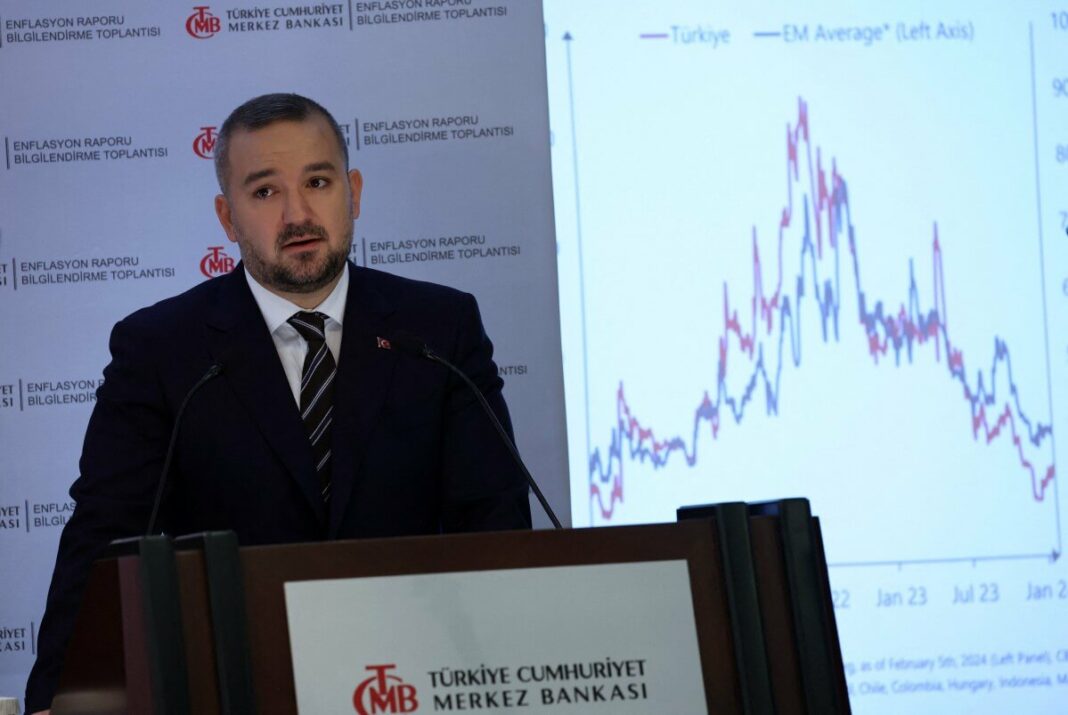

Senior officials from Turkey’s central bank told foreign investors last week that they are increasingly worried about persistent inflation and may slow the pace of upcoming interest rate cuts, Reuters reported, citing investors who attended the meetings.
The discussions took place on the sidelines of the annual meetings of the International Monetary Fund (IMF) and the World Bank in Washington, where Central Bank Governor Fatih Karahan and his two deputies met with international bondholders.
Four foreign investors who took part in some of the closed-door sessions told Reuters that the officials did not provide specific guidance on this week’s monetary policy decision but signaled a more cautious approach after two large rate reductions in July and September. The bank lowered its key policy rate by 300 basis points in July and another 250 points in September, surprising some analysts who expected a slower pace of easing.
Participants said policymakers emphasized their intention to monitor market expectations closely ahead of Thursday’s rate decision and noted concern about what one investor described as “sticky” inflation.
The central bank has not publicly commented on the meetings. Karahan, approached by reporters in Washington, declined to comment but earlier acknowledged that Turkey’s disinflation process had recently slowed.
Economists divided on next move
Turkey’s annual inflation rose to 33.3 percent in September, exceeding expectations and marking the first annual increase since inflation peaked at 75.4 percent in May 2024.
A Reuters poll of 17 economists showed widely differing expectations for the upcoming decision: The median forecast points to a 100-basis-point cut, but some expect no change, while others see a reduction of up to 250 basis points.
Several investors who attended the Washington meetings said the bank’s recent aggressive cuts may prompt a “course correction.” Two participants said officials appeared prepared to pause rate cuts entirely if inflation pressures persist.
Speaking at a public Atlantic Council event in Washington last week, Karahan said the downward trend in inflation “has slowed down a little bit recently,” adding that the progress toward price stability so far remains “significant and encouraging.” He reiterated that monetary policy would stay tight until inflation falls to sustainable levels.
Concern over departure of senior policymaker
Since mid-2023 the Central Bank of Turkey has reversed years of unorthodox low-rate policy blamed for driving inflation and weakening the Turkish lira. The shift toward tighter monetary policy has helped rebuild foreign reserves and attract renewed investor interest in Turkish assets.
However, investors said they are closely watching the upcoming retirement of Deputy Governor Cevdet Akçay, a respected member of the monetary policy committee known for his hawkish stance. Akçay is due to leave his post in April upon reaching the mandatory retirement age, and no successor has yet been announced.
Economists say his departure could test investor confidence in the central bank’s commitment to price stability as it seeks to balance easing with inflation control.