


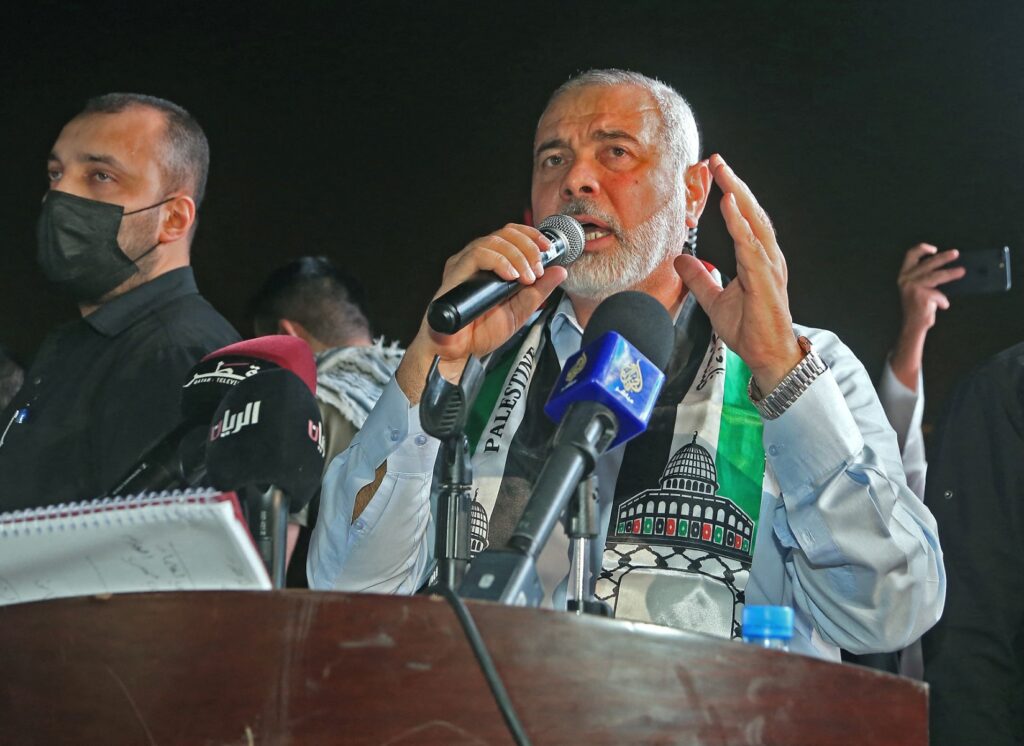
Israel allowed at least 66 Palestinians and Turkish citizens to leave the Gaza Strip earlier this month at Ankara’s request, including 16 relatives of the late Hamas political chief Ismail Haniyeh, the London-based news outlet Middle East Eye (MEE) reported on Monday.
According to MEE, the group comprised 14 Turkish citizens and 40 close relatives of Turkish nationals — spouses, sons, fathers and mothers — who were permitted to exit the enclave under a bilateral arrangement between Israel and Turkey.
The release took place after a Gaza ceasefire agreement reached in the first week of October, in which Turkey played a mediating role by helping to bring Hamas to the negotiating table, MEE said, citing two unnamed sources familiar with the process.
Five of the 16 Haniyeh family members reportedly had ties to Turkish citizens. Haniyeh, who headed Hamas’s political bureau until he was killed in an Israeli airstrike in Tehran in July 2024, had long maintained contact with Turkish officials.
While Turkey does not host an official Hamas office, the group’s leaders have frequently traveled between Qatar, Turkey, Egypt and Lebanon, sometimes staying in Turkey for months. British daily The Telegraph previously reported in 2020 that Turkey had granted citizenship to several Hamas leaders, including Haniyeh.
Israel’s decision to allow his relatives to leave Gaza is notable given that its military killed three of Haniyeh’s sons and four grandchildren in an April 2024 strike on their car in Gaza and detained his sister, Sabah al-Salem Haniyeh, inside Israel around the same time.
Quoting unnamed sources familiar with Israeli government thinking, MEE said the move reflects an effort to ease tensions with Ankara by responding positively to Turkish diplomatic requests.
Since the ceasefire, Israeli media outlets citing anonymous officials have adopted a softer tone toward Turkey’s leadership, MEE observed. The right-wing news site Ynet reportedly praised Turkish intelligence chief İbrahim Kalin for being “empathetic to hostages” and for seeking “renewed ties with Israel.”
Israeli columnist Ben Caspit wrote in Maariv that while Turkish President Recep Tayyip Erdoğan has long been a harsh critic of Israel, his foreign minister and potential successor, former intelligence chief Hakan Fidan, is viewed by Israeli security circles as more pragmatic.
In another Maariv article cited by MEE, Uriel Lynn, president of the Federation of Israeli Chambers of Commerce, urged reconciliation with Ankara, calling Turkey “key to the day after in Gaza.”
“Turkey is not an enemy of Israel. We have had many years of fruitful trade, economic and tourism relations,” Lynn wrote, adding that Israeli policy should be guided by “prudence rather than childish prominence.” He praised Prime Minister Benjamin Netanyahu for exercising restraint and said one of Israel’s new foreign-policy tests would be “restoring relations with Turkey.”
Lynn argued that normalization with Turkey was essential both for regional stability and for advancing Israel’s economic interests.